Federal court ruling on Alabama prison mental health care could lower staffing requirements
Jul 02, 2026 | 6:01 am ET
Description
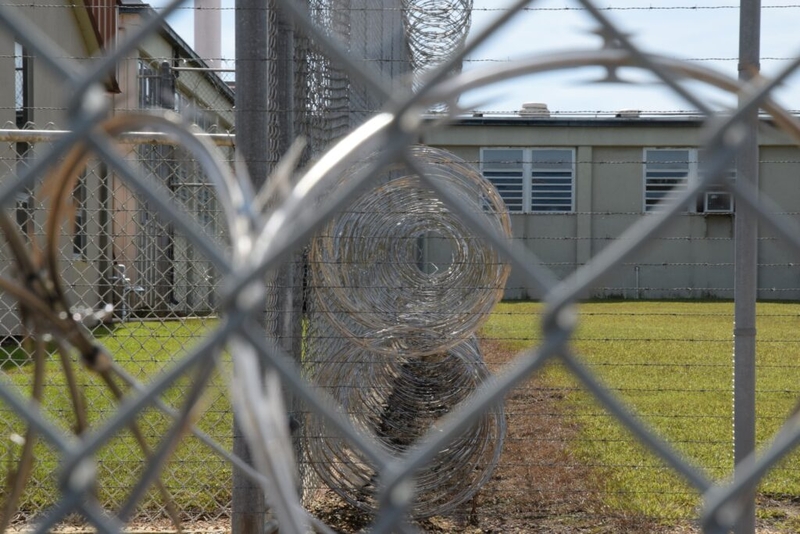
Barbed wire seen behind a fence at an Alabama prison. A federal ruling last week could allow ADOC to staff prisons at levels below a lower court order from 2017, but criminal justice experts said it will not affect the overall thrust of the ruling. (Brian Lyman/Alabama Reflector)
The state could be allowed to hire fewer qualified corrections officers to address mental health needs in Alabama prisons under a federal court ruling last week, according to criminal justice reform advocates.
A three-judge panel of the U.S. 11th Circuit Court of Appeals Friday largely sustained U.S. District Judge Myron Thompson’s ruling in the case, known as Braggs v. Lovelace, that inadequate mental health care in the Alabama Department of Corrections constituted cruel and unusual punishment.
“We were very happy with what the opinion says,” said Latasha Dejarnett, senior staff attorney with the Southern Poverty Law Center, which represented plaintiffs in the case incarcerated in the Alabama Department of Corrections, in an interview on Wednesday. “We think that it affirms what we have long believed, which is that relief that was granted by the district court was necessary and warranted. And that the conditions within ADOC are inadequate, and that they don’t meet the level of constitutional care that is required.”
Messages were sent to the Alabama Department of Corrections and the Alabama Attorney General’s Office on Tuesday and Wednesday seeking comment.
But the three-judge panel of the 11th Circuit ordered the lower court to review three parts of the order for mental health remedies, including required staffing numbers; mandated cell configurations aimed at thwarting suicide attempts, and including the Julia Tutwiler Prison for Women in Wetumpka as part of the mental health remedies.
Narrowed focus
The panel ruled that the remedies extended beyond what was required to address the specific issues in the lawsuit. The judges on the panel cited the 1996 Prison Litigation Reform Act which has a “need-narrowness-intrusiveness” requirement. That means that remedies ordered by courts must be narrowed to address the issues raised in the lawsuit and must be as least intrusive as possible on the prison system.
“Where a court enters prospective relief under the PLRA, it must provide ‘particularized findings, on a provision-by-provision basis,’ meaning that such ‘particularized findings, analysis, and explanations should be made as to the application of each criteria to each requirement imposed’ by the court,” the 11th Circuit ruling states.
Criminal justice experts and advocates said the order could narrow the scope of the remedies used to address mental health treatment issues in Alabama prisons but would not fundamentally affect the work being done there.
Alabama Corrections commissioner: Department will miss court-ordered staffing target
Dejarnett said the 11th Circuit wants the court to review those parts of the order to make sure that “it is narrow enough to address mental health concerns.”
“The court doesn’t want an order that addresses areas that may not affect people with mental health concerns,” Dejarnett said.
The lawsuit, first filed in 2014, alleged that inmates in ADOC custody did not receive adequate mental health treatment, citing high suicide rates in corrections facilities and alleged indifference to mental health issues by corrections officers.
Thompson in 2017 ruled for the plaintiffs, finding that ADOC failed to identify people with serious mental health needs; failed to recognize people at risk of committing suicide and provide adequate treatment and monitoring. Thompson’s order included directives for monitoring of state prisons by outside experts and adequately screening and classification of people suffering from mental illness.
Thompson also ordered that ADOC “must fill all mandatory and essential posts at the level indicated in the most recent staffing analysis at that time.”
The staffing levels remain woefully inadequate relative to the order from Thompson, according to Dejarnett. Based on the prison population and the layout of the facilities, ADOC needs to have an additional 2,000 officers, according to the staffing analysis done in the first quarter of 2026 that Dejarnett reviewed.
ADOC currently has about 1,600 officers with the qualifications to meet the requirements of Thompson’s order. ADOC needs a total of about 3,600 corrections officers, according to Thompson’s order, so Corrections needs an additional 2,000 officers. ADOC has netted 50 additional officers since 2017.
That does not include the additional staffing that ADOC would need to staff the newly constructed Elmore County facility.
Carla Crowder, executive director of Alabama Appleseed, a group that advocates for criminal justice reform, said in a statement on Wednesday that the 11th Circuit ruling gives Alabama latitude for continuing to increase staffing in prisons.
“In every conversation I had with former Commissioner Hamm, he raised recruitment and staffing as an absolute necessity toward decreased violence and improved conditions in the prisons,” Crowder said. “That has not changed. The 11th Circuit’s order doesn’t change that.”
The SPLC, for its part, said it will continue urging for more staffing.
“The need for staffing is still a great need and is still an important concern,” Dejarnett said. “I still think that is something that Judge Thompson will continue to take seriously. What we, the plaintiffs, will have to show is that there are mental health concerns that exist throughout the prison that require staff to be able to respond to that.”
Cells and Tutwiler
The appeals court also scaled back the need to suicide-proof all the cells in ADOC prisons, saying that amounted to a best practice, but that a remedy from the court does not need to go that far, only that it not be “grossly incompetent.” The federal district court must decide which cells need to be reconfigured to address potential suicide attempts.
Dejarnett said the order from the 11th Circuit does not require ADOC to make all cells in the prison system suicide-proof, like removing items that could be used to commit suicide.
Appeals court reverses some orders in lawsuit against Alabama Department of Corrections
“We believe that it is necessary, but we do understand that the court has an obligation to only order relief that is narrow,” Dejarnett said.
The 11th Circuit panel also removed incarcerated women from the order, saying there was little evidence that was presented that the conditions within the women’s prison presented a “substantial risk of serious harm”. The state agreed to make major changes to Tutwiler operations in 2015 after the U.S. Department of Justice found evidence of sexual harassment and abuse of women incarcerated at the prison.
Dejarnett said SPLC will argue for further interventions at Tutwiler. She said that a lot has changed since the order, so the plaintiffs will present evidence at the women’s prisons and argue for interventions.
“I think we see it as an opportunity for us to inform the court about what the conditions are, and what the needs of the people are within those prisons, particularly at Tutweiler.” she said.
Michael B. Mushlin, an emeritus law professor at Pace University in New York who wrote a book on the rights of people in prison, said he was “impressed with the care” both Thompson and the 11th Circuit panel gave to the case.
“It is really a careful, thoughtful opinion about a really significant issue plaguing American prisons,” he said. “It threads a careful path through this minefield of the Prison Litigation Reform Act.”
Sharon Dolovich, a UCLA law school professor and director of the UCLA Prison Law and Policy Program, also praised the appeals court’s thoroughness with the case.
“In a judicial climate where courts are oriented largely in favor of the state, this court did not take the opportunity to easily swat away the district court’s opinion but went systematically through each aspect of the state’s arguments against the district court opinion, and in each case, in a basic application of law and fact, concluded that the district court had met its burden and that the remedial relief order should be upheld,” she said.
The key points box was written by Ralph Chapoco.

Montgomery