New barriers save the day for Bristol July 4th concerts in the park
Jul 01, 2026 | 5:45 am ET
Description
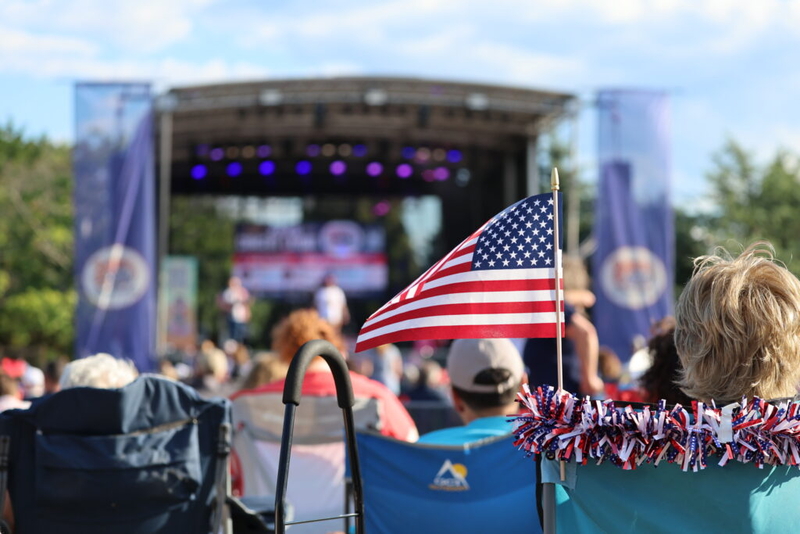
An American flag attached to a lawn chair flies in the wind as concertgoers watch 7 Day Weekend perform during the opening night of the Bristol Fourth of July Concert Series on June 21, 2026, at Independence Park. (Photo by Jordan J. Phelan/Rhode Island Current)
The music is back at Independence Park in Bristol. So are the folding chairs, the coolers and the longtime neighbors finding one another beside Bristol Harbor.
On June 21, the first night of this year’s Fourth of July concert series, the 4-acre lawn filled from the boardwalk to Thames Street, restoring one of the town’s most familiar summer scenes to the downtown area after the concerts were moved to Roger Williams University last summer to address public safety and overcrowding issues.
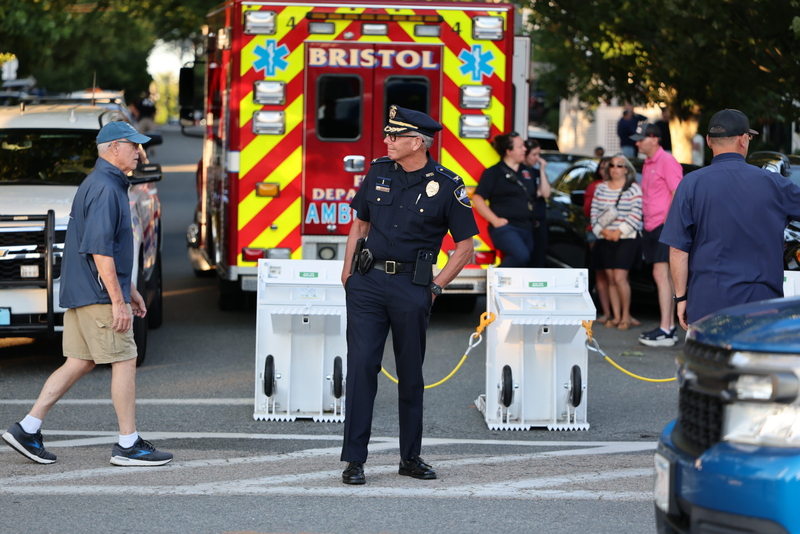
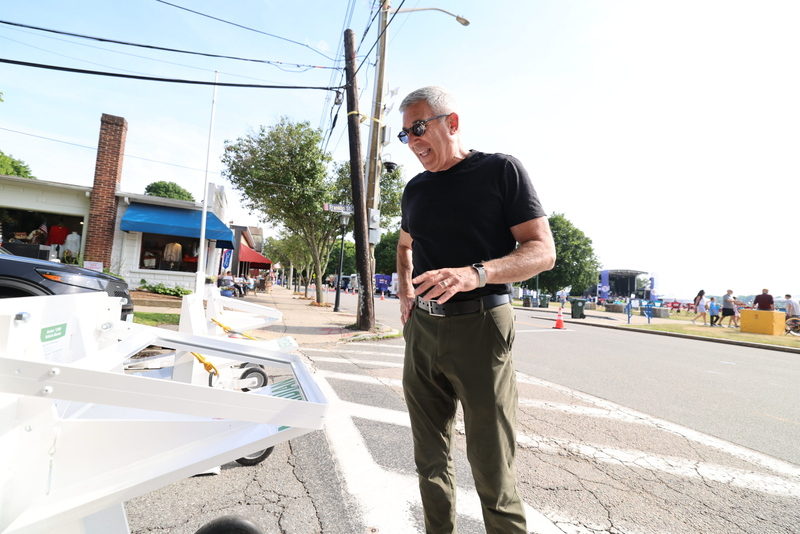
But now, at the edge of the crowd, stands something new: Meridian Archer barriers.
The barriers can stop a vehicle while still allowing pedestrians to pass through. A $192,700 federal grant awarded to the town covers 16 barriers plus a trailer and gates. Bristol is the first municipality in Rhode Island to receive the system, Michael J. Hogan, executive director of the Public Safety Grant Administration Office at the Rhode Island Department of Public Safety, confirmed. The equipment can be shared with other communities when Bristol is not using it, Police Chief Kevin Lynch said.
The Bristol Fourth of July Committee’s November 2024 decision to relocate the concerts last summer led to a petition with 1,400 signatures calling for the concerts to return to Independence Park, three voter initiatives filed with the Town Council and a fundraising drive that raised over $20,000 to cover additional security costs. At a February 2025 meeting, the committee declined to reverse course and said it could not accept the funds for public safety.
For a town that calls itself “America’s Most Patriotic Town,” a moniker rooted in its claim to the nation’s oldest continuous Fourth of July celebration, dating to 1785, the question was what Bristol would have to change in order to keep the tradition going.
Police had warned the committee that the concerts were beginning to exceed the available space at Independence Park. During one crowded 2024 concert, pedestrians spilled toward Thames Street and officers shut down traffic even though the plan had been to keep the road open. In a statement issued after the relocation backlash, Lynch said a child had suffered a facial injury from “crowd brushing.”
“Anytime you have an event that exceeds the footprint, you have cause for concern,” Lynch said in a recent interview.
Roger Williams University offered a larger, more controlled site, with more parking and easier security. University officials did not immediately respond to a request for comment when contacted for this story.
The field at the northeastern edge of the Roger Williams University campus is only 2.5 miles from Independence Park, but for Bristol resident Douglass Sanders, it was not the same.
Sanders, 28, remembers skating down Bayview Avenue toward Independence Park as a teenager and hearing the music become louder as he passed front yards and porches. The concerts, he said, gave people a reason to go downtown and feel the town gathering around itself.
“It’s almost like Christmas in the middle of the summer,” Sanders said. “Everyone’s jolly. Everyone’s got a big old smile on their face.”
Sanders said he didn’t want to attend any of last summer’s concerts because of the venue change. “I love going downtown when the concert series is happening,” Sanders said. “I don’t want to go to college to have that happen.”
As security threats rise, plans change
Over the past five years, municipalities across the country have made changes to their plans for outdoor civic festivities after officials or organizers cited public safety concerns.
In Rutland, Massachusetts, officials canceled most of the town’s planned 2026 Fourth of July celebration — including fireworks, a parade and a concert — after police and fire leaders said they could not safely support both the event and routine emergency services because of staffing limitations. In New London, Connecticut, organizers canceled the 2025 Sailfest after 45 years, citing city budget constraints that affected public safety and city services. In Albany, N.Y., city officials shortened last year’s Memorial Day parade route, with the police chief citing concerns about the deadly vehicle attacks on New Year’s Day 2025 in New Orleans and during the April 2025 Lapu-Lapu Day festival in Vancouver, British Columbia.
Bristol police work with state, federal and local partners, including the Rhode Island Fusion Center, which investigates and assesses terrorism risks, to prepare for large public events, Lynch said.
“This is not just simply putting police officers to direct traffic,” Lynch said. “We’re looking at threats throughout the country.”
The Cybersecurity and Infrastructure Security Agency now maintains guidance on vehicle-ramming mitigation and vehicle-incident prevention for public gatherings. A 2026 report from the National Counterterrorism Innovation, Technology, and Education Center, a Department of Homeland Security-funded academic center, found that 41% of high-profile U.S. vehicle-ramming incidents at events and public gatherings since 1970 occurred in the last decade.
Park layout reconfigured
For this year’s concert series, which continues until Thursday, July 2, Independence Park has been redesigned. Food trucks have moved from the grass to Thames Street, opening more room for spectators. Traffic has been reconfigured, with one-way movement through part of Thames Street and closures at key intersections. The renovated boat ramp provides more than 20 spaces officials planned to use for accessible parking, supplemented by other nearby spaces.
The police department added traffic safety officers for concert nights and separated managing traffic from event-security duties. The stage has been set farther back, and red, white and blue lines have been spray-painted down the middle of the venue to create an emergency-access aisle. Emergency access has become a design principle rather than a hope.
“If you want things to stay the same, things will have to change,” Steven Adelman, an independent safety and security consultant for live events at Adelman Law Group and co-founder of the Event Safety Alliance in Norwalk, Connecticut, said.
Adelman attended the June 26 concert as a visitor, spoke with law enforcement officials about the specifics of Bristol’s renewed traffic safety plan and walked through Independence Park and the surrounding streets to review the changes. What stood out to him was not only the Meridian Archer barriers, but the smaller decisions that make a safety plan work: visible police cruisers, officers in high-visibility vests, food trucks spaced for emergency access, clear signage and painted aisles meant to keep parts of the lawn open.
Roger Williams University, Adelman said, was easier to secure: officials could more readily control traffic and entry points and get emergency vehicles in and out. But if Bristol wanted the concerts downtown, it could not rely on the same resources that might have worked decades ago.
“You can still have your celebration right on downtown streets,” Adelman said, “but it cannot be the way it was when you were a child. It’s got to be up to modern safety standards, or it’s not going to be a good idea.”
Bristol was unusual, Adelman said, because it solved the problem twice: first by moving the concerts to a more controlled site, then by finding a second solution — new equipment, new planning and a downtown setup that could satisfy both public desire and public safety.
Back beside the harbor
An estimated crowd of 2,000 to 3,000 people attended the opening night concert. Crowds continue filling the park from the boardwalk to Thames Street each night.
Sherry Scott, who owns the Beehive Cafe with her daughter, Emily, said last year’s relocation disrupted the rhythm downtown businesses depend on during the Fourth. It “felt like we didn’t even know Fourth of July was happening,” she said.
“As businesses, we plan for our season,” Scott said. “We plan our income based on things that you know happen every year.” When something that reliable is pulled away, she said, “it really affects their bottom line.”
Customers who had canceled Bristol plans when the concerts were moved last year were excited again, Scott said.
“I was proud to see the community come together and say, ‘No, this is what we want,’ and then see leaders come together and hear us,” she said. “Now I think is when we’re going to see the joy — the joy of bringing it back.”
That joy is visible again at Independence Park, in the chairs spread across the grass, the music carrying over the harbor and the crowds moving through downtown. But the return is not a return to exactly what existed before. At the edge of the celebration, the barriers remain — a reminder that preserving Bristol’s oldest tradition now requires changing the way it is protected.


Providence, RI