Life beyond earth hearing in Pa. legislature less ‘little green men,’ a bit more space exploration
Jun 30, 2026 | 3:09 pm ET
Description
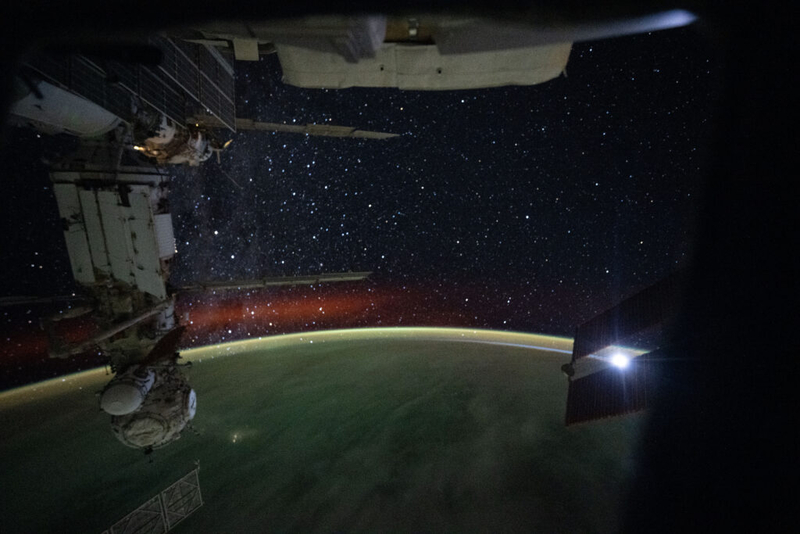
The International Space Station soars 262 miles above southern India on June 21, 2026. (NASA/Chris Williams)
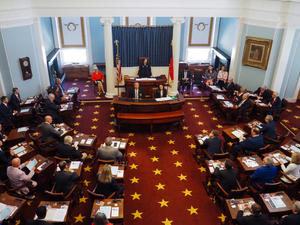
As the state budget process grinds on with no end in sight, House lawmakers spent an hour on Tuesday looking toward the stars, musing about space exploration and unidentified flying objects (UFOs).
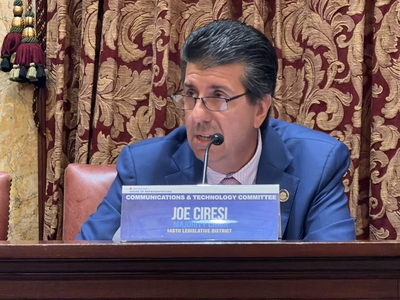
Rep. Joe Ciresi (D-Montgomery), who chairs the House Communications and Technology Committee, was quick to say the hearing went beyond reported alien sightings, with a focus on space exploration and public safety threats to airspace safety.
“As we all know, through the 50s, 60s and 70s, Pennsylvania played a pivotal part in exploring space, landing on the moon and satellites,” said Ciresi. “We (as a committee) had the opportunity a few months ago to go to one of the labs out in Pittsburgh where they were working on a lunar lander … it was really exciting to see how Pennsylvania is leading the charge.”
The National Aeronautics and Space Administration (NASA) restarted manned missions to the moon just three years ago after a 50-year hiatus, vowing to establish long-term operations to prepare for future missions to Mars.
“The stuff you hear about, it’s just like make-believe. And now it’s actually happening,” said Rep. Jason Ortitay (R-Allegheny), pointing to Pittsburgh-based Astrobotics lunar lander.
Others criticized the timing of the meeting, noting that it occurred on the same day that the state is due to submit its next spending plan.
“PA House Democrats have the majority and on the day the budget is due, they are holding a hearing on UFOs,” read a post from the House Republican caucus. “Meanwhile, House Republicans are focused on lowering taxes, growing the economy, and making life in PA more affordable.”
The House advanced Gov. Josh Shapiro’s budget in April, but Senate Republicans who hold a slim majority in the upper chamber have yet to publicly introduce their counterproposal. In the last two decades, the majority of state budgets have missed the June 30 deadline.
Ciresi said an earlier meeting at Penn State to discuss the same information was cancelled, and that the available dates for future hearings were limited.
Technological advances
Jason Wright, a professor of astronomy and astrophysics at Penn State, also serves as the director of the Penn State Extraterrestrial Intelligence Center. He detailed some of the detection technology being developed to potentially identify life elsewhere in the universe, such as radio waves, probes, infrared light and more.
But reality is still catching up to the space exploration depicted in popular science fiction, though cell phones and full-body scanners are now a reality, Wright cautioned in prepared remarks that some things didn’t seem to be possible.
“We have no reason, outside of plot contrivances of science fiction, to think that ‘warp drive’ is possible, and so any actual physical contact would take hundreds of thousands or many millions of years to undertake,” said Wright. “The discovery of alien technology is almost certainly not going to be like it is in the movies. But this does not diminish my excitement at the fact that we are searching for such technology smarter and more effectively than ever.”
Technosignatures, like radio waves, are likely easier to identify than biosignatures, such as the methane and ozone in our atmosphere, he continued. He cautioned that identifying a signal of extraterrestrial origin wouldn’t be enough “to quickly start communing with the other species, asking them questions, exchanging technological breakthroughs and planning visits.”
False alarms are “completely normal” in the field, but Wright shared that he “always want(s) the United States to be at the forefront of this field” and emphasized to lawmakers the need to educate the next generation of scientists.
“One thing I’ve found about the search for extraterrestrial intelligence is it is very easy to get anyone interested in,” said Wright. “We don’t have any shortage of people that want to be astronomers. The challenge, I think, is making sure that they have the solid mathematics … often, they’re very surprised to discover that astronomers must become physicists first.”
Pennsylvania has investigated more than a dozen UFO incidents in the past decade, records show
The presence of UFOs, whether extraterrestrial or not, also pose a threat to our airspace safety, added Chris Mellon, the board chair for The Disclosure Foundation, which tries to help whistleblowers come forward with information about “unidentified anomalous phenomena” and more.
Mellon, a former federal deputy assistant secretary of defense for intelligence, noted that many Americans aren’t aware of “the shocking extent to which unmanned aircraft of unknown origin are already penetrating restricted U.S. airspace and disrupting military operations.”
Some of the reports have left the intelligence community “completely baffled,” continued Mellon, though some were later identified as domestic or foreign drones from adversaries like China or Russia.
“The continuing inability of our military to control or defend its own airspace should shock and concern policymakers and the public. After all, if the Air Force and Navy can’t defend the airspace around their own bases, how can they defend the rest of the country?” Mellon asked.
He pointed to a December 2017 series from the New York Times about the Pentagon’s UFO program, which publicized the growing number of reports and concerns at the highest levels of the military. Since then, millions of records have been released, he said.
“We spent months trying to get someone in the (U.S.) Defense Department to pay attention. Nobody wanted to take responsibility. No one wanted to touch the issue,” said Mellon. “We’ve come a long way in a very short period of time.”
Ciresi, the committee chair, said Tuesday’s hearing wasn’t meant to inform potential legislation, but emphasized the need for continued technological advances.
“We kid around (about) alien technology or whatever, but this is also about public safety and national security. We don’t know what other countries have developed … and we have no way to detect (anomalies),” said Ciresi. “The technology coming out of space exploration is also helping with a lot of stuff we do here … it’s a lot more than little green men. It’s way beyond that.”

Harrisburg, PA