As firefighters mourn 3 of their own, concerns grow about this season’s risks
Jun 29, 2026 | 8:57 pm ET
Description
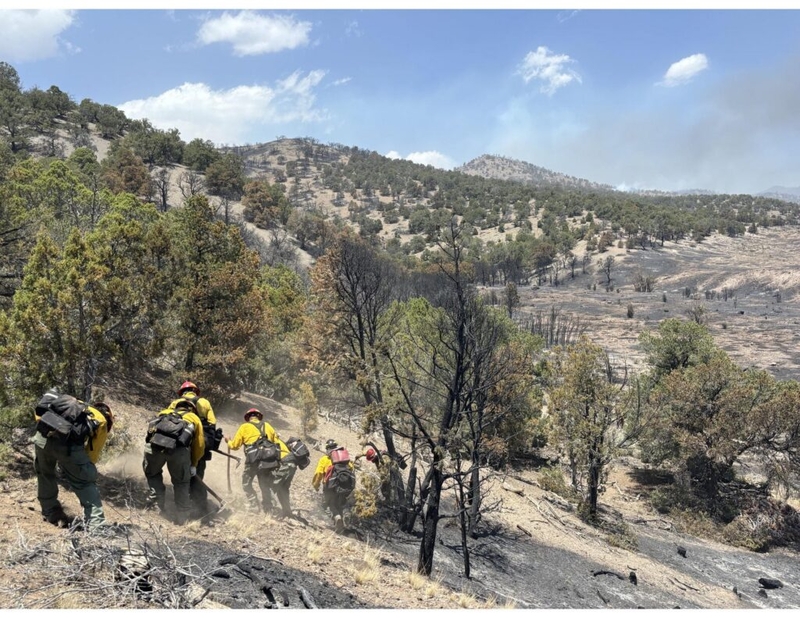
A line of firefighters check for hotspots and secure the fire line on the Cottonwood Fire near Beaver, Utah, in a photo shared on Saturday, June 28, 2026. (Photo courtesy of U.S. Forest Service)
A union representing federal wildland firefighters is raising concerns about their safety and fatigue after an “explosive” first phase of the season resulting in the deaths of three firefighters in Colorado near the Utah border.
Federal officials on Monday identified the deceased crew members as Emily Barker, 38, of Clinton Township, Michigan; Nick Hutcherson, 27, of Glendale, Arizona; and Sydney Watson, 27, of Warrior, Alabama. Hutcherson and Barker were employees of the U.S. Forest Service; Watson of the new U.S. Wildland Fire Service housed in the U.S. Department of the Interior.
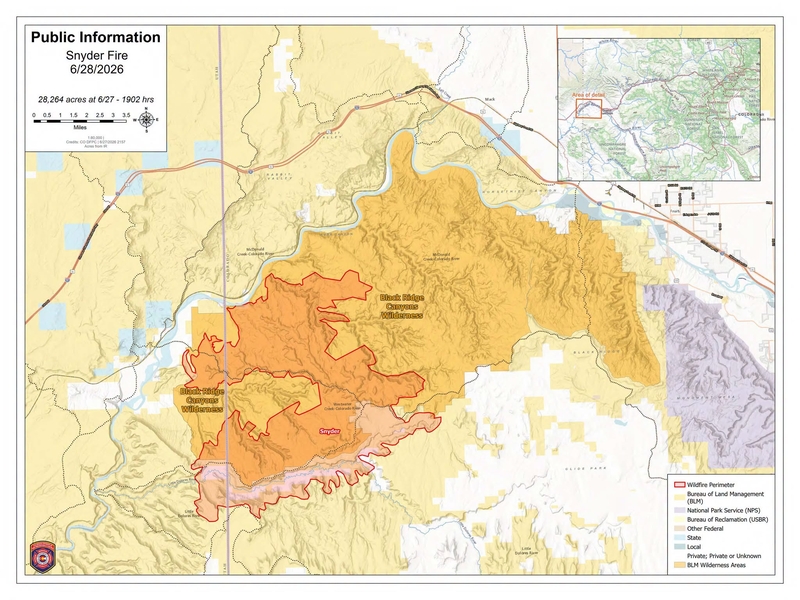
The three died in a burnover incident when flames overtook them as they were battling the Knowles and Gore fires that have since merged with other blazes into the 28,000-acre Snyder Fire on the Utah border. The tragedy was the largest in many years among federal firefighting teams, said Matt Brossard with the National Federation of Federal Employees.
Utah, Colorado mourn 3 firefighters killed in fire outbreak on state border
It happened nearly 13 years to the day after 19 members of the Granite Mountain hotshots perished in the Yarnell Hill Wildfire in Arizona on June 30, 2013.
While the exact circumstances surrounding the firefighters’ deaths over the weekend weren’t immediately clear, other troubling factors are, say Brossard and advocacy groups like Grassroots Wildland Firefighters. Some of the issues are environmental.
“We haven’t really gotten to the heart of the Western fire season yet. It’s still somewhat early, being the end of June,” Brossard told Utah News Dispatch. “Seeing some of the explosive fire growth that we’re seeing definitely raises some concerns for July, August and September.”
More extreme firefighting conditions lay ahead in Utah, as the Cottonwood Fire burns in the Tushar Mountains east of Beaver. It is the nation’s largest, at roughly 94,000 acres in size and 4% containment, and just one of the blazes burning in the state. The National Interagency Fire Center warned Monday that “extremely critical fire weather” with winds of up to 60 mph was likely in eastern Utah and western Colorado, along with parts of New Mexico and Arizona.
Another concern is staffing. The U.S. Forest Service said early in June that it had filled more than 11,000 firefighting jobs and pledged to get to 11,300 by July. Brossard is skeptical of those numbers, telling Utah News Dispatch, “we’re definitely seeing a lower number than that, and we’re seeing some pretty big holes in critical positions.”
In response to questions from Utah News Dispatch about firefighter safety and staffing, an Interior Department spokesperson said in a statement “while we understand the interest in broader discussions about staffing and firefighter well-being, there is no indication that those concerns played a role in this tragedy.”
Elizabeth Peace, associate deputy communications director, continued to say “we would respectfully ask that conclusions not be drawn that are unsupported by the facts. Our employees deserve to have their service and this loss viewed accurately and respectfully. As always, firefighter safety remains our highest priority, and staffing levels are managed to meet operational needs across the fire program.” She did not provide numbers on staffing.
After cuts driven by the Department of Government Efficiency (DOGE) last year and openings created by employees who left for better paying jobs, the Forest Service is down mid-level managers. Other advocates for wildland firefighters have raised concerns in recent weeks about burnout and safety risks due to job losses and turnover.
“We’ve lost a lot of — I hate to call them the old timers — we lost a lot of the firefighters with a large amount of experience, and now we’re running an organization with not the most experienced workforce,” Brossard said. On top of that, he’s worried about exhaustion that comes with long days and traveling around the country.
“With the fire season progressing longer and longer, and hotter and hotter, that fatigue is definitely going to be a factor here very soon,” Brossard said. “Especially for these firefighters in Utah and Colorado, that fire activity is not slowing down.”
Barker, Hutcherson and Watson were members of a “helitack” crew, a specialized team that responds to hard-to-reach wildfires via helicopter, either landing near a wildfire or rappelling to the ground. Helitack crews often stay overnight in remote places and once finished with their assignment, backpack out with up to 120 pounds of equipment to reach a pick-up spot, according to the U.S. Forest Service.
Brian Fennessy, chief of the U.S. Wildland Fire Service, said Monday the three firefighters made the “ultimate sacrifice in service to their fellow citizens.”
Fennessy said in a statement that they “embodied the courage, professionalism and selflessness that define the wildland fire service.”
Forest Service Deputy Chief Sarah Fisher called it “an incredibly difficult moment for the entire wildland fire community” and joined Fennessy in noting the toll on the firefighters’ families.
“We recognize the tremendous impact this loss has on them and are deeply grateful for the devotion their loved ones brought to our organizations,” Fisher said. “We will honor their memory with compassion and support as their selfless service and commitment create an enduring legacy.”
The news release said two other firefighters suffered burn injuries and were receiving medical care, but did not give details on the severity of their conditions. Reflecting on their injuries, Brossard made note of a grim reality. More fires in a season tend to mean more injuries for the teams battling them.
“Those two firefighters that are in the hospital have a very long road ahead,” Brossard said. “We need to keep them in our thoughts, and hopefully, knock on wood, that we don’t have another incident where this happens again this year.”
Salt Lake City, UT