US Supreme Court to take up Arizona proof of citizenship case
Jun 29, 2026 | 8:00 pm ET
Description
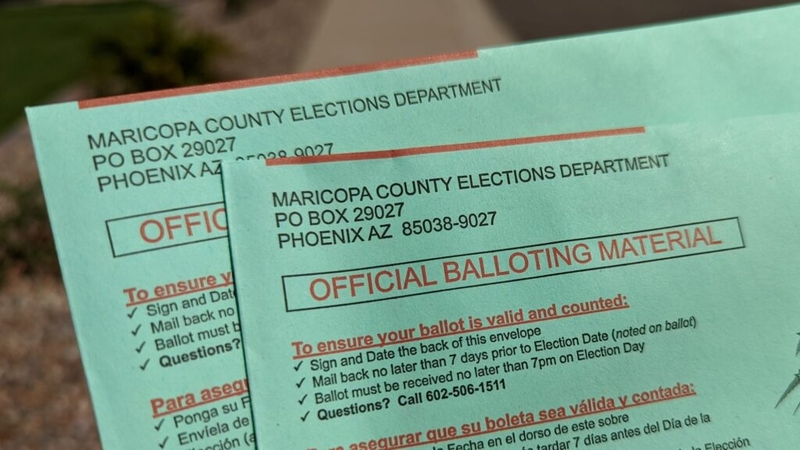
The U.S. Supreme Court has agreed to take up a case casting the Republican National Committee against a host of Democratic and voting rights groups over voting restrictions in Arizona. (Photo by Jim Small/Arizona Mirror)
The U.S. Supreme Court on Monday agreed to consider a case that could decide whether the state can require Arizonans to provide proof of citizenship to register to vote and if it can purge voter rolls in the months leading up to an election.
The high court’s decision in the case, which could come before the 2028 presidential election, could impact similar laws in other states that also face legal challenges.
The case originated in 2022 when a group of voting rights organizations, including Mi Familia Vota and Living United for Change in Arizona, challenged two new laws signed by then-Gov. Doug Ducey, a Republican.
The laws would ban voters who don’t provide proof of citizenship from voting by mail and in presidential elections. It would require more frequent and extensive checks of voter rolls for noncitizens, and subsequent purges.
The Republican-controlled Arizona Legislature enacted the laws in response to unproven claims of widespread noncitizen voting in 2020, which were made alongside baseless claims that the 2020 election was stolen from President Donald Trump.
The Republican National Committee and the U.S. Department of Justice asked the nation’s highest court to take up the case after the 9th U.S. Circuit Court of Appeals ruled last year, in agreement with a trial court, that Arizona’s proof of citizenship and purge requirements violate the National Voter Registration Act of 1993 and the Civil Rights Act.
The lower court blocked portions of the Arizona laws, and the 9th Circuit Court of Appeals upheld that decision.
“Only American citizens should vote in American elections,” RNC Chairman Joe Gruters said in a Monday statement. “It’s the law, and it’s supported by the overwhelming majority of Americans.”
Studies show that noncitizen voting is exceedingly rare, with one study of the 2016 election finding that it accounted for 0.0001% of votes cast.
The Campaign Legal Center, which is representing the voting rights groups in the case, said in a Monday statement that the U.S. Supreme Court’s involvement puts the voter protections bestowed by the NVRA at risk.
“Ignoring critical voter protections like the National Voter Registration Act forces Arizonans to jump through unnecessary hoops to participate in our democracy,” spokesperson Danielle Lang said in the statement. “We must ensure that every Arizonan, regardless of their background, has an equal and unobstructed path to exercise their fundamental freedom to vote.”
Since 2004, Arizona has required its residents to provide proof of citizenship when they register to vote in state and local elections. But in 2013, the U.S. Supreme Court ruled that the state couldn’t require proof of citizenship to vote in federal elections, per the NVRA.
After that, those who were unable to provide proof of citizenship could register as federal-only voters, allowing them to vote in federal races if they attest that they are U.S. citizens under penalty of perjury.
But the 2022 laws went further by banning federal-only voters from voting by mail — by far the most popular way to vote in the Grand Canyon State — and allowing voter rolls to be purged of noncitizens within the 90 days leading up to an election. The NVRA imposes strict limits on sweeping voter registration purges in the 90 days before a federal election.
Voting rights groups say that these rules disproportionately impact Latino, Native American and student voters who are citizens but don’t have access to the documents — such as birth certificates or passports — necessary to prove it.
During a Feb. 9 discussion on the floor of the Arizona Senate, Democratic Sen. Theresa Hatathlie of Coal Mine Mesa, who is Navajo, said that her 67-year-old sister still doesn’t have a birth certificate. Hatathlie’s sister was born at home on a rural part of the Navajo Nation, 22 miles from the nearest community. She has been unsuccessfully trying to get a birth certificate for more than 15 years, Hatathlie said.
Proof of citizenship to vote and giving election officials the ability to purge alleged noncitizen voters ahead of elections is a key aim of the SAVE America Act, Trump’s signature elections legislation that is stalled in Congress due to some Republican holdouts
So, Trump’s Justice Department last month asked the U.S. Supreme Court to take up RNC v. Mi Familia Vota, to overturn the lower court rulings and find that the Arizona laws don’t violate the NVRA.
The Trump administration has been pushing for states to hand over voter rolls to the Department of Justice to run them through the Department of Homeland Security’s SAVE system, which it uses to verify citizenship by checking information in federal databases.
Many Republican states have begun uploading their voter rolls to SAVE to search for potential noncitizens, and the Trump administration unsuccessfully sued the states that refused to hand over their voter rolls, including Arizona.
Critics of the program say SAVE has incorrectly identified U.S. citizens as noncitizens, a problem that could be exacerbated if the Supreme Court allows its widespread use in the weeks before an election. Last-minute misidentifications would leave little time for voters to prove their citizenship.
Arizona’s Democratic Secretary of State Adrian Fontes reminded voters in a Monday statement that the Supreme Court’s decision to take on the case will not impact 2026 elections.
“However, after years of legal wrangling and legislation, Arizona does need clarity from the Court on how to administer the citizenship requirement for voting,” Fontes wrote. “The current process is confusing to voters and results in some voter applications being totally rejected because of which form they use.”
Contributing reporting by Jonathan Shorman
Phoenix, AZ