Arkansas Explained: Capitol grounds crowded with monuments and some controversy
Jun 29, 2026 | 6:00 am ET
Description
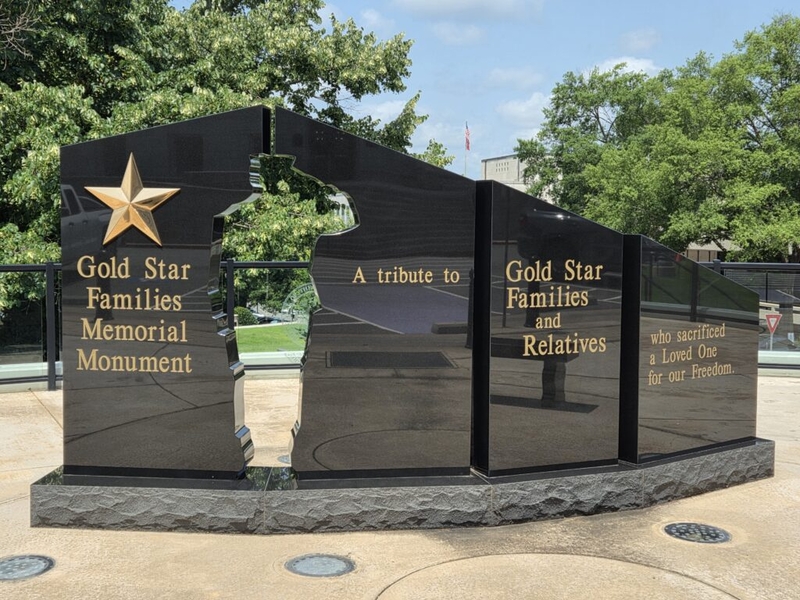
A black stone structure in honor of Arkansas' Gold Star families stands behind the state Capitol in Little Rock on June 25, 2026. (Photo by Tess Vrbin/Arkansas Advocate)
Two religiously infused displays on Arkansas Capitol grounds have drawn state and national attention: the Ten Commandments statue that a judge has ordered removed and a planned “monument to the unborn” backed by abortion opponents that’s faced planning setbacks.
Such widespread attention on the Capitol’s monuments is unique, so Arkansans might not know that there are at least 17 monuments on Capitol grounds, and some are more than a century old.
The structures and plaques memorialize veterans and casualties of foreign wars, the anniversaries of Arkansas and the United States, and Arkansas’ role in the Civil Rights Movement, among other things.
All monuments are privately funded and do not use taxpayer dollars, said Samantha Boyd, spokesperson for Secretary of State Cole Jester.
Here’s more information about how these monuments get approved and the controversy surrounding two of them:
How do monuments end up on Capitol grounds?
The Arkansas Legislature is the only entity that can create or remove a monument, according to state law. Before 2017, a monument could receive Capitol Arts and Grounds Commission approval before receiving legislative authorization.
The Arts and Grounds Commission, which usually meets monthly, is responsible for reviewing and approving monument designs. The panel’s 10 members are appointed by the secretary of state, the governor, the leaders of the House and Senate and the secretary of parks, heritage and tourism.
The secretary of state must give final approval of a monument’s design and location before construction can begin.
What controversy has surrounded the Ten Commandments monument?
Arkansas erected a stone depiction of the Ten Commandments outside the Capitol in 2017 to comply with a 2015 law.
In less than 24 hours, a man with a history of mental illness intentionally smashed his car into the display. The man had also destroyed a Ten Commandments monument outside Oklahoma’s Capitol in 2014.
A new monument surrounded by concrete barriers was placed between the Capitol and Supreme Court buildings in 2018. Several groups, including the Satanic Temple, quickly filed federal lawsuits arguing the monument violated the First Amendment’s prohibition of government favoring an establishment of religion.
The suits were combined into one case now in its eighth year of litigation, with the American Civil Liberties Union of Arkansas representing the plaintiffs.
Federal judge blocks law requiring Ten Commandments monument at Arkansas Capitol
A federal judge ruled in March that the monument is unconstitutional and must be removed, but the order is on hold while the state appeals the ruling.
The Satanic Temple sought to install a statue of the goat-headed deity Baphomet in response to the Ten Commandments monument. The Legislature responded with the 2017 ban on erecting monuments without legislative sponsorship.
What’s next for the planned ‘monument to the unborn’?
Earlier this month, Jester approved a design for a “living wall” of plants in the grassy space behind the Capitol and to the north of the Supreme Court building. The living wall would commemorate abortions performed in Arkansas during the nearly 50 years Roe v. Wade was in effect until the Supreme Court overturned the federal right to abortion in 2022.
Sen. Kim Hammer of Benton, the Republican nominee for secretary of state, sponsored the first-of-its-kind 2023 law ordering a “monument to the unborn.” He also sponsored the laws creating the Ten Commandments monument and the law blocking the Satanic Temple from erecting a Baphomet statue.
Hammer and GOP Rep. Mary Bentley submitted the living wall design to the Capitol Arts and Grounds Commission in March. The design was notably similar to the one the commission chose in 2023 from Hot Springs Village artist Lakey Goff.
Commission Chair Stephen Bright, who is also Jester’s chief taxpayer services officer, said the living wall will ideally be complete in 18 months, but only if supporters raise enough money.
The commission said in January that Goff’s living wall design was no longer feasible because she sought to copyright it, which would make it unchangeable.
Fundraising had been behind schedule, and commissioners said the design should be less expensive to motivate donors. Goff’s design was initially estimated to cost more than $900,000 before she submitted a proposal costing $345,000.
Hammer’s and Bentley’s design is estimated to cost $229,000, including a $20,816 maintenance retainer. In the past two years, private individuals have donated $28,790 for the monument.
More than $17,000 is currently in the monument’s trust fund after the state paid Development Consultants Inc. for preliminary engineering and plan development expenses.
What are some of the other monuments around the Capitol?
Anyone who drives past the Capitol on 7th Street can see the round gray stone of the Vietnam Veterans Memorial, in place since 1987. Inside the curved structure are the names of 645 Arkansans who died in the Vietnam War.
Also visible from the streets surrounding the Capitol are a sculpture of an eagle honoring 25 Arkansas Medal of Honor recipients and two statues commemorating Arkansans’ participation in the Civil War. The Confederate Soldiers Monument and the Confederate Women Monument stand on opposite sides of the Capitol facing Woodlane Street.
Both Confederate monuments were erected in the early 20th century, and Gov. Jeff Davis’ dedication of the soldiers’ monument asserted that the Confederacy was “the cause we each know was right,” according to the Encyclopedia of Arkansas.
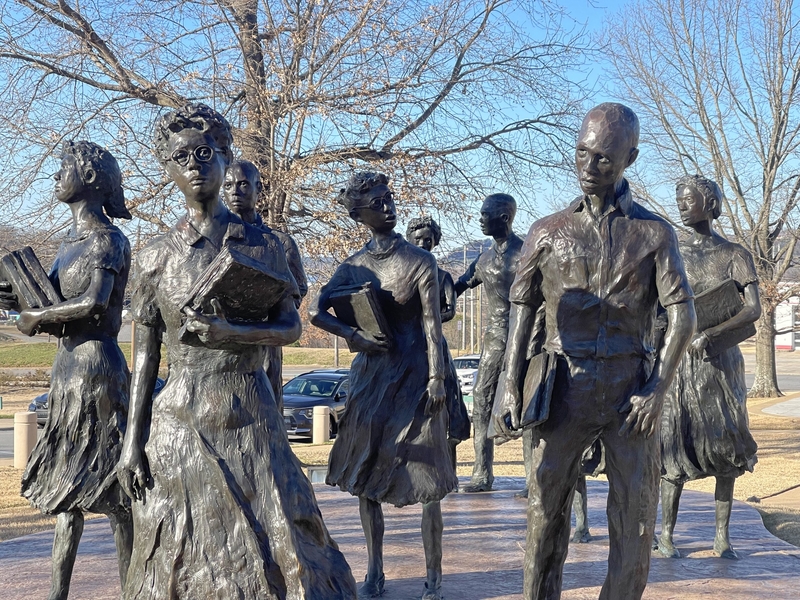
North of the Capitol is a bronze depiction of the Little Rock Nine, the Black students who desegregated Central High School in 1957. Gov. Mike Huckabee, father of current Gov. Sarah Huckabee Sanders, dedicated the monument in 2005.
Behind the Little Rock Nine is a replica of the Liberty Bell, dedicated in 1976 for the United States’ 200th anniversary.
The complex’s most recent monument is the Gold Star Families Memorial, erected in 2019 west of the Capitol. Behind it is a bronze memorial to fallen firefighters, in place since 2014.
Are any other monuments in progress?
Two 2025 laws ordered monuments to the school districts in Charleston, Fayetteville and Hoxie for their desegregation efforts that predated the Little Rock Nine.
The three monuments “remain in the early stages” and need more fundraising, design and planning efforts before the Capitol Arts and Grounds Commission chooses their locations, Boyd said.
Little Rock