Ahead of midterms, North Carolina Democrats lead the fundraising race. Does it matter?
Jun 29, 2026 | 6:05 am ET

Description
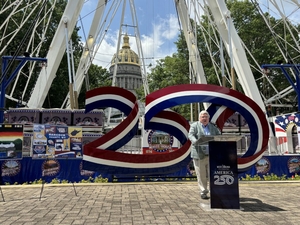
Supporters of former Gov. Roy Cooper watch him speak at an April 9, 2026 rally in Durham for his Senate campaign. (Photo: Brandon Kingdollar/NC Newsline)
If you watch TV in North Carolina, there’s a good chance you’re already seeing a lot of former Gov. Roy Cooper these days.
That’s in part because his campaign had raised more than $26 million as of the end of March to back his U.S. Senate bid, one that is crucial to deciding who controls the chamber.
That makes Cooper the fifth-ranked fundraiser among all Senate candidates this cycle — and puts him at three times the total of his opponent, former RNC and NCGOP Chair Michael Whatley, who had raised just over $8 million by March 31.
North Carolina’s Senate race no longer a toss-up, top forecasters say, with Cooper in the lead
Looking at campaign contributions from individuals, rather than PACs, Whatley came in third among North Carolina U.S. Senate candidates this cycle, with $3.75 million by the end of March — less than Cooper with $10.68 million and Sen. Thom Tillis (R-N.C.) with $4.59 million.
Tillis dropped his reelection bid in June 2025.
It’s emblematic of a trend in North Carolina politics ahead of the 2026 midterms: so far, Democrats are blowing past their Republican opponents in campaign fundraising, buoyed in part by a surge in small-dollar donations.
North Carolina political scientists and campaign consultants say these numbers are important, but they don’t tell the whole story. Here’s what to know about the money race in the state ahead of new disclosures in June and July.
‘I’m definitely revising my estimate’
Whatley’s fundraising is still outperforming past Republicans. His campaign has received about twice as much in funds as the campaign of Sen. Ted Budd (R-N.C.) had by this point in 2022.
It’s Cooper’s campaign that’s the outlier — he has brought in more than three times what Budd’s opponent, former state Supreme Court Chief Justice Cheri Beasley, raised by the end of March 2022.

Charles Hellwig, a longtime Republican consultant, said it’s a credit to the former governor’s power as “probably the best Democratic campaigner since [Gov. Jim] Hunt,” a fellow political heavyweight who won a record four terms as governor — though failed in his 1984 bid for the Senate.
“Cooper has all the national push, just on a bigger scale, and he’s got decades of his own network and decades of longtime Democratic donors,” he said. “My hope is that Whatley wins. I think it’s going to be real close and that Cooper’s absolutely a great fundraiser.”
Another factor that may impact the fundraising battle in the months ahead: political observers are no longer calling North Carolina’s U.S. Senate race a toss-up. Sabato’s Crystal Ball and Cook Political Report, the two top independent election forecasters, now say that Cooper is the favorite, though the race remains close.
That means projections that North Carolina would be the most expensive Senate race in the country, or perhaps even in U.S. history, may no longer be realistic if national Republican groups decide to spend their money elsewhere.
“I’m definitely revising my estimate, and I think others are too,” said Chris Cooper, a political scientist at Western Carolina University. “It’s going to be obscenely expensive by any metric, but it’s not going to be record-breaking.”
If national dollars that might have flowed into North Carolina end up going to tighter contests in Maine, Ohio, Alaska, and perhaps even Texas, Chris Cooper said, that could make Whatley’s task of introducing himself to voters more challenging. But it could also slow Cooper’s fundraising if Democratic backers focus on those other races as well.
“The same amount of money is here to go around — North Carolina’s not going to get as much of it,” he said.
Hellwig said he would be happy to see a shift in focus. “It would be the best thing if the national Democrat money believed Cooper would have it sewn up and pulled their money out and tried to go flip Texas or whatever. That’d be just fine by me.”
‘One hand tied behind her back’
Top candidates may be eager to see a calmer-than-usual North Carolina election season. But down the ballot, a shortfall in national dollars could spell trouble.
The state’s top judicial race shows the same fundraising pattern as the U.S. Senate election. A few months before resigning her seat in the North Carolina legislature to focus on her state Supreme Court campaign, Republican nominee Rep. Sarah Stevens (R-Surry) was also lagging far behind her Democratic opponent, Justice Anita Earls.

Earls, competing in one of the most-watched state Supreme Court races in the country, had brought in more than $2.4 million as of Feb. 14, according to a March report to the North Carolina State Board of Elections. Over the same period, Stevens raised roughly $240,000.
Unlike Whatley, however, Stevens is falling behind her predecessors. By the end of the first fundraising quarter of their Supreme Court elections, Judge Richard Dietz had raised more than $300,000 and Judge Jefferson Griffin raised nearly $900,000.
Part of the problem is that, as a sitting lawmaker, Stevens was unable to accept money from lobbyists. Her campaign returned $8,300 in donations that were ruled illegal by the State Board of Elections earlier this year. That issue, combined with her sluggish fundraising numbers to date, may have contributed to her decision to leave the House to focus all her attention on the campaign.
Morgan Jackson, a longtime Democratic political consultant and senior adviser for the Cooper campaign, said Earls has a strong foundation to tell her story and push back on GOP attacks, while Stevens lacks momentum in the race.
“She’s been running a race with one hand tied behind her back by being at the legislature every day,” Jackson said. “Also, the fact that we’ve been over 1,000 days without a state budget is not really helpful to be running as an incumbent legislator, especially in the leadership.”
He said Republicans have still had enormous success at drawing outside spending, particularly in the state Supreme Court races. “I would be willing to bet that it will be the most expensive judicial race in North Carolina history.”
Patrick Sebastian, a North Carolina conservative pollster and political consultant, said Earls appeals to Democratic donors as a “liberal darling” similar to Cooper. “When they find one, they will pump money in.”
‘Do they want to give money this year?’
Republicans are heading into their most challenging General Assembly election in years with a major question mark: Who will be leading the party?
In the state Senate, a costly primary election last March between Senate President Pro Tem Phil Berger (R-Rockingham) and Rockingham County Sheriff Sam Page may give Democrats an edge in breaking that chamber’s Republican supermajority.
The primary led to Berger’s defeat — but not before his backers spent more than $10 million on the race, money that could have gone to other Senate Republican candidates instead. Sebastian, who worked on the Page campaign, said Berger’s lame duck status will likely make it difficult for him to replace that money.

“That’s what I’m going to be looking at next month when these finance reports come out. Is Berger able to raise the money for his caucus considering he will not be there next year?” Sebastian said. “Do they want to give money this year not knowing who the pro tem is going to be next year?”
Prior to the primary, the state GOP was already running behind. The North Carolina Democratic Party’s state committee outraised its Republican counterpart by more than a million dollars by the end of the first fundraising quarter this year, having brought in $3.5 million and $2.2 million respectively.
“A lot of Republicans in this state have had trouble raising money as compared to Republicans in other states,” Sebastian said. “We’re far, far, far away from being a Florida or Texas as far as just the number of wealthy donors willing to shell out the dollars.”
However, Sebastian said, Republicans still have “so much more money than the Democrats” when looking at the full scope of General Assembly fundraising. He called that advantage Republicans’ “saving grace” in the face of a national mood that has soured on the party over rising prices and war in Iran.
Democrats, Sebastian said, face their own fundraising hurdles because they’ve been out of power at the legislature for 15 years.
“So many people don’t believe there’s any chance they’re going to be able to take the majority,” Sebastian said. “It would take some polling showing that they are going to win, but then it could be too late.”
‘Pumping money in hand over fist’
Even with a rush of outside spending looming, direct contributions confer a distinct advantage to candidates that spending by external groups cannot provide.
By law, television and radio ad purchases by candidates must be offered at the “lowest unit charge,” making them far more affordable than ads by outside groups, who must spend a significantly higher sum for the same amount of airtime.
“The television rates are significantly less with campaign committee dollars,” Sebastian said. “That’s probably a big reason why Roy Cooper is already on the air. He’s getting a great value right now.”
Another advantage from leading the race in direct contributions, Jackson said, is that advertisements by the campaigns themselves go further because they best reflect the candidate’s message. Outside groups are banned by law from coordinating with campaigns.

“Campaigns know their candidates and can make the case to voters,” he said. “They understand their candidates, they understand the message, they understand the war that’s being fought every day in these campaigns.”
But even with his large war chest, Cooper may not dominate the airwaves for long, said Michael Bitzer, a professor of politics and history at Catawba College.
“The early indications are that outside interest groups, particularly aligned with Republican Senate campaigns, will be pumping money in hand over fist,” Bitzer said. “I think we will see a significant amount of money coming in, whether it’s from the candidates or more likely from PACs, special interest groups, those kinds of entities.”
Jackson said he expects this to be the first race Cooper has run where he’s outspent by supporters of his opponent.
As of mid-June, Jackson said he’s seen $88 million in airtime reservations by Republicans versus $31 million in reservations by Democrats. “That’s a $50 million deficit right there that is only expected to grow probably to the nature of a $100 million deficit,” he said.
There’s one more reason to keep an eye on Whatley’s campaign fundraising in the months ahead — it will be a strong indicator of whether Republicans still think he has a chance, despite running behind Cooper in every poll, often by double digits.
“Typically, we tend to see voters go into their respective political corners by the time we reach the fall,” Bitzer said. “Money gives a good signal, so the fundraising at the various ends of the reporting periods will give us a sense of those things.”
Raleigh, NC