Pa. House committee advances GOP-sponsored civil asset forfeiture bill
Jun 26, 2026 | 3:35 am ET
Description
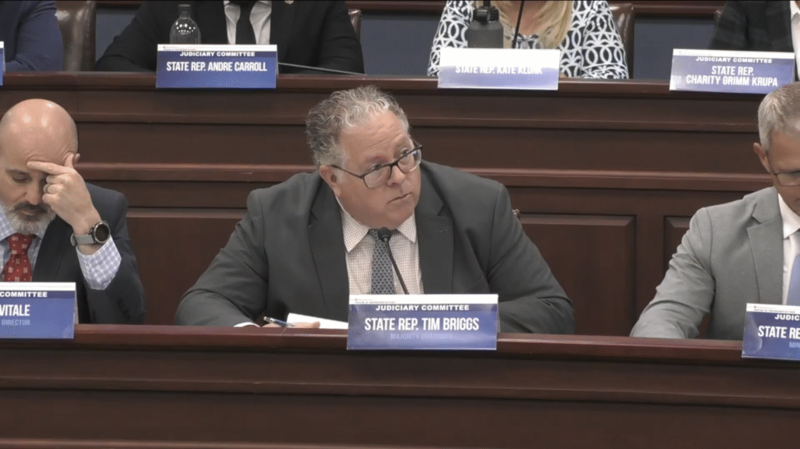
Rep. Tim Briggs (D-Montgomery), the chair of the state House Judiciary Committee, at a meeting on June 25, 2026. (Photo from PACast)
Emily Scolnick is a 2026 Dow Jones News Fund intern at the Pennsylvania Capital-Star.
Legislation to better inform Pennsylvanians affected by civil asset forfeitures about their rights has advanced in the state House.
The Republican-sponsored proposal passed the Democratic-majority chamber’s Judiciary Committee unanimously and with no debate Thursday. It now moves to the floor for full consideration.
Listen to the audio recap:
Pennsylvania law enforcement agencies carry out civil asset forfeitures when they seize money or property from someone who is not facing criminal charges.
“My legislation offers a more balanced and constructive approach to addressing some of the concerns that have been raised regarding the forfeiture process,” said Rep. Tom Jones (R-Lancaster), the measure’s prime sponsor. “Rather than restricting the tools available to law enforcement, my legislation focuses exclusively on due process and the access to information.”
Under the commonwealth’s current civil asset forfeiture laws, property owners must navigate a complex legal system without much, if any, guidance from the state. The new measure would require law enforcement to provide “clear, written notice” of their rights and a sample Motion for the Return of Property.
Civil asset forfeiture is primarily used to mitigate drug trafficking, organized crime, human trafficking, and other criminal activity. At the committee meeting, Jones said these laws “help prevent criminals from being able to continue profiting from the victimization of others.”
The Institute of Justice currently gives Pennsylvania’s civil asset forfeiture laws a “D-” grade, noting that they strongly incentivize law enforcement to seize property.
Jones acknowledged that while some law enforcement stakeholders “have expressed a few concerns” with the proposal, conversations surrounding the measure were primarily positive and he will work to address those concerns prior to its House floor consideration.
“By ensuring that property owners receive clear notice of [their] rights, we can promote transparency and public confidence in the forfeiture process without undermining its effectiveness,” he said.
The bill would take effect 60 days after final passage.

Harrisburg, PA