Analysis: How not to interpret Ferguson’s primary win
Jun 24, 2026 | 6:59 pm ET
Description
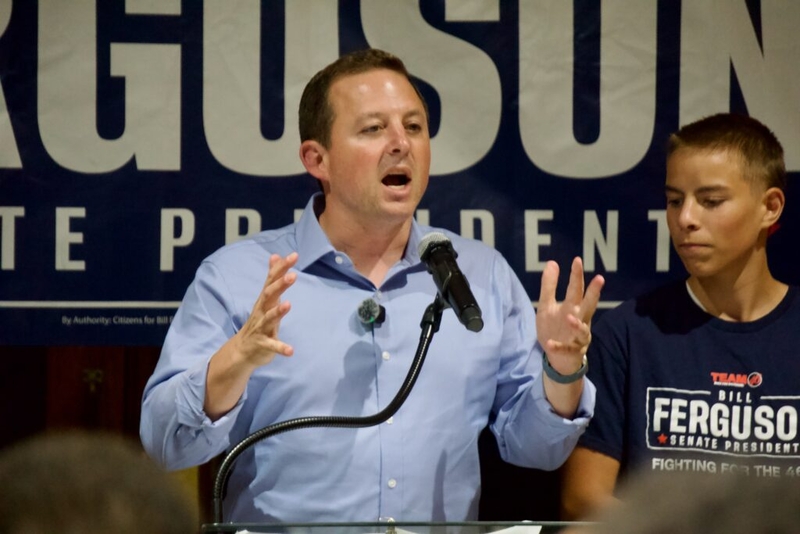
Senate President Bill Ferguson (D-Baltimore City) gives a victory speech to supporters Tuesday night after a comfortable win in one of his biggest challenges in years. His son Caleb listens. (Photo by Christine Condon/Maryland Matters)
Senate President Bill Ferguson’s Democratic primary victory Tuesday over a provocative, persistent challenger was fueled by many factors and could have many consequences for the future governance of this state.
One thing it was not was a referendum on mid-decade congressional redistricting.
Ferguson, who launched his own political career in 2010 by ousting an entrenched incumbent in Baltimore City’s 46th District, defeated tour boat captain and social media influencer Bobby LaPin 56.6% to 43.4%, according to preliminary numbers from the Maryland Board of Elections.
LaPin’s campaign in certain ways mirrored Ferguson’s earlier insurgent race, aiming to capitalize on progressive energy and the changing demographics in the South Baltimore district. He prosecuted the progressive, populist case against Ferguson skillfully enough, but did not have the money or the campaign apparatus or the political chops to make the primary result closer than it was.
Ferguson ran a well-funded and largely well-organized race, capitalizing on the goodwill he had built up funneling largesse to the district as a member of the Budget and Taxation Committee and later as Senate president. Many District 46 voters are savvy enough to recognize the benefits of having a presiding officer as one of their representatives in Annapolis, and Ferguson has cultivated relationships with the district’s big corporations, small businesses and community organizations throughout his tenure – not just in election years. Big-moneyed groups helped with independent expenditures boosting the Senate president.
But invariably, some out-of-state experts and national political pundits will try to interpret the primary result through the prism of redistricting. They shouldn’t.
Despite some challenges, most legislators appear headed to reelection
To be sure, Ferguson gained national attention – much of it no doubt unwanted – through his stand against mid-decade redistricting during this year’s General Assembly session. He single-handedly stymied Gov. Wes Moore (D) and House Democrats, who sought to draw a map that would give Maryland Democrats an 8-0 advantage in the congressional delegation.
Ferguson asserted that such a move would be legally and politically risky, and also attempted a reformer’s argument, questioning the wisdom of rushing to the bottom on the once-unorthodox tactic of mid-decade redistricting.
Ferguson was under heavy pressure to change his stance: From Moore, from U.S. House Minority Leader Hakeem Jeffries (D-N.Y.), from the state’s congressional Democrats, from Obama administration Attorney General Eric Holder, and from an array of other powerful progressive voices and thought leaders.
But never did these forces come together to try to defeat Ferguson in the primary. And that matters.
Sure, a couple of Moore aides made $50 donations to LaPin’s campaign – one of whom has since been exiled. And Moore himself, despite doling out dozens of endorsements in the primary, somehow never got around to publicly backing Ferguson’s reelection bid. He never endorsed LaPin, either.
Their reticence ensured that redistricting was never going to be uppermost in the minds of 46th District Democrats.
LaPin tried to make an issue out of Ferguson’s opposition to Moore’s redistricting plan. But it was part of a broader campaign strategy to suggest that Ferguson – and by extension, the Democratic Senate – was “a day late and a dollar short” on a host of progressive policy prescriptions that have been debated in Annapolis.
It was not an irrational line of reasoning nor an illogical game plan. But it didn’t make redistricting a centerpiece of the campaign argument.
If anything, Ferguson elevated redistricting as a campaign issue himself when he suggested, some weeks after the U.S. Supreme Court’s April 29 Callais decision, effectively gutting the Voting Rights Act, that he’d be open to redrawing the state’s congressional lines after all.
It may have been a campaign ploy by Ferguson to protect his left flank. It may have been a genuine change of heart considering how endangered minority voting rights in this country have become. Or it could have been a combination of the two.
Nevertheless, Ferguson, Moore and House Speaker Joseline Peña-Melnyk (D-Prince George’s and Anne Arundel) have now tentatively, privately resolved to schedule a special legislative session later this summer, with a minimum goal of putting a constitutional amendment on the fall ballot to pave the way for re-redistricting before the 2028 election. The full contours of the special session have not been fully agreed to.
So why does it matter how Ferguson’s primary win is interpreted?
Because the voters were not ratifying his initial resistance to redistricting. They had a four-term incumbent with a record of substance to consider versus a quirky challenger who was good at manifesting outrage and making eye-catching videos, but ultimately did not convince enough voters that they should fire Ferguson and hire him. That’s politics.
Yet we have to be careful. Every drama in every state over mid-decade redistricting seems to have become part of a bigger national conversation, with overblown political implications.
Yes, California Gov. Gavin Newsom (D) is spinning his state’s new congressional map into partisan political gold. Yes, President Trump’s successful revenge campaign against the Republican Indiana state senators who voted against re-redistricting says a lot about the state of the GOP nationally. Yes, it’s hard not to tally the likely wins and losses for both parties after so many states redrew their congressional maps this year.
But all too often, national pundits lose sight of the local elements on the ground in these specific cases and states – and try to mold a local result into part of a broader political narrative.
District 46 has a unique set of political dynamics. Several voters will think Ferguson’s renomination was well deserved, others will be disappointed by the results – and may choose to take whatever LaPin accomplished and build for another day.
Maybe Ferguson’s initial resistance to redistricting will be part of that latter group’s calculation. But the result more than 8,600 Democratic primary voters delivered in one small legislative district on Tuesday should not be seen as conferring a blessing on Ferguson’s opening position on redistricting – and it has very little to do with the ongoing national debate on the topic.
Annapolis, MD