Matos campaign asks RI elections board to investigate Loughlin’s financial reports, TV buys
Oct 30, 2026 | 6:23 pm ET
Description
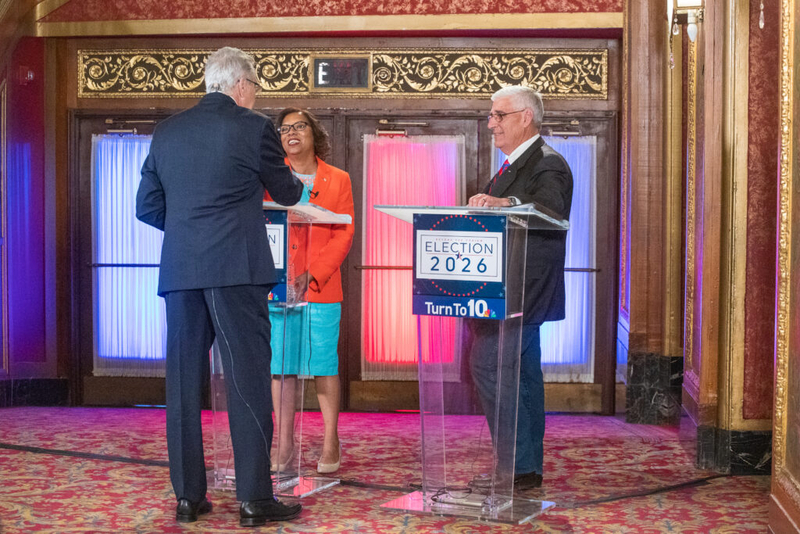
NBC 10 moderator Gene Valicenti speaks with Lt. Gov. Sabina Matos, center, and Republican challenger John Loughlin after Wednesday’s lieutenant governor debate at the Providence Performing Arts Center on Oct. 7, 2026. (Photo by Alexander Castro/Rhode Island Current)
With just days to go before Tuesday’s general election, Democratic Lt. Gov. Sabina Matos’ campaign filed a complaint with state elections officials against her Republican opponent John Loughlin Thursday alleging Loughlin’s campaign manager improperly reported and benefited from taxpayer-funded campaign money.
Loughlin denies the allegations.
“The Matos campaign’s letter is a textbook example of either a fundamental misunderstanding of how media is purchased or a deliberate attempt to invent a scandal where none exists,” Loughlin wrote in a letter to the Board of Elections that he also shared with Rhode Island Current Friday.
The Board of Elections declined to say Friday whether or not the issue was being investigated.
Loughlin filed his campaign spending report by the Oct. 27 deadline, listing $659 in expenses. The next morning, he amended his final pre-election campaign finance report twice, with both totaling $3,641 in expenses.
The next day, the Matos campaign asked the Rhode Island Board of Elections to investigate whether Loughlin’s campaign manager improperly benefited from taxpayer-funded campaign money, a practice the Matos team has characterized as “skimming.”
After the Matos campaign filed the complaint Thursday morning, Loughlin amended the report a third time, listing $58,651 in campaign expenditures for the period ending Oct. 26. The newly added expenses total $55,010, including two $25,000 expenditures for TV ads — one each for WJAR and WPRI — plus $5,010 in radio ads.
Loughlin’s refiled paperwork followed a $25 late fee levied Wednesday by the Rhode Island Board of Elections, because the changes made were significant enough that they made the submission count as a late filing. State election regulations define a material amendment as one which “shall mean to add, delete, or alter more than $500, or 10%, whichever is larger, of the total fiscal sum or either the contributions or expenditures on any campaign finance report,” and Loughlin’s changes fell into this category.
Board of Elections spokesperson Christopher Hunter did not confirm or deny whether an investigation had begun. He said that campaign finance investigations remain confidential until a violation is believed to have occurred. The person being investigated can also waive confidentiality.
The Matos campaign’s complaint accused Chris Mueller, Loughlin’s campaign manager, of ultimately deriving financial benefit from publicly matched campaign funds. Matos’ campaign manager Mark Gray alleged in the complaint that Mueller used his advertising business to collect commissions on the television ads purchased by the Loughlin campaign.
“The report failed to reflect over $80,000 in matching public funds and $3000 in payments by his campaign, both vastly exceeding the 10% threshold for a substantially complete report,” Gray wrote of Loughlin’s original Oct. 27 filing.
Gray’s complaint distinguishes the campaign’s radio advertisements from its TV spots, claiming that the radio ads were purchased directly and without commission. He noted that Federal Communications Commission forms show the TV ads were purchased through Chris Mueller Campaigns, and cite a 15% commission for the agency.
Gray argues that Mueller’s business and the Loughlin campaign headquarters share an address, and that Mueller filled out the required candidate advertising agreements for both the radio and TV orders. Gray concluded that this amounted to routing the television purchases through Mueller’s business, thereby allowing him to profit from publicly matched funds via the commission fees.
Candidates who participate in Rhode Island’s public matching funds program are permitted to use the money for specified campaign expenses, including radio and television advertising. But in his letter, Gray accused Mueller’s agency of rerouting the funds and violating the law’s intent to “prevent politicians from… funneling public funds into the pockets of vendors and campaign staff.”
“It is not possible that the Loughlin campaign is not aware of these expenditures, given that all of the ads were bought directly by the campaign or by a campaign employee,” Gray wrote. “It is our belief that the Loughlin campaign, as managed by Mr. Mueller, is deliberately hiding these costs and flaunting the state’s disclosure laws in an attempt to hide their use of matching public funds from the voters.”
A Rhode Island Current analysis of Loughlin’s FCC filings identified $58,605 in TV orders, which included $28,375 at WPRI, $26,600 at WJAR and $3,630 at WNAC. The campaign also purchased $9,790 in radio spots on WPRO, bringing the total to $68,395.
Those figures include spots scheduled to air beyond the Oct. 26 campaign finance reporting period. The television contracts also show Chris Mueller Campaigns as the buying agency and note a 15% agency commission, although these forms don’t establish that Mueller received this money, or exactly when expenses were incurred or paid.
‘No public matching funds were diverted to any individual’
Rhode Island Current contacted Loughlin and Mueller Friday with several questions. Loughlin responded by emailing the letter he sent to election officials, arguing the allegations are inaccurate and reflect a lack of insight into purchasing mores.
“The core of their allegation rests on the difference between gross and net rates — a distinction every experienced media buyer, station salesperson, and campaign understands,” Loughlin wrote.
Loughlin said his campaign was charged a gross rate by the television stations, a standard practice. The net price, meanwhile, is calculated after removing the commission.
“When a campaign or its media buyer is billed the gross rate, the station retains the option to issue a refund or credit for the commission portion (the difference between gross and net),” Loughlin wrote. “That is standard industry practice, not a scheme.”
So, Loughlin wrote, when the TV stations then told his campaign that a refund was available for the commission portion, the campaign told the stations to reinvest that money into more ads, rather than refund the cash.
“No public matching funds were diverted to any individual,” Loughlin wrote. “The money stayed in advertising.”
Neither Loughlin’s letter nor his revised forms have convinced the Matos campaign.
Gray wrote in an email to Rhode Island Current Friday that, despite the Loughlin campaign’s multiple amendments, “There are still major differences between what the campaign is reporting and the FCC files.”
Gray’s complaint is asking the elections board to revisit Loughlin’s Oct. 27 report and examine whether its multiple amendments have made it remain delinquent, and assess any penalties as necessary.
A poll released Oct. 20 by Salve Regina University’s Pell Center found the lieutenant governor’s race was statistically tied with 44% of likely voters supporting Loughlin and 43% backing Matos. Matos performed well among women and Hispanic voters while Loughlin has stronger support among men and white voters, the poll found.
Reporter Christopher Shea contributed to this story.
Providence, RI