Kaua‘i Police Ignored Warnings Ahead Of Murder, Residents Say
Jun 22, 2026 | 6:01 am ET
Description
Photo courtesy of Honolulu Civil Beat
William "Billy" Sinclair was well known in his Kīlauea neighborhood for being intimidating and threatening. In the year before he was arrested for the murder of his former tenant, residents repeatedly called the police to say Sinclair had been waving guns at them, making threats, and shooting firearms on his property.
Neighbors were so scared that they successfully sought restraining orders that forbade him from possessing firearms or ammunition. Yet after his June 8 arrest, police found that he had an arsenal: three pistols, two shotguns, two semi-automatic handguns, 13 rifles, three suppressors and ammunition.
It’s unclear what — if any — steps the Kaua‘i Police Department had taken to remove them before. What is clear, neighbors say, is that not enough was done to stop Sinclair’s threatening behavior from escalating, even when they called police multiple times about gunshots and loud booms coming from his house.
“KPD really failed the community,” said a neighbor who spoke to Civil Beat on the condition of anonymity due to concerns about his family’s safety. “They’re supposed to protect the community and they didn’t.”
A Note On Anonymous Sources
Civil Beat generally uses on-the-record sources. However, we occasionally use unnamed sources when a source is sharing important information we wouldn’t have otherwise been able to obtain and when they could face negative consequences for speaking publicly. The reporter and at least one editor must know the identity of the source and the use of anonymity must be approved by a senior editor. You can read more about our anonymous sources policy here.
Tiana Victorino, public information officer at the police department, said in an email that the department is unable to comment on specifics of the case because the investigation is ongoing. She added that when a TRO is served, the department reviews firearm registration records.
“If registered firearms are identified, officers will take appropriate steps to recover those firearms and place them into safekeeping in accordance with applicable law and department procedures,” she wrote.
As a convicted felon, Sinclair would not have been allowed to register a gun in the state.
When asked about how the police department handles recovering unregistered firearms, Victorino said the department follows state law, which says that an officer may take custody of any firearms and ammunition in plain sight, any discovered during a consensual search and any surrendered by the respondent. Police can also ask the court for a search warrant to seize the firearms and ammunition if the officer cannot locate the firearms mentioned by TRO petitioners.
Sinclair, who owns a plumbing business, was arrested on June 8 after a dayslong manhunt that began in the North Shore town of Kīlauea and ended 15 miles away in Kapa‘a.
He was indicted Wednesday by a Kaua‘i grand jury on second-degree murder charges in the death of 37-year-old Sergio Reyes Hernandez, as well as second-degree attempted murder of Kīlauea motorist Shey Ferguson, along with dozens of charges related to firearms possession.
‘Police Didn’t Do Anything’
Sinclair has no criminal history in Hawai‘i but had felony convictions in California in the late 1990s for second-degree robbery, criminal street gang activity and assault with a firearm. As a convicted felon, he was not supposed to have any firearms in Hawai‘i.
The 51-year-old was often seen revving his motorcycle late at night. Neighbors said Sinclair would rev his motorcycle in an intimidating manner while passing by them, yell at them when he’d walk or drive past their house and flash his gun during arguments.
In one alarming incident, they said Sinclair pointed a gun at a mother who was upset that he had almost run her child off the road with his motorcycle.
Neighbors were also concerned about the gunshots and loud booms coming from Sinclair’s residence in the months before his arrest. Some said they worried a bullet would go through their walls and the anxiety made it hard for them to fully relax in their homes. The whole community was fed up with him, they said.
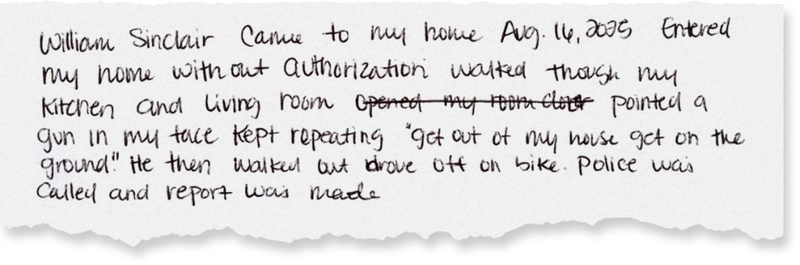
Some of them had sounded the alarm about Sinclair as early as last summer, when Gilbert Alapai applied for a temporary restraining order. In July, Sinclair showed up at Alapai’s house and swung a knife around, Alapai wrote in his TRO petition. On Aug. 16, Sinclair walked into Alapai’s home uninvited, pointed a gun in Alapai’s face and repeatedly said, “Get out of my house. Get on the ground.”
Alapai made a police report after Sinclair left that time, and his TRO petition was filed with the 5th Circuit Court on Aug. 18 and approved a day later. A Kaua‘i judge later granted a three-year harassment injunction.
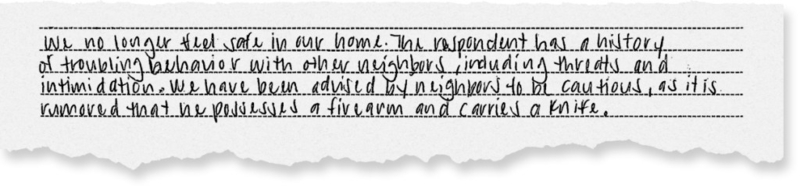
Neighbors Cassiah Linn and Leonel Calvan called police on Sinclair on Nov. 29 and 30. The couple has two dogs and their property shares a corner boundary with Sinclair’s. For two months, Sinclair’s dog had been coming over to another neighbor’s property, they wrote in their TRO petition. Their dogs would bark when that happened.
The first day, Sinclair came to their front door demanding to speak with the dogs’ owner, telling Calvan’s sister, who was visiting, “Tell your brother to take care of his dogs or I will.”
The next morning, Linn and Calvan’s dogs, who were in their yard, began barking after Sinclair let his dog outside. Sinclair immediately appeared in the neighboring yard, yelling threats. This time, when police responded, the officer recommended that Linn and Calvan get a TRO.
Later that day, Sinclair returned to that other neighbor's yard, yelled racial slurs and said, “I’m going to make your life a living hell,” Linn and Calvan wrote.
“We no longer feel safe in our home,” they wrote.
Linn and Calvan’s restraining order was approved on Dec. 1, just under an hour after being filed with the Fifth Circuit Court. A judge extended the TRO two weeks later and then granted a three-year harassment injunction the following month. All the TROs and injunctions specified that Sinclair was not to possess firearms.
Neighbors told Civil Beat they called the police on Sinclair numerous times and that they’d see police try to talk with Sinclair, but he’d often return to his house and tell police they couldn’t enter his property, making it difficult for officers to communicate with him. Some neighbors said they wanted police to search for Sinclair’s weapons.
Victorino of KPD confirmed that the department had received calls related to Sinclair prior to the death of Hernandez, who was his former tenant, though she would only respond generally since those calls are part of the active investigation.
“Depending on the situation, officers may document the incident, conduct further investigation, and advise individuals on available legal remedies, including Temporary Restraining Orders,” she wrote.
Dayslong Manhunt
Just before 1 a.m. on June 6, Kaua‘i police arrived at Hernandez’s workplace, Federico’s Fresh Mex Cuisine, in Hanalei. His girlfriend, Leslie Gomez, had found his body on the bathroom floor with several puncture wounds, and officers recovered a bullet behind a toilet.
Police learned through the restaurant's owners that Hernandez had an issue with his former landlord, but Gomez was the one who told them the landlord was Sinclair. She had lived with Hernandez at Sinclair’s residence — which is owned by Sinclair’s wife, Haley Belmonte — for five years.
Sinclair and Belmonte claimed Gomez and Hernandez owed $10,000 to $15,000 for property damages, Gomez told police. The renters offered to pay half that amount to someone who would perform the repairs, but Belmonte and Sinclair refused, Gomez said in a court document from the arresting officer describing KPD's efforts to arrest Sinclair.
A few hours later, police received a report of suspected reckless endangerment at Sinclair’s residence. Other callers reported hearing gunshots nearby. As police responded, they learned that Kīlauea resident Shey Ferguson had been grazed by a bullet.
Ferguson had stopped at the stop sign in front of Sinclair’s house and heard six gunshots before being struck by a bullet coming from the direction of Sinclair’s home, according to the court document.
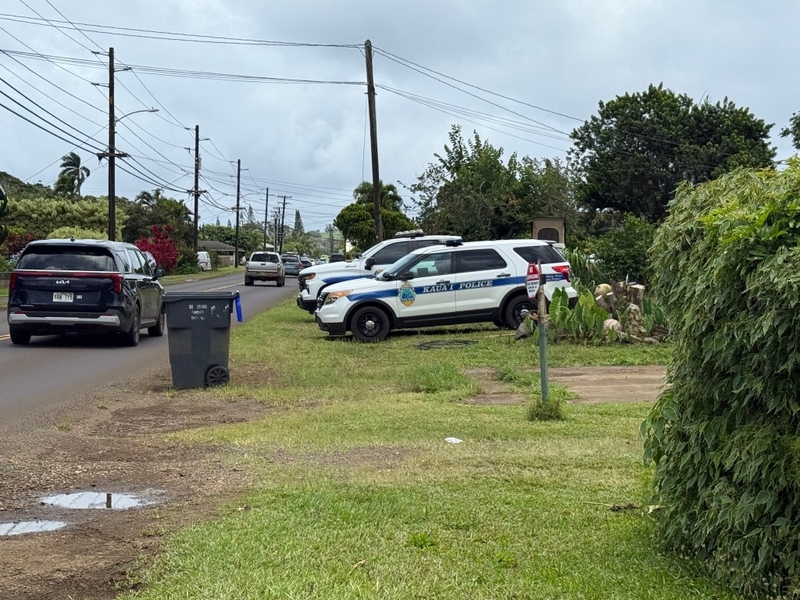
Police officers, including those from KPD’s Special Response Team, set up a perimeter around the house. One officer saw Sinclair exit with a rifle and then go back inside. Police began evacuating nearby neighbors at 6 a.m. and closed nearby roads.
It took nearly 12 more hours before police obtained a search warrant and began combing through the home and three vehicles. Officers were never able to make contact with Sinclair after he went back inside. They realized toward the end of their search that he likely snuck out the back. Police found multiple guns, ammunition, spent bullet casings, a wallet containing Hernandez’s identification cards and passport, and two sets of keys that Gomez later identified as Hernandez’s, according to the court document.
It took two days for police to catch up with Sinclair in Kapa‘a, where community members and officers reported seeing him walking toward the Kapa‘a pool and later toward the public library. As police closed in, Sinclair jumped into the ocean behind the library.
Today, Sinclair is being held without bail after pleading not guilty to the 28 charges against him.
Addressing Community Concerns
In hindsight, council member Felicia Cowden said it's clear police should have done more to address residents’ fears regarding Sinclair. She lives a couple minutes down the street from him and serves as chair of the council’s public safety committee.
She also said that Sinclair’s gun possession highlights a weakness in oversight for firearms removal and that more needs to be done to proactively reduce or eliminate the supply of illegal guns. At a minimum, police should conduct a property search when they receive complaints that someone with TROs against them has brandished weapons.
She’s coordinating a community discussion about the police actions — with the chief of police present — at the next Kīlauea Neighborhood Association meeting on July 7 at the Kīlauea Neighborhood Center.
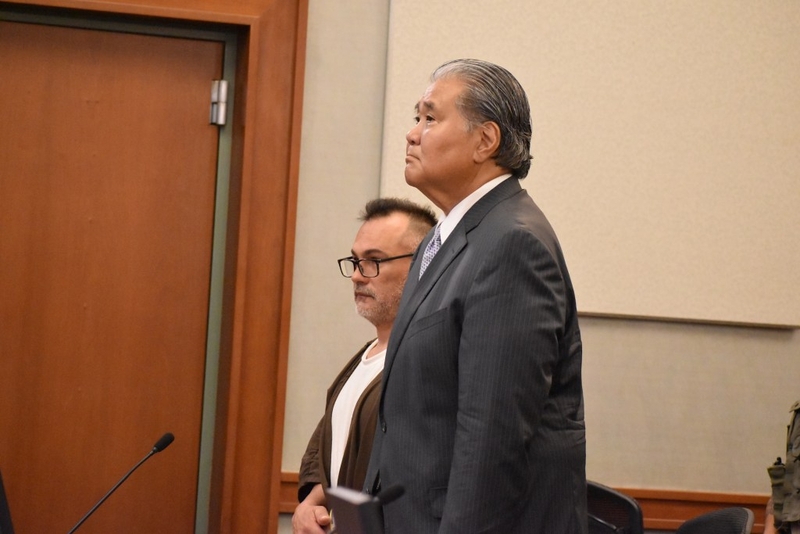
Keith Shigetomi, Sinclair’s court-appointed attorney, told Civil Beat that neighbors’ complaints about Sinclair were news to him and he finds it hard to believe that police wouldn’t do anything based on complaints that a specific person threatened someone with a weapon.
Shigetomi added that police didn’t assist Sinclair and his family when they made police reports about burglaries, property damage and threats while they lived at their Kīlauea house.
“Every time they would make a report to the police, they would downplay it or say ‘Well, you don’t have any proof of anything, so there’s nothing we can do,’” he said.
One Kīlauea resident who was threatened by Sinclair said she felt like a weight was lifted off her shoulder when Sinclair was apprehended. She asked that her name not be used due to safety concerns.
“We wanted him out of our community for a while,” she said.
Civil Beat's reporting on Kauaʻi is supported in part by a grant from the G. N. Wilcox Trust.

Honolulu, HI