Dozens object to rule requiring Arkansas libraries to restrict ‘sexually explicit’ materials
Jun 15, 2026 | 5:53 pm ET
Description
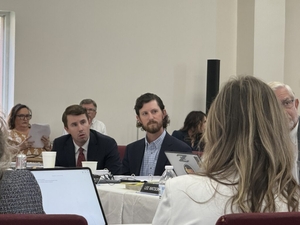
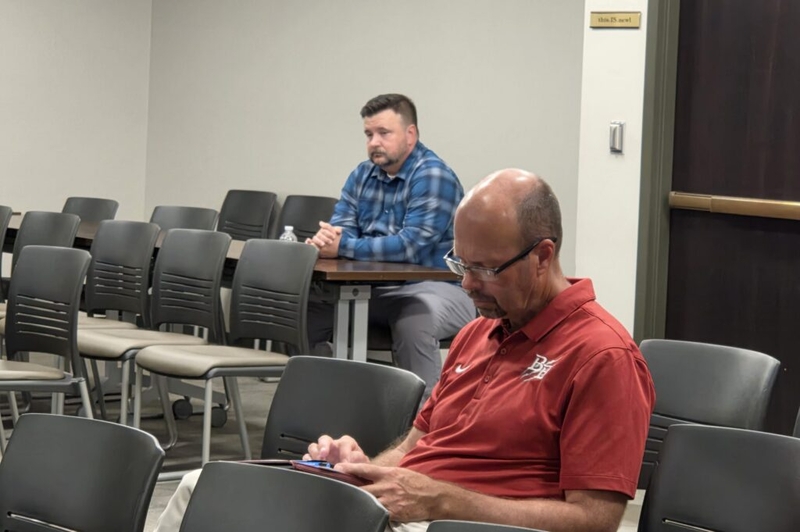
From left: Adam Webb, executive director of the Garland County Library, and Arkansas State Library Board Chairman Clay Goff listen to public comment on proposed rules for libraries to receive state funding at the Arkansas Department of Education headquarters on June 12, 2026. (Photo by Tess Vrbin/Arkansas Advocate)
Key points:
- Proposal would require libraries to ensure that children under 16 cannot check out “sexually explicit materials,” which depict or describe sexual contact and behavior as defined by federal law. It would also restrict access to materials that contain images or descriptions of human genitalia.
- The proposal includes an exception for children 11 and older to access “age-appropriate information designed to prepare minors for the sociology of puberty” with parental consent.
- Monday was the deadline for public comments on the proposal. If approved by the state Library Board, the proposal would go before a legislative committee to be finalized.
Dozens of Arkansans told the Department of Education that they oppose requiring public libraries to restrict children’s access to “sexually explicit materials” in order to receive state funding.
At least 62 people submitted concerns in writing by Friday about the draft rule requiring libraries to ensure patrons age 16 or younger cannot check out materials that depict or describe sexual contact and behavior. Monday was the deadline to submit public comments about the rule, proposed last month by the State Library Board.
“Arkansans do not lose their First Amendment rights at the library door, and the state should not condition funding on policies that violate those rights,” American Civil Liberties Union of Arkansas Legal Director John Williams said in a Monday statement.
The education department heard in-person public comment on Friday from four library employees, two of whom also submitted written feedback.
All comments mentioned the proposed content restrictions, and no comments expressed support for the rules.
“I’m not sure if it’s just all-around prudishness, or a hatred of LGBTQ people, or Christian nationalist-style repression. Maybe all three,” Laurel Owen wrote. “But book censorship has never been done by good governments. Ideologically it’s reprehensible.”
Arkansas Explained: Proposal aimed at restricting access to ‘sexually explicit’ library books
The Arkansas State Library Board worked on the draft rules with the education department and attorney general’s office. All six board members were appointed last year by Republican Gov. Sarah Huckabee Sanders in compliance with a 2025 law requiring the replacement of the previous board.
That law passed after a Republican-led proposal to abolish the Arkansas State Library met bipartisan opposition from lawmakers. The bill included library content restrictions similar to the draft rule.
State Library Board Chairman Clay Goff said Friday that he hopes the rules become final within the next month. This would require a special meeting of the board, since its next regular meeting is Aug. 14.
If approved by the board, the rules go to the Arkansas Legislative Council, the Legislature’s governing body when it’s not in session.
Legal and financial concerns
The proposed restrictions likely contradict federal court rulings against Arkansas’ previous attempts to govern library content, said Adam Webb, executive director of the Garland County Library and president of the Arkansas Library Association.
Webb is among 18 plaintiffs who challenged Act 372 of 2023, which would create criminal liability for librarians who distribute content that some consider “obscene” or “harmful to minors,” and give city and county governing bodies the final say over library content.
A federal judge blocked those provisions of the law in 2024. Three appeals court judges heard oral arguments last week and gave no indication of how soon they will rule in the case.
Webb said he also took issue with the rules’ requirement to “maintain operations that benefit the citizens served by the library and are consistent with the purpose of a public library” in order to receive state funding.
“This subjective standard is not a matter of financial accountability and could be applied selectively against libraries based on philosophical or political disagreements of the ‘purpose of a public library,’” Webb said.
Craighead County conservatives led a successful campaign to cut the local library’s funding in half with a 2022 ballot initiative. Supporters of the campaign previously opposed the library having an LGBTQ+ Pride display and hosting a transgender author’s visit.
Saline County voters will decide in November whether to cut about one-third of their libraries’ operating budget.
The draft rules could withhold state funding from Craighead County, Webb said, and from Saline County if its ballot measure passes.
“A public library must also maintain an annual operating budget equal to or greater than ninety five percent (95%) of the average of the three previous years’ annual operating budgets,” the rules state.
Most but not all Arkansas libraries receive state funds, and many have local taxes that support libraries’ operating budgets.
‘Arbitrary’ standards
The proposal includes an exception for children 11 and older to access “age-appropriate information designed to prepare minors for the sociology of puberty” with parental consent.
Several of the comments noted that many children start puberty before they turn 11. Calhoun County Library director Allie Gosselink said many of her 10-year-old daughter’s classmates have started puberty, and not all children feel comfortable discussing it with their parents.
“There is nothing shameful about the way our bodies have been created to function, and this restriction creates not only the perception of shame but a very real barrier to knowledge that girls deserve to have at the age at which it becomes relevant to their lives, not an arbitrary age decided by a rule,” Gosselink wrote.
I’m not sure if it’s just all-around prudishness, or a hatred of LGBTQ people, or Christian nationalist-style repression. Maybe all three. But book censorship has never been done by good governments. Ideologically it’s reprehensible.
Arkansas has among the nation’s highest teen pregnancy rates, and preventing a mother under the age of 16 from accessing information “ceases to be a rational course of action,” Gosselink said.
She and other library employees repeated their concerns that keeping certain books out of children’s reach in small, one-room libraries is logistically impossible.
The draft rule would also require libraries to “not knowingly promote or advertise sexually explicit materials.” State Library Board member Emmaline Pilkington, wife of a Republican state representative, said she did not want libraries to promote LGBTQ+ Pride Month and raise questions from her young children.
LGBTQ+ identities are not inherently sexually explicit, and Pilkington’s comment “illustrates exactly how the rules as written could clearly result in arbitrary enforcement,” said Michaela Huss, the Craighead County Jonesboro Public Library’s teen librarian.
Additionally, 30 clergy members submitted a letter, organized by the Interfaith Alliance of Arkansas, urging Education Secretary Jacob Oliva and the State Library Board “to reject these provisions and instead pursue policies that respect religious freedom, protect parental rights without limiting the choices of other families, preserve local control and professional library expertise, and ensure that Arkansas libraries remain welcoming places of learning for all.”
Editor’s note: The key points for this story were written by an Arkansas Advocate journalist.
Little Rock