WA lawmaker fights ethics charges in rare public hearing
Jun 10, 2026 | 7:00 am ET
Description
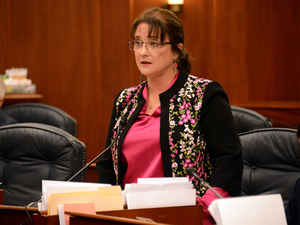
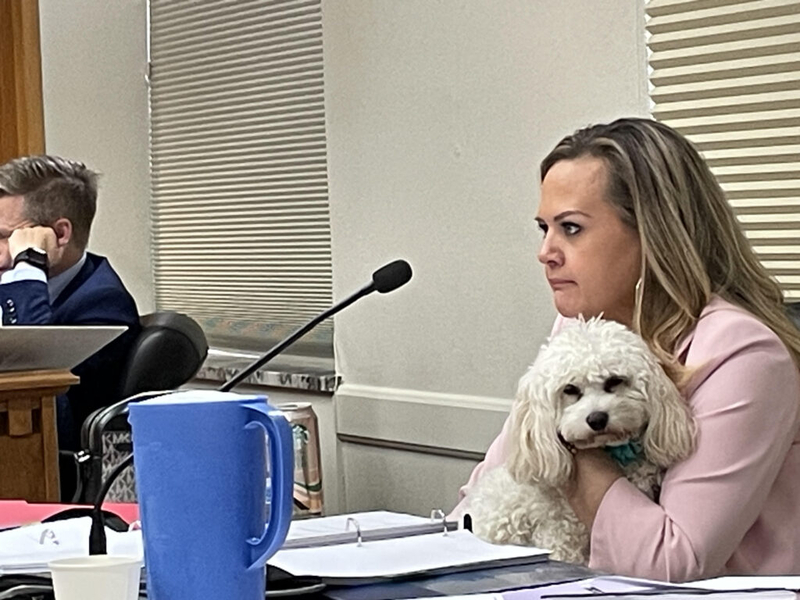
Washington state Rep. Tarra Simmons, D-Bremerton, listens to testimony during a hearing on allegations she violated state ethics laws on June 8, 2026. Simmons denies the charges. (Photo by Jerry Cornfield/Washington State Standard)
Washington state Rep. Tarra Simmons got her long-sought opportunity Tuesday to publicly defend herself against an array of ethics charges.
The Bremerton Democrat spent nearly three hours in front of a state panel, rebutting allegations that she improperly used her legislative position to help a friend get a job and to steer funding to a nonprofit where she worked.
Simmons insisted she’s been hypervigilant about complying with the rules since arriving in the Legislature in 2021. She said she was warned that, as the first formerly incarcerated person elected to state office, political foes would look for ways to derail her career and ethics complaints like these would be one.
“I’ve tended to be a little paranoid about it,” said Simmons, who was sentenced to about two years in prison in 2011 for drug-related and firearm charges. She represents the 23rd Legislative District in Kitsap County. “We have all kinds of relationships we have to manage all at once. It is important to be clear about what role we are in.”
Simmons’ testimony headlined a two-day trial-like proceeding conducted by the nine-member state Legislative Ethics Board.
Written closing statements will now be submitted. They are due by 5 p.m. on June 23. At that point, the board will begin deliberations and issue a final order within 90 days.
If Simmons is found to have breached ethics rules, she could be fined up to $5,000 per violation and ordered to pay the state’s costs.
State attorneys were ready to deliver final comments Tuesday. But Simmons’ attorney preferred to submit them in writing, knowing it would extend the process.
Attorney Doug McKinley said his client is “a very public person who’s accused in a very high-profile way” of an ethical violation.
“You want to be extra, extra careful to articulate why the board should not rule against her, and you can be a lot more careful and a lot more patient when you write it than when you give it orally at the end of a long day of testimony,” McKinley said.
Such hearings are rare. The last occurred a decade ago, and involved a House member’s posting of state-produced photos and videos on her campaign Facebook page.
The lead-up
A complaint filed in February 2025 incited a seven-month investigation that resulted in the board concluding last October that there was reasonable cause to believe Simmons violated the state’s Ethics in Public Service Act.
Over the ensuing three months, Simmons and the board discussed but failed to reach agreement on a settlement. In January, the board scheduled the hearing and released a 13-page order sketching out the underpinning of the board’s decision.
Allegations center on Simmons’ interactions with two nonprofit organizations: the American Equity and Justice Group and the Equity in Education Coalition.
Attorneys for the ethics board staff argued Simmons improperly leveraged her job as a lawmaker and a $10,000 donation of surplus campaign funds to help a man with whom she was involved in a relationship get a job with the American Equity and Justice Group.
Anthony Powers, the founder and leader of the group, testified Monday that Simmons introduced him to the man, Antoine Coleman, and pledged a donation to cover his salary if needed.
She “didn’t tell me I had to hire him,” he said. Though she didn’t place conditions on use of the money, he said it was his impression that if he hired Coleman it could be used to pay him.
Another charge arises from Simmons’ role in securing state grant funding in 2024 to support an expansion of a public dashboard of criminal justice data created by the American Equity and Justice Group.
As part of the grant, a subcontract was issued to the Equity in Education Coalition, where Simmons worked, to compile information on factors affecting education outcomes in disadvantaged communities. Assistant Attorney General Julia Eisentrout argued Simmons’ interest, even if it wasn’t financial, conflicted with the discharge of her official duties as a legislator.
Sharonne Navas, the coalition executive director, testified that Simmons was not paid with any money from the grant.
Simmons said that when she previously led a different nonprofit, Civil Survival, she sponsored bills that resulted in the group receiving state funds for programs, a portion of which went to pay her salary. She said she had been assured by House counsel and ethics board staff that the situation was not improper.
That connection, she said, was “way closer than the allegations being made here.”
‘We don’t want a part of it’
Kim Gordon, a Seattle attorney and a treasurer and board member with the American Equity and Justice Group, filed the complaint. She was the state’s first witness Monday.
Gordon said she submitted the complaint because “it had become clear to me that Representative Simmons was continuing to take steps down a path that caused me to have concerns about ethical violations and fraud.
“This was the way that I knew to make it really clear, ‘Hey, I don’t know if this is illegal. I don’t know if this is a violation of the ethics rules, but that path she’s on, she is going on without us,’” she said. “We don’t want a part of it.”
There was a dispute about the mechanics of the complaint itself. It asserted ethical violations dating back to 2023 but contained no specifics, which, McKinley argued, are required.
Gordon testified that before she filed the complaint, she consulted with Jennifer Strus, counsel to the ethics board. She said Strus told her that she did not have to provide details.
On Tuesday, Strus, under questioning from McKinley, confirmed talking with Gordon before the complaint was filed. But Strus denied telling Gordon that she did not have to provide any details in support of the allegations.
Olympia, WA