Ruth Fortune’s hopes for congressional primary ride in a tote bag
Jun 09, 2026 | 4:49 pm ET
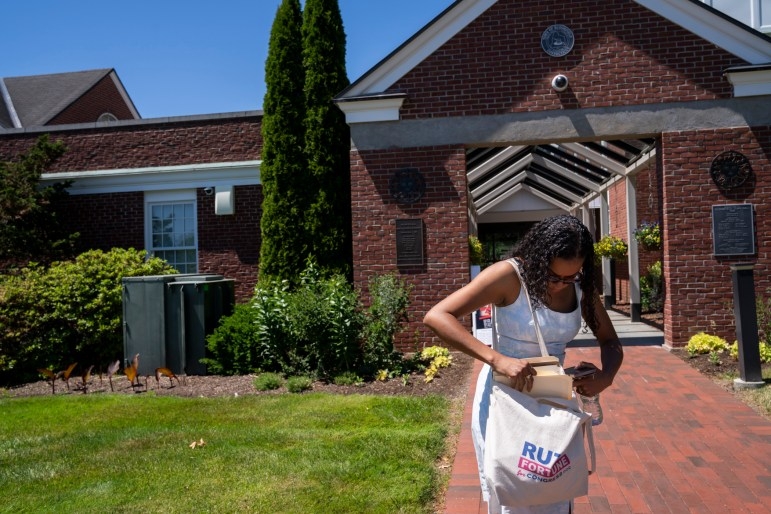
Description
Photo courtesy of CT Mirror
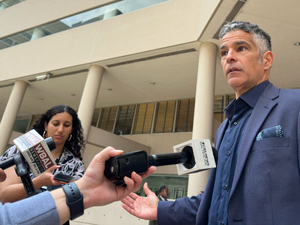
Inside the white canvas tote bag congressional candidate Ruth Fortune carried Tuesday to town hall in Bloomfield were 74 pages of signatures that volunteers and paid canvassers had collected over the previous 42 days, with a goal of making history by navigating Connecticut’s arcane petition process for ballot access.
Similar scenes were playing out throughout the 27 cities and towns of the 1st Congressional District on behalf of Fortune, a political outsider trying to become the first person to qualify via petitioning for a primary challenge against an incumbent congressman in Connecticut.
By Fortune’s count, her campaign has gathered roughly double the 3,743 signatures needed to qualify — 2% of Democrats registered in the district. The math is simple, but the rules relating to the collecting, filing and validating them are not.
With the extra names, Fortune is well-positioned to join U.S. Rep. John B. Larson, former Hartford Mayor Luke Bronin and state Rep. Jillian Gilchrest of West Hartford on the Aug. 11 primary ballot. The other three qualified by winning at least 15% of the delegate vote at a Democratic nominating convention last month.
But as Fortune is quick to note, the system has potential traps regarding the qualifications of petition circulators and petition signers.
“There’s a lot of hiccups that come up in the process,” said Fortune, a relative political newbie who now pronounces herself an expert on petitioning. “I’m probably now in the state one of the top five people with knowledge about this process, maybe top three.”
In one town that she declined to identify, the Republican registrar signed the forms that allow circulators to collect signatures in that community, telling her staff that either the Democratic or Republican registrar could sign. Fortune said state law seems to require that a Democrat sign the forms.
Before learning of the exchange, the forms signed by the Republican registrar were used to collect nearly 2,000 signatures. Now, Fortune says, she wonders if those names will be disallowed.
One of the other hiccups is that state law required registrars of voters to be available only from 1 to 4 p.m. Tuesday, the deadline for filing. Fortune tried to file some petitions Monday, only to find some registrars’ offices closed.

Her campaign still was collecting signatures Tuesday afternoon in East Windsor, taking advantage of that town’s third budget referendum in a month. Voters leaving the polling place already had been identified as registered voters; her campaign only had to make sure signers were Democrats.
In Bloomfield, the deputy Democratic registrar, Cindy Harrison-Odom, welcomed Fortune, counted the petition pages and gave her a receipt acknowledging the acceptance of 74 primary petition pages at 10:55 a.m. — five hours and five minutes ahead of the deadline.
“You did good,” she told Fortune. “Seventy-four pages is a lot.”
Bronin narrowly won the endorsement at the Democratic convention, giving him the top line on the primary ballot. Larson, 77, a 14-term incumbent facing a generational challenge from three candidates ranging in age from 38 to 46, is expected to be the beneficiary of a crowded ballot.
Larson was complimentary of Fortune, saying she’s “working her tail off” to qualify. He agreed that historically more candidates in the race tends to bode well for the incumbent.
“The question then becomes — there’s three progressives and one moderate, so is it the progressives that divide up the vote? Or is it the anti-incumbent that divides the vote? So it’s kind of a mixed bag,” Larson said as he exited the House chamber after votes Tuesday in Washington.
His campaign has tried to define Bronin as the moderate in the race, a description the former mayor rejects. Larson also has noted none of his opponents have identified votes they would have cast differently.
“So far, the only issue seems to be my age. I think all the opponents have said, well, they’d pretty much vote the same way I have,” Larson said. “I also expect that people with money are going to make this pretty negative.”
Only Bronin and Larson have raised significant money.
Registrars have a week to count and validate the signatures collected by Fortune’s campaign. They are recorded on pages attested as accurate by circulators in the presence of a notary.

Fortune explained to Harrison-Odom that her campaign ceased to have notaries use their stamps, which obliterated rows of signatures.
Instead, the notaries signed the pages.
Harrison-Odom nodded.
Voters had to print and sign their name and list their date of birth and street address. Fortune noted that she took pains to document when one circulator moved from one 1st District town to another for fear their signatures would be thrown out.
Fortune, 38, is an appointed member of the Hartford Board of Education, an estate lawyer comfortable with analyzing complex rules, and a Haitian immigrant prepared for unexpected contingencies, an instinct she says she’s honed as someone who came to the U.S. without legal status as a 12-year-old.
In a tote bag emblazoned with her campaign logo, Fortune carries a folder with her certificate of citizenship and a color photocopy of her passport identification page — a caution against ever being challenged by federal immigration agents.
“I hope I will never need it, but hope for the best, plan for the worst,” Fortune said.
Fortune said that however her petition drive ends, she will remain politically active in the cause of election reform. The process needs to be simplified, the barriers to qualifying lowered, she said. She will suggest changes to the General Assembly.
“I want them to reform this process,” she said.
Fortune was one of four congressional candidates who attempted petition drives to force Democratic primaries against incumbents: Kyle Gauck opposing Joe Courtney in the 2nd; Andrew Rice opposing Rep. Rosa L. DeLauro in the 3rd; and Joseph Perez-Caputo opposing Jim Himes in the 4th.
All but Fortune were falling short.
“We are officially terminating the campaign, because we know we’re not close,” Gauck said Monday afternoon.
Rice was making one last push Monday, pleading for help in a drive-time radio interview on WTIC radio, inviting them to join him at a library in Hamden to sign his petitions.
“It is a very challenging process,” Rice said. “We’re going to keep giving it our all until the bitter end.”
Rice, who complained that he was fraudulently denied 15% at his convention, said he will begin a new petition process — seeking a place on the November ballot as an unaffiliated candidate.
“I am looking to run as an independent, because I’m not going to go quietly,” he said.
CT Mirror reporter Lisa Hagen contributed to this story from Washington.
Hartford, CT