Looking at late Oregon Sen. Bob Packwood beyond the scandals
Jun 09, 2026 | 1:15 pm ET
Description
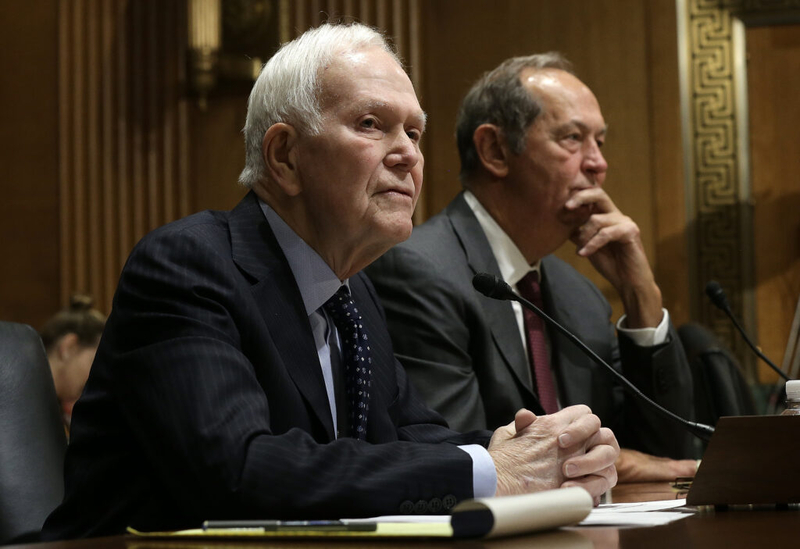
Former Sen. Bob Packwood (L) (R-OR) and former Sen. Bill Bradley (R) (D-NJ) testify before the Senate Finance Committee on Feb. 10, 2015 in Washington, DC. The committee heard testimony on lessons learned from the Tax Reform Act of 1986 during the hearing. (Photo by Win McNamee/Getty Images)
After Robert Packwood, the long-time U.S. senator from Oregon, died last weekend, news stories about him flowed around the country. Most had a common theme.
Many led with, and focused on, the tawdry and extensive sexual harassment and abuse scandals that in 1995 ended his Senate career. “Maverick Republican Sen. Bob Packwood of Oregon, who resigned after sexual harassment scandal, dies” … “Bob Packwood, longtime Oregon Senator marred by scandal, dies at 93“ — headlines like these were standard fare.
They weren’t factually wrong, and the implosion of Packwood’s political career probably did bring him to the attention of people around the country who hadn’t been as aware of him before.
The now-incumbent senator who replaced Packwood, Ron Wyden, said in a statement, “His horrible history as documented in his own diaries will forever overshadow that public record. Simply put, historians’ first line about Bob Packwood must include those women who he abused and assaulted for years and years.”
Without minimizing the long-running history of abuse, or the fact that he resigned in face of likely expulsion, I’d still beg to differ. The heavy emphasis on the end of that career does disservice to a fair consideration of the rest of his long career, which carries reverberations and lessons worth considering today.
Packwood was a tough politician; he won the Senate seat by defeating incumbent Democrat Wayne Morse. There’s some irony in how Packwood’s departure paved the way for Wyden.
Packwood was part of what many Oregonians look back on as an era of broadly popular high-level Republican office holders; another irony is that they — along with officials including Mark Hatfield, Tom McCall and Vic Atiyeh — didn’t get along very well. But they all believed in governing effectively and between them shaped much of what Oregon is today.
Packwood was a strong partisan Republican — his first big visibility splash came as the young chair of the Multnomah County Republicans, then a powerful and successful group. But like his fellow Oregon leaders of the ’70s and ’80s, Packwood made strong efforts to work across the aisle with Democrats, and he was willing to bolt from his own party’s orthodoxy in ways that might be almost unthinkable today.
Packwood’s many years in the Senate give him the seniority needed to wield serious clout. He made the most of his two brief chairmanships of the Senate Finance Committee, both for Oregon projects and in major national issues. He was on the leading edge, at some point along in the Senate, of attempts to legalize abortion before Roe v. Wade.
He was a major leader in environmental causes in Oregon, a critical backer of the Hells Canyon National Recreation Area Act among other things. He actively pushed legislation and visibility for issues ranging from solar energy to bike paths, causes that in many cases were years ahead of their time.
Then there was tax law, of which he was a master. An extremely skilled legislator highly adept at cutting deals, he may have hit his legislative peak with a massive tax bill in 1986 that broke through what had looked like an impermeable thicket of opposition, persuading many central players — including President Ronald Reagan — to think about tax structures in different ways.
Could a Packwood replicate that kind of activity now? It would be more difficult. Even Wyden, who throughout his Senate career has emphasized bipartisan efforts more than most senators, has had successes but also difficult periods in this time of hyperpartisanship.
Packwood’s take on partisanship was reflected in a Republican Party activity that long outlasted his Senate career: The Dorchester conference. Packwood, then a state legislator, founded the annual event at Lincoln City in 1965. His motivation was to form a countering force to the Goldwater Republicans, and invitations to the first meeting warned, “Far right-wingers will be deliberately excluded.”
Over the decades, Dorchester drew not only most of the major Republican figures from around Oregon, but many prominent national leaders as well. The conference for many years had outsized influence in the party. More than six decades later, it continues on.
The Republican Party of today is different from that of Packwood’s day, and so is the Dorchester, and for that matter so is the U.S. Senate.
The dark side of Packwood’s record won’t be missed, and shouldn’t be avoided in telling his story. But it’s not the whole of the story, and the brighter side has ideas and approaches that even today could be worth revisiting in making our way through darker days.
Salem, OR