The trans-Alaska pipeline paid taxes. So can the LNG.
Jun 09, 2026 | 4:00 pm ET
Description
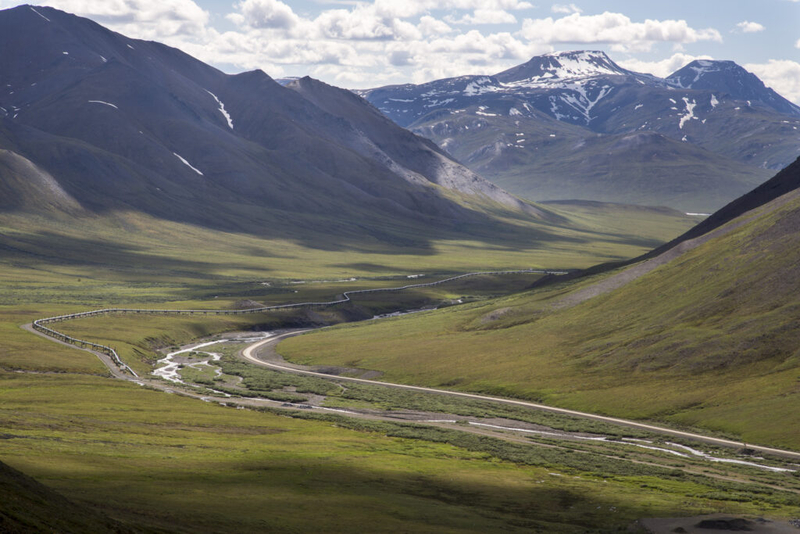
The trans-Alaska pipeline and Dalton Highway are seen on July 4, 2014, in the Brooks Range area near the pipeline's Pump Station 4, about 270 miles south of Prudhoe Bay. (Photo by Bob Wick/U.S. Bureau of Land Management)
I have heard talk of a North Slope gas pipeline since my childhood. Growing up in Fairbanks around adults who built the Trans-Alaska Pipeline System, I saw how it gave them financial security, so I planned on joining Laborers’ Local 942 to be part of the gas line construction. I became a camp tradesman and teacher instead. And while I want a new gas line, I do not want to give pipeline developers the huge tax cuts they say are necessary to make the project financially viable, especially when they don’t have international LNG buyers lined up. That is the deal Alaska lawmakers are considering now with House Bill 381.
History matters here. The trans-Alaska pipeline was not built because Alaska handed the Alyeska consortium a 90% tax cut. It was built because the consortium companies financed the roughly $8 billion construction — that’s in 1970s dollars — themselves.
The deal with Alaskans was simple: you build it, you pay your taxes and we share the wealth. That deal built modern Alaska.
What is being asked of us today is the opposite deal. Glenfarne is telling Alaska’s Legislature that a $1 billion annual property tax break is required to build a project described as economically viable one year ago by Governor Mike Dunleavy, the Alaska Gasline Development Corporation’s CEO and Glenfarne’s own CEO. As Senator Giessel has correctly named it, this would be “a huge give,” particularly when Alaska needs money to keep itself functioning.
Alaskans are being pushed to lock in a 36-year, approximately $13 billion loss to the Fairbanks North Star Borough, Kenai Peninsula Borough, the North Slope Borough, and every community in between by a Lower-48 company, a lame-duck governor and yet another Begich. Compare this to the trans-Alaska pipeline’s construction, where severance taxes and property taxes on the pipeline itself were paid in full, and there was an actual demand for the stuff.
We are being told to move “swiftly” by a governor whose political future is tied to his “friend” Donald Trump’s energy dominance rhetoric, by a New York developer with no previous experience with an LNG export project at this scale and by lobbyist Mark Begich.
“Swiftly” is a word con artists use to manufacture a sense of urgency and pressure their victims into impulsive financial decisions. We weren’t swift in the 1970s. We were stubborn, suspicious of outside money and protective of the state’s leverage. That is an Alaskan tradition worth defending right now — especially in an era when federal guardrails against corporate self-dealing are being actively dismantled in Washington.
If Alaska LNG is the genuinely transformative project its sponsors claim, it can carry a fair tax. If it cannot, then no amount of municipal sacrifice in Nenana, North Pole or Nikiski will make it pencil out — but Alaskans will have given away our present and future leverage and received a stranded asset in return. Alaskans deserve full financial disclosure from Glenfarne before any tax structure is set. I stand by the principle the pipeline generation fought for: Alaska’s resources belong to Alaskans first.

Juneau