Arizona ranks among worst states for bilingual preschoolers, new report finds
Jun 08, 2026 | 1:30 pm ET
Description
(Photo via Getty Images)
Despite being one the states with the highest number of bilingual children, Arizona is one of the worst states for them to go to preschool.
A new report from the National Institute for Early Education Research found that the Grand Canyon State is among the states with the fewest supportive policies in place for students who are learning English at the same time as they are speaking another language at home, which hampers their ability to succeed in the long run.
According to the Migration Policy Institute, more than 1.8 million Arizonans aged five and up speak a language other than English, with the vast majority of them speaking Spanish. Across the country, one-third of young children under five are dual language learners. And that proportion is only expected to keep growing.
While Arizona ranks in the top 10 states with the highest number of bilingual students, a significant percentage of them aren’t able to access state-funded preschool. Alexandra Figueras-Daniel and Allison Friedman-Krauss, the report’s authors, posit that the reason for that is an insufficient eligibility process. Many state-funded programs focus on income eligibility, which may loop in some bilingual children, but few programs actually ask what language is used at home.
The eligibility criteria to attend Arizona’s state-funded preschool programs similarly don’t include a non-English background, and the result is a bilingual student population that falls far short of the state’s actual number of bilingual children. Just 23% of students in Arizona’s state-funded preschool programs are dual language learners. But 41% — nearly double the number of bilingual kids in preschool — of all three- and four-year-olds in the state are learning at least two languages.
There’s also a distinct lack of policies in Arizona preschools to ensure bilingual students are reaching educational benchmarks. Some preschools require a written plan to support dual language learners, mandate bilingual staff once the population of dual language learners reaches a certain percentage or place dual language learner students in classes with students who speak their same home language. Arizona’s state-funded preschool model has just one supportive policy: the ability to provide bilingual instruction. That might mean monolingual non-English classes, dual language immersion classes or a transitional bilingual program.
On top of having a lack of supportive policies for dual language learners, Arizona’s state-funded preschool programs fall short in overall quality, according to a country-wide analysis performed by the National Institute for Early Education Research. The organization established 10 benchmarks to categorize preschool programs that includes a staff to student ratio, a preschool teacher’s required educational level, and the number of hours a year staff must undergo professional development, among other criteria.
Arizona met just three of those benchmarks, which were the use of classroom observations to improve the instructional quality over time, the use of culturally sensitive and comprehensive curricula and an existing process to select and implement teaching curriculum.
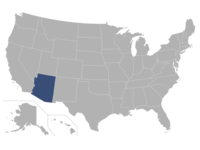
Phoenix, AZ