Don’t forget who imposed chaos on Alabama’s elections
Jun 08, 2026 | 5:59 am ET
Description
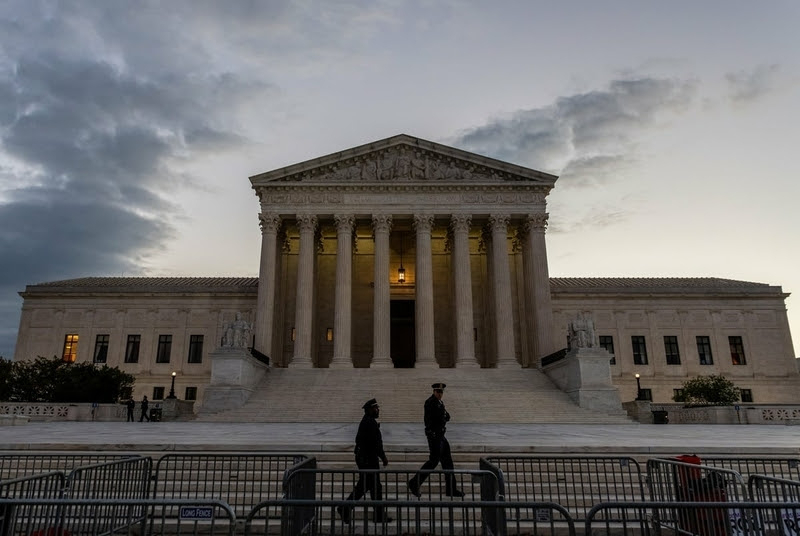
The U.S. Supreme Court. The court on Tuesday allowed Alabama to use a congressional map previously deemed racially discriminatory. (Photo by Jane Norman/States Newsroom)
Here’s the word in the Supreme Court’s Allen v. Milligan decision that got me mad.
Interposed.
Don’t get me wrong. The whole ruling on Alabama’s congressional districts is infuriating. The use of definite articles is the only thing the court did right. If you care about popular will and representation, well, the nation’s high court doesn’t. Particularly when Black Americans vote in ways six conservative justices don’t like.
But look at “interposed” in its full context, in the unsigned order:
“Here, the District Court interposed itself into Alabama’s ongoing efforts to conduct its imminent 2026 congressional elections under maps that its elected representatives selected . . . While federal courts should not impose changes close to an election, states are free to decide for themselves whether last-minute changes to an election are in their best interests.”
It’s hard to know where to start. How about the sheer irresponsibility of this statement? The court just told every political party in power in this country that if voters might take their jobs away, election laws can be disregarded. That’s not how democracy works.
Then there’s the naked partisanship. Consider: The Supreme Court in 2022 first invoked the Purcell “principle” — ostensibly about preventing confusion over elections — after a three-judge panel of U.S. Circuit Judge Stanley Marcus and U.S. District Judges Anna Manasco and Terry Moorer ruled that Alabama’s congressional maps prevented Black voters from having a voice in their governance.
Supreme Court allows Alabama to use 2023 congressional map in August special primary
The high court found it necessary to delay that ruling for over a year. Past the 2022 midterms, where it could have hurt Republicans.
They let it go into effect in 2023 after the Republican House leader said in the open that they would defy it. (Only white conservatives get to tell off the judiciary without consequences.) But once they had a chance to rule on Louisiana v. Callais, an abomination of a Jim Crow lawsuit, they started coming for Alabama.
First, they all but annihilated Section 2 of the Voting Rights Act. It wasn’t enough for Americans deprived of their voting rights to show discrimination. No, they had to show that the Legislature intended to discriminate against them.
Even worse: the courts have to presume that a Legislature drawing up a map to cut minorities out of government is working in good faith. (Read the Milligan opinion again; whichever justice wrote it is beside themselves with rage that a court of law could question the sincerity of the Alabama Legislature, which has spent the better part of 207 years attacking minorities.)
Justice Samuel Alito wrote in the Callais decision that it did not affect the Milligan ruling, which gave something like an equal voice to Black Alabamians in the state’s congressional delegation.
But the court reversed itself once Alabama’s white officials demanded it.
The Legislature rescheduled primaries, throwing out thousands of votes. A system that worked in every way except for not guaranteeing complete Republican domination was tossed at the last minute. Voters’ needs? Preferences? The Purcell “principle?” Irrelevant.
The Alabama attorney general’s office even had the chutzpah to argue that its earlier refusal to obey the federal courts was actually a noble effort to avoid discrimination.
Manasco, Marcus and Moorer saw this for what it was.
Over the course of five years, the three have been judicious with a complex case. They have weighed constitutional demands and administrative realities. Their rulings were not exactly what those challenging Alabama’s shenanigans sought. But they were reasonable, defensible and reflective of the facts. The panel showed a seriousness of purpose that honors their profession.
Last month, the judges pointed out that the current map is “race-blind,” an alleged requirement of Callais. They also showed how even the most doe-eyed review of the evidentiary record condemned Alabama’s actions.
There’s clear evidence of racial discrimination. And blatant evidence of bad faith from Alabama officials. They refused to obey directives from the judiciary. Once they told the trial court they needed months to implement a congressional map that assisted Democrats. When they could use a map benefiting the GOP, those obstacles evaporated.
“The reason the district court found intentional discrimination even after affording such deference to the Alabama Legislature is simple: The record is crystal clear,” Justice Sonia Sotomayor wrote in dissent. “Even if Alabama may have unintentionally drawn the first racially discriminatory map, when it later adopted redistricting criteria that made it mathematically impossible to remedy racial discrimination, the district court drew the obvious (and certainly not implausible) inference that Alabama intended to discriminate.”
To find otherwise, Sotomayor’s colleagues had to ignore the law, the evidence and the Constitution.
The Supreme Court let Alabama chuck people’s votes to allow Republicans to chase U.S. Rep. Shomari Figures out of office. It allowed a late revision of the laws — almost certain to cause chaos — for partisan advantage.
And they did it with all the shamelessness and hypocrisy of the Supreme Court’s worst decisions. Six unelected commissars decided their will matters more than the law or the voters. That’s interposition.
Montgomery