The litmus test that Democrats, and independents, are faced with in Platner’s Senate bid
Jun 05, 2026 | 5:00 pm ET
Description
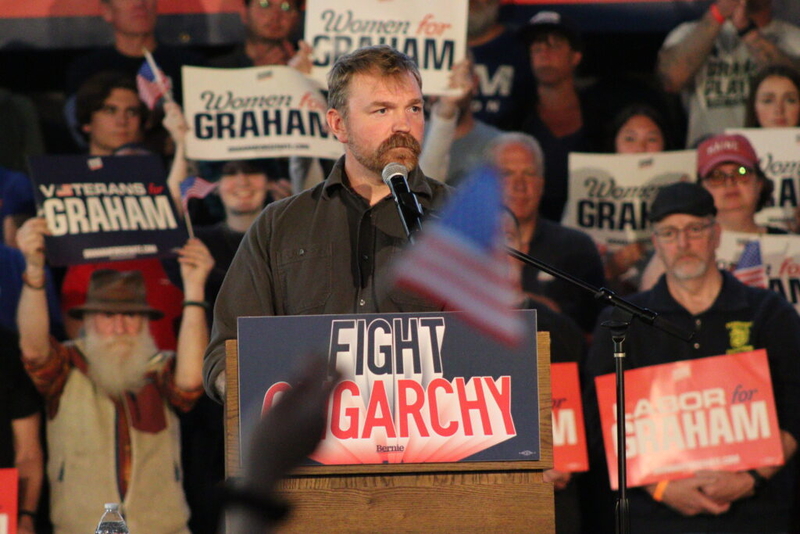
U.S. Senate candidate Graham Platner speakers to Mainers on May 25, 2026, in Portland at a rally with U.S. Sen. Bernie Sanders of Vermont and gubernatorial candidate Troy Jackson. (By Emma Davis/ Maine Morning Star)
The latest controversies involving U.S. Senate candidate Graham Platner present a test of how much Maine voters will weigh his personal life against the policies he’s advocating for.
That’s a question not only for Democrats voting in the semi-open primary on Tuesday but also independents.
The political newcomer has urged more focus on policy issues this week, following accusations of extramarital sexting and “unsettling” behavior from his exes. Voters who Maine Morning Star spoke with are mixed, but several said the latest revelations aren’t changing their calculus. With the seat long held by incumbent Republican U.S. Sen. Susan Collins seen by Democrats as key to flipping the balance of power in Congress, some say those larger stakes take priority.
“I can’t imagine that I won’t vote for Platner in the general,” said state Rep. Allison Hepler (D-Woolwich), who had endorsed Gov. Janet Mills in March and still plans to vote for her in the primary.
When Maine Morning Star talked to Mills’ supporters after she suspended her campaign in April, some were quick to emphasize that she didn’t drop out. That foreshadowed her response last weekend, when she reminded voters that she will still be on the ballot, though her campaign hasn’t responded to questions about whether they’d actually restart the campaign. The secretary of state’s office confirmed votes will still be counted for her.
The tools available to assess whether these latest controversies are impacting Platner’s popularity are imperfect but there are signs he’s maintaining support, as he has since the first offensive online statements came to light, so much so that Mills suspended her campaign, citing a lack of funds.
Platner’s campaign reported a fundraising surge since the sexting accusations on Saturday. A Tuesday memo said fundraising since Saturday was 17% higher than the previous four-day period, and that small-dollar donations jumped 27% compared with the week prior.
What voters are saying
Dresden resident Alfred Beattie, a Democrat, has gone back and forth on whether to back Platner.
After Platner’s first big rally with U.S. Sen. Bernie Sanders in September, Beattie thought his mind was made up. He liked that Platner didn’t speak like a politician and understood the average working person’s struggles. In November, after the initial revelations about Platner’s controversial comments came to light, Beattie was undecided again but leaning toward Mills. With her, he’d said, he knew what he was going to get.
After Mills suspended her campaign, Beattie started considering lesser-known Democrat David Costello, who lags far behind in polls and fundraising. But on Friday, Beattie said he plans to vote for Platner.
“My individual wants and desires in a candidate go a little bit lower in priority as opposed to just getting a Democratic candidate to beat Susan Collins,” Beattie said. “It’s too much of a high stakes election.”
Platner hasn’t denied that he sent sexually explicit messages to other women early in his marriage as first reported by The Wall Street Journal on Saturday, but said he and his wife have worked through it and he believes they deserve some privacy.
On Thursday, some of his exes recounted “unsettling” behavior to The New York Times, including Lyndsey Fifield, who has worked for GOP campaigns and causes, who claimed he bragged about having a Nazi tattoo and grabbed her by the shoulders. Platner denied those accusations, telling MS Now Thursday night “these are the statements of someone who is politically motivated.”
These accusations follow earlier revelations in the fall of a litany of offensive online comments he made between between 2009 and 2021 and his now-covered Nazi-linked tattoo, a connection one of his exes alleges he’d long known but Platner has denied.
Amid these controversies, some Maine voters have urged a focus on policy issues instead, as Platner himself has.
“They’re calling Platner a secret Nazi,” Beattie said, “but Collins is the one who basically gave Trump whatever he wanted when it came to rounding up illegal immigrants.”
At the same time Platner gave his first interview to MS Now since the New York Times story, Collins cast her 10,000th consecutive vote, setting a Senate record, and received tributes from her colleagues, notably including Democratic U.S. Sen. Chuck Schumer of New York. In that vote, Collins crossed the aisle and supported an unsuccessful Democratic bid to send her party’s immigration bill back to committee to add a requirement that the government investigate losses and denials of Medicaid benefits, before ultimately backing the final package.
Even if they don’t plan to vote for her, some Maine voters commended Collins’ appropriations and negotiating power. Hepler, the state representative from Woolwich, noted the federal funding Collins has secured for Maine, specifically for the working waterfront which has helped her coastal district, as well as Collins pushing to restore the sea grant that finances research and supports jobs.
Hepler, who introduced Platner at a packed town hall in Phippsburg last week, said one of her long-standing concerns about him has been his lack of experience in elected office. She also questions why Democrats couldn’t have vetted him better, noting that she knows people who could champion the same progressive stances but don’t come with the baggage.
Brunswick resident Sophie Creamer, an independent, is in part drawn to Platner because of how he’s engaged in politics outside of elected office.
“It means something that Graham is coming to this as someone who has done community organizing,” Creamer said, pointing to Platner’s work previously leading efforts through a local political group called Acadia Action. Creamer had been skeptical of Platner at first but decided to back him after a one-on-one conversation in which he repeated an aim he often has on the campaign trail — that he views his Senate bid as a means to building a broader organizing campaign.
When asked about the latest accusations, Creamer said, “peace and love, what does this have to do with his policies?”
“I’m voting for him because I am a conscious person and I need to be voting in elections,” Creamer said, “but I’m doing it from the standpoint of he is going to be someone that would be more allied with me in organizing than Susan Collins.”
While ultimately up to voters, Mark Brewer, chair of the political science department at the University of Maine, thinks what people have done personally matters politically. “It gives you a window into how they live their lives and what they might look like as public servants,” he said.
Platner’s rise is not a new phenomenon. Brewer pointed to the long history in the U.S. of insurgent, populist candidates capturing public attention, including Trump and former Maine Gov. Paul LePage, who is now running for Maine’s 2nd Congressional District.
“Things that would have been in many ways instantaneously disqualifying 20 years ago no longer are for any candidate,” Brewer said.
He credits that to three things: Trump changing the bar, social media and Democrats’ frustration with their own party leadership and desire for representation outside the establishment.
The independent question
While Maine’s U.S. Senate race has highlighted tensions within the Democratic party, there’s also another block of voters that could be consequential in Tuesday’s semi-open primary and later in the general election: those unenrolled with a political party.
That bloc, Democrats and Republicans each make up roughly a third of registered voters in Maine. The state started having semi-open primaries in 2024, meaning voters unenrolled with any party can vote in the Democratic U.S. Senate primary, if they so choose.
Independents, the fastest growing group of voters in the country, are often the decisive vote in close elections, said Jeremy Gruber with Open Primaries, a national organization pushing for increased access for independent voters in primary elections that was a key leader in the effort to create semi-open primaries in Maine.
“They are the most unpredictable of voters, which give the political class constant agita,” Gruber said, “but they are a robust force in terms of forcing candidates to be responsive to where voters are if they’re going to be successful.”
The latest Pan Atlantic Research Survey, conducted before the most recent controversies, had Platner up against Collins among independents 48% to 35%. Overall, polls have found Platner in the lead against the incumbent, as well as lesser-known Democratic challenger Costello. Andrea LaFlamme is also mounting a write-in campaign.
But, notably, the last time Collins was up for reelection, she defied polls that had heavily favored Democratic challenger Sara Gideon. Collins overcame a record amount of money spent against her and drew strong support from Republican and unenrolled voters.
“If we look at general elections, we know that the unenrolled voters have a big impact,” Brewer said. “In a primary, we don’t know yet. We’re going to get a good data point.”

Augusta, ME