Federal judge presses attorneys on how Idaho’s transgender bathroom ban will work
Jun 05, 2026 | 4:57 pm ET
Description
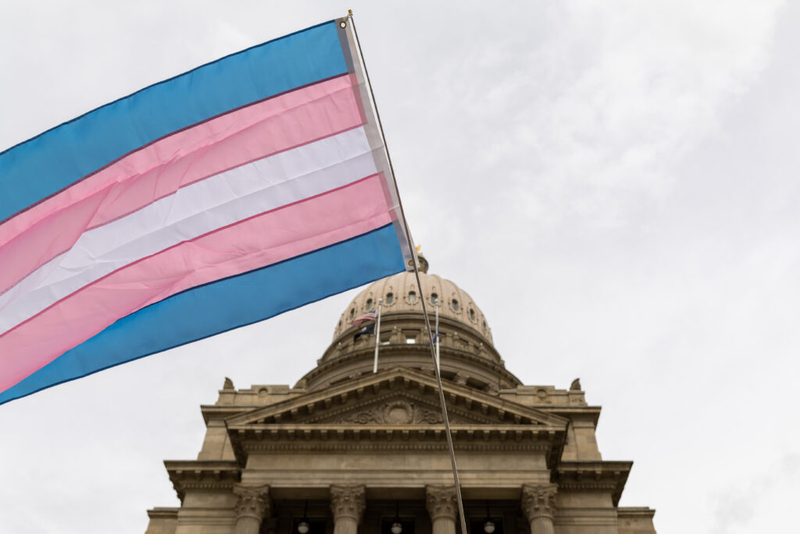
At a Transgender Day of Visibility rally on March 31, 2026, in front of the Idaho State Capitol in Boise, a person holds a transgender pride flag in front of the state Capitol. (Photo by Kyle Pfannenstiel/Idaho Capital Sun)
As a federal judge considers whether to temporarily block Idaho’s new transgender bathroom ban law that will apply to private businesses, attorneys delved into how law enforcement would enforce the law at a court hearing Friday.
The lawsuit was brought by six transgender Idahoans over House Bill 752, which passed the Legislature this year with support from only Republicans and is set to take effect July 1. The law will create criminal charges — with repeat offenses punishable by a felony that carries up to five years in prison — for people who “knowingly and willfully” enter a bathroom or changing room designated for the opposite sex, with some exceptions.
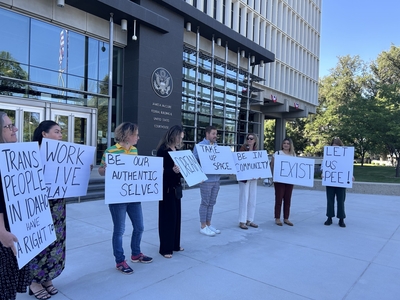
Kell Olson, an attorney for Lambda Legal representing the suing trans Idahoans, argued that the law doesn’t make Idahoans safer than they already are today. But he argued the law threatens trans people’s safety.
“HB 752 does make Idaho less safe for transgender people,” Olson told the judge. “It threatens serious and immediate harm, no matter what trans people do.”
The lawsuit seeks class-action protections to prevent the law from blocking transgender people from using bathrooms that align with their gender identity. But the lawsuit doesn’t seek to prevent the law’s restrictions on changing rooms.
Idaho Solicitor General Michael Zarian, who’s representing Idaho Attorney General Raúl Labrador and county prosecutors, argued that the law echoes a longstanding policy position to protect people’s naked bodies from being seen by others, especially people of another sex, and to have sex-seperated bathrooms.
“The point is not that transgender people are more likely to commit safety violations. The point is that men in women’s restrooms are more likely to commit safety violations,” Zarian said, adding that sometimes men pretend to be transgender to access women’s spaces.
He argued that the law protects privacy. Zarian said people are at least partially unclothed in bathrooms, that bathroom stalls have gaps, and that the Legislature was responding to incidents around the state where people felt uncomfortable.
The federal judge, Chief U.S. District Judge for the District of Idaho Amanda K. Brailsford, said she’d quickly issue a ruling on whether to grant a preliminary injunction, which could block the law throughout the lawsuit.
Idaho’s trans bathroom ban is latest in a series of anti-trans laws passed by Legislature. Some say they’re moving out of state over it.
The bathroom ban is one of the latest in a series of anti-trans laws passed by the Idaho Legislature in recent years. Idaho’s 2020 law that bans trans women and girls from competing in sports that align with their gender is awaiting a ruling by the U.S. Supreme Court. Idaho’s 2023 trans bathroom ban in public schools took full effect last month. A high school group challenging the law dropped its lawsuit after a trans student part of the group died by suicide, the Idaho Capital Sun previously reported.
The trans bathroom ban has pushed some to plan to move out of Idaho, including a Boise family of medical professionals that raised their trans daughter in Idaho and one of the trans Idahoans suing over the law.
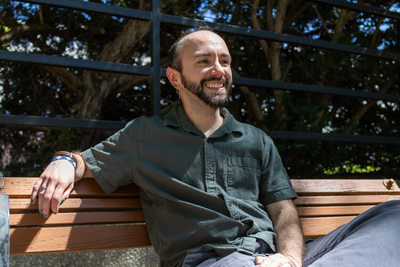
Diego Fable, who is part of the lawsuit, says the bathroom ban is pushing him to move out of Idaho, where he’s lived for the past decade. In an interview Thursday, he told the Idaho Capital Sun that he felt like if lawmakers’ goal was to drive trans people out of Idaho, then “they’re probably going to find they’re losing more than they expect.”
“Boise once touted itself as kind of being a place of personal freedom and being able to live like how you want, without government overreach,” Fable said. “And now … here I am leaving the state exactly because they were doing the opposite.”
The American Civil Liberties Union says that Idaho’s bathroom ban is the only state ban that extends to private businesses — and that Idaho’s ban has the steepest penalties out of the three states that have criminal bathroom bans.
A 2025 study by the UCLA’s School of Law’s Williams Institute found there was no evidence that people face more harm if transgender people are allowed to use bathrooms that align with their gender identity. But when trans people are refused access to facilities that align with their gender, the study found that trans people report verbal harassment and physical assault.
How would law enforcement enforce Idaho’s trans bathroom ban? Checking IDs and DNA testing can be tricky, attorneys say
To prove someone is using the bathroom of another sex, officers might want to check people’s identification cards. But that can be tricky, the judge suggested.
For a Boise family of medical providers, Idaho criminal trans bathroom ban was the last straw
Olson, a trans man, told the judge that if officers asked for his ID card, it lists him as a male. Then Brailsfield noted that most of the suing transgender Idahoans have state-issued ID cards that align with their gender identity.
Zarian, the Idaho solicitor general, suggested to the judge that enforcement of the law would be easy “because there is DNA testing.” When the judge pressed him on whether a trans person will need to consent to that testing, Zarian said not necessarily but that he doubted that people will be asked to undergo DNA testing on the spot. But Olson said DNA testing largely requires a warrant.
After the hearing, ACLU of Idaho attorney Emily Croston said the state hadn’t clearly laid out how the law will be enforced.
“I don’t think the state has an answer for how you identify someone’s biological sex,” Croston told reporters. “… Are we just going to look at folks as they enter a restroom and determine whether we think they look enough like a man or a woman? That’s ridiculous.”
The arguments were part of one of the lawsuit’s core claims: That the law is unconstitutionally vague. And the debate over how to enforce the law highlights concerns that law enforcement groups flagged in the Legislature.
“Officers responding to a complaint would be placed in the difficult position of determining an individual’s biological sex in order to enforce the statute,” Idaho Fraternal Order of Police President Bryan Lovell wrote to lawmakers. “In many circumstances, there is no clear or reasonable way for officers to make that determination without engaging in questioning or investigative actions that could be viewed as invasive and inappropriate.”
After the court hearing, Olson told reporters he talked about how the bathroom ban would affect him as a transgender man “to paint a picture of what the practical operation of this kind of law means, and what it means in someone’s daily life.”
“If I just go to a restaurant with my family and want to wash my hands before dinner, this law comes into play. Now I have to stop and decide, do I — if this law is in effect — do I go into the restroom that is illegal now, the men’s room?” Olson said. “Or do I walk into the women’s room and take all of the risk that that now comes with, whether that’s assault or harassment, or someone calling the police, because now it looks like I’m violating the law.”
Zarian, the attorney for the state, also delved into one of the law’s exemptions that allows people to use restrooms of another sex if they are in “dire need” of going to the bathroom.
Pressed by the judge, he acknowledged that it “might be difficult to prove someone had a dire need,” but he said that doesn’t prove that the law itself is vague.
Boise, ID