Trump administration denies Alaska’s request for larger cost share of Halong disaster recovery
Jun 04, 2026 | 9:50 am ET
Description
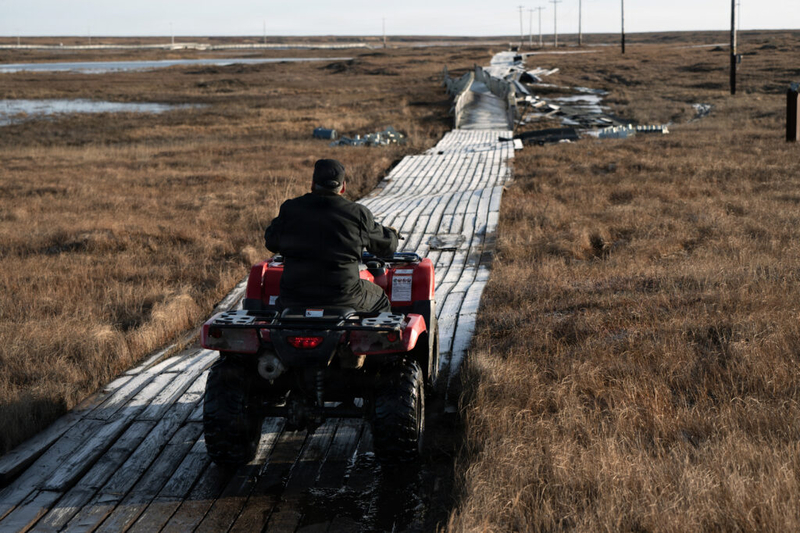
Members of the Alaska Organized Militia, including the Alaska Army and Air National Guard, Alaska State Defense Force, and Alaska Naval Militia, work alongside and conduct damage assessments with community members in Kongiganak, Alaska, Oct. 18, 2025. In the wake of Typhoon Halong, AKOM members were on the ground in western Alaska, conducting damage evaluations and laying the groundwork for recovery operations in affected communities. (Alaska National Guard photo by Staff Sgt. Joey Moon)
The Trump administration has denied Alaska’s request for a larger federal cost share for disaster recovery efforts following devastation wrought by the remnants of Typhoon Halong in Western Alaska last fall.
In a May 31 denial letter, a senior official with the Federal Emergency Management Agency denied the state’s appeal for a 90% federal cost reimbursement for the first three months following the disaster, saying the request for additional funding was “not warranted.”
The denial leaves the federal government covering 75%, and the state covering the remaining 25% of disaster recovery costs, putting Alaska on the hook for tens of millions of dollars.
Gov. Mike Dunleavy claimed the federal government would fully reimburse the state for the first 90 days of immediate disaster relief and recovery efforts, when President Trump signed a federal disaster declaration in October.
But FEMA denied the request for full reimbursement in December. The state appealed and requested a 90% federal cost reimbursement, and that request was again denied on May 31.
Officials with Dunleavy’s office did not comment on the decision on Tuesday or Wednesday.
In the letter, the FEMA official said the department will continue to monitor the costs and could consider a 90% federal cost share if the costs run up to a certain level established by federal law.
Jeremy Zidek, public information officer with the Alaska Division of Homeland Security and Emergency Management, which oversees the state’s disaster response, said by email Tuesday the 75% federal cost share is standard. He said that reimbursement rate will be for all past and future disaster recovery costs related to the storm.
“After the denial of the state’s 90/10 request the state is still in a good position to address all 2025 West Coast Storm related funding requirements which are eligible for state disaster recovery programs and to fund the federal cost share,” he said.
There is not yet a full cost estimate for the Western Alaska storm disaster, including ex-Typhoon Halong. In February, the division’s director, Bryan Fisher, told lawmakers the latest FEMA assessment at that time was $125 million.
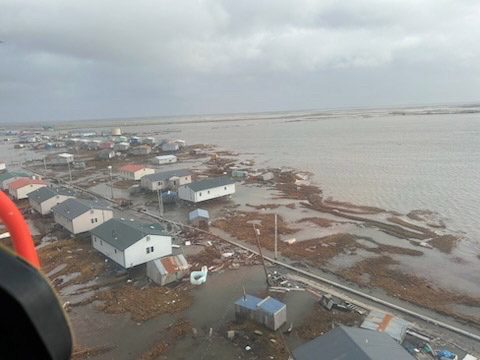
Further rebuilding and repair efforts in Western Alaska are underway this summer. An estimated 1,200 people are still displaced from the region, according to KYUK Public Media in Bethel. A coalition of tribal leaders from across the Yukon-Kuskokwim Delta told visiting federal policymakers with the U.S. Senate Committee on Indian Affairs last month that beyond immediate infrastructure repairs, severe erosion and environmental contamination are affecting communities. They also raised concerns with the federal disaster response system, from delayed payments to a patchwork response. The hardest-hit villages of Kipnuk and Kwigillingok have voted to relocate, but funding and timelines are uncertain.
Since the storms, FEMA reports approving $47 million in individual and household assistance, including nearly $9.5 million in housing aid, and over $5 million in public assistance grants.
On the state side, the Alaska Legislature allocated additional disaster relief funding, including funding to be used in case of a FEMA denial.
This spring, lawmakers approved an additional $75 million for the Western Alaska storm response in an unusually high supplemental budget.
Lawmakers also appropriated $35 million in the state’s Disaster Relief Fund for the next fiscal year in the case the Trump administration denied the appeal. That brings the fund to a total of nearly $73 million for addressing a number of disasters throughout Alaska this past year, Zidek said, with the largest portion going to the Western Alaska storm recovery.
“We anticipate this amount will be sufficient to address funding of the state disaster recovery grants and our federal cost share obligations,” Zidek said.
But House Speaker Bryce Edgmon, I-Dillingham, said in a phone interview Tuesday that he expects further unanticipated disaster recovery costs this year. “From a budgeting standpoint in the Legislature, I will not be surprised to see a supplemental budget request,” he said.
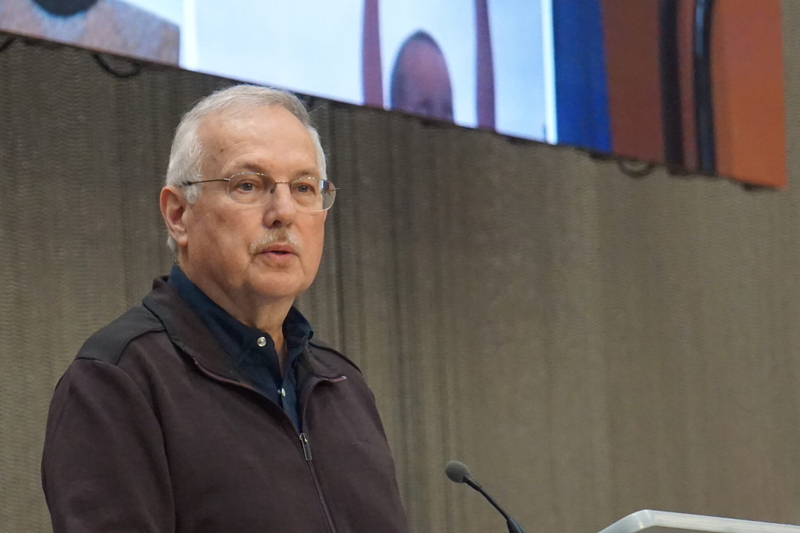
Edgmon said unfortunately, the FEMA denial was an “expected outcome.”
“(The governor) was optimistic that we might be able to get 100% reimbursement from FEMA. I think that optimism was fairly short-lived, based on FEMA’s comments, and you know their concerns about the amount of money, working with other states, and the like,” he said. “The general understanding was that it was probably going to be a 75-25 split.”
Edgmon said while the cost of the disaster recovery is still uncertain, legislators will address the state’s funding needs as they come in, acknowledging the huge regional recovery effort.
“It’s pretty hard to know what the actual cost is going to be leading up to at some point in the future, and we hope as soon as possible relocation of at least two communities in the Y-K Delta,” he said.
Edgmon said the displacement has been painful for those communities, and he’s hopeful the state will continue partnering with FEMA in the disaster recovery effort and eventual relocation of communities.
“There was a real effort to get FEMA to engage as much as possible, to fund as much as possible. Certainly, we want to be able to provide for the relocation of communities, which is going to be a very large price tag involved in that, when that time arrives, and we just need to continue doing everything we possibly can to get people back in their homes,” he said.
Alaska’s federal delegation reinforces support for storm affected region
Alaska’s congressional delegation weighed in Tuesday, with spokespeople for U.S. Republican Sens. Lisa Murkowski and Dan Sullivan saying in statements that both senators are committed to advocating for the communities hit by the Western Alaska storms.
Murkowski and Sullivan supported the state’s appeal and said they were active in urging FEMA and the Trump administration to fully support the disaster relief effort.
Joe Plesha, communications director for Murkowski, said that the senator had reached out personally to Markwayne Mullin, secretary of the U.S. Department of Homeland Security, which oversees FEMA, to advocate for the state’s appeal for a 90-10 split.
“While that appeal was unsuccessful, she will continue looking for opportunities to secure federal assistance and administrative flexibility to help Western Alaska and survivors of Typhoon Halong,” he said.
Plesha noted Murkowski chaired the U.S. Senate Committee on Indian Affairs’ two-day field hearings last month, to hear from storm affected residents. “She is focused on working with local, state, tribal, and federal partners to establish a nimbler system so that communities can not only recover quicker but establish the infrastructure and support systems to become more resilient,” he said.
Devyn Shae, a spokesperson for Sullivan said the senator supports residents in their “long journey of rebuilding.”
“Alaskans are incredibly resilient, but ensuring the communities hit by Typhoon Halong have the resources they need to fully recover remains a top priority for Senator Sullivan,” Shae said. “The senator and his team are reviewing FEMA’s decision and will continue working alongside state and local partners to support ongoing recovery efforts.”
Juneau