Virginia schools push for local tax option as aging buildings strain rural divisions
Jun 04, 2026 | 5:27 am ET
Description
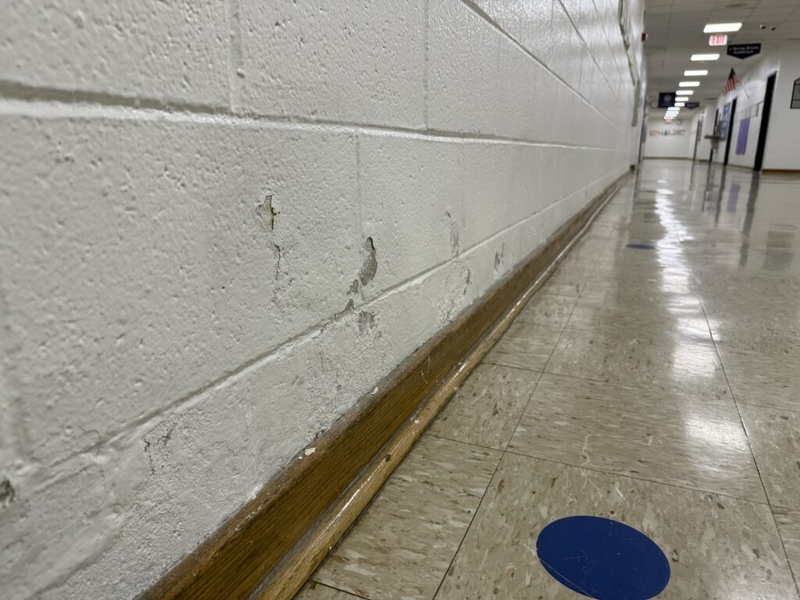
A view of the conditions from inside one of the schools in Mathews County. (Photo courtesy of Mathews County Public Schools)
Every time storms threaten the Tidewater region, Superintendent David Daniel worries the next round of severe weather could cripple Mathews County Public Schools’ aging environmental system, forcing classroom closures and creating safety risks for students.
In one case, the storm did just that. Moisture overwhelmed the elementary school’s heating, ventilation and cooling system, causing water to collect on the floors and forcing staff to close the school for three days because of safety concerns. Daniel said the infrastructure is decades behind where it needs to be.
Now, Mathews and other localities hope to change that if lawmakers and the governor approve changes to state law that would allow all localities to generate tax revenue for school construction projects, which have historically been costly for jurisdictions.
If approved, voters in each locality decide through a referendum whether to adopt an additional local sales tax to fund school construction and maintenance.
“I think having appropriate facilities and funding for public education is critical,” Daniel said. “Localities can’t do it alone, especially as small rural localities aren’t able to equitably prepare their students to compete in a statewide or a global economy without the help of Richmond.”
The legislative process
As a Dillon’s Rule state, Virginia only allows local governments to exercise powers granted by the legislature. Localities can adjust property tax rates but need General Assembly approval to change sales taxes.
Currently, only nine localities — including the city of Danville and the counties of Charlotte, Gloucester, Halifax, Henry, Mecklenburg, Northampton, Patrick and Pittsylvania — can levy a 1% sales tax for school projects. Efforts to expand the authority to other areas, such as Newport News and Prince Edward County, have failed.
Former Gov. Glenn Youngkin vetoed similar bills in previous years, citing concerns about adding to Virginians’ tax burden. He also noted that lawmakers and his administration had already appropriated millions of dollars for school construction.

A 2021 Virginia Department of Education survey found that more than half of the state’s schools are over 50 years old, with replacement costs into the billions.
Keith Perrigan, president of the Coalition for Small and Rural Schools, hosted federal, state, and local leaders for a “Crumbling Schools Tour” five years ago that highlighted schools in need of updates or replacement.
“Obviously, there’s a lot of work to be done, and based on our information with the Coalition of Small and Rural Schools, a large percentage of those schools that need improvements are in rural areas,” Perrigan said in a recent interview.
“To have the opportunity to generate the revenue that it would take to improve those facilities and have taxpayers make that decision themselves is certainly, we think, a win-win for not only the commonwealth, but especially for rural schools in the commonwealth.”
Summer school, maintenance time
As schools prepare for summer break, some divisions are balancing maintenance projects with getting facilities ready for summer instruction.
Henrico County Public Schools is preparing 16 sites for summer school while continuing to address persistent air conditioning and heating issues.
“With summer academy season upon us, ensuring the comfort, well-being and ability of students and staff to fully engage in teaching and learning remains a top priority,” Mike Dunavant, a spokesperson for Henrico Schools, said in a statement, adding that “those sites will be prioritized for repair if any arise.”
In Mathews County, Daniel said the school system will not offer summer school this year — a program that provides academic support and credit recovery — because of costs associated with buses, bus drivers, cafeteria workers and teachers, which total about $650,000.
Instead, the division will use the summer for critical infrastructure and safety upgrades, including electrical work, HVAC improvements, lighting, boilers, and light poles.
The middle school will also merge with the elementary and high school due to low enrollment and high repair costs.
The tax benefits
Last summer, Gloucester completed a $65 million renovation on its high school, likely aided by revenue from the 1% school construction tax.
The project included roof upgrades, all-new HVAC systems and ductwork, and modernization of electrical, plumbing and stormwater systems.
The school also added a new 1,250 kW generator to support critical operations during power outages.
Safety and security improvements included new doors and windows, an upgraded fire sprinkler system and alarm network, and a redesigned secure main entrance vestibule.
“The one percent has allowed us to repair an aging high school,” Gloucester County Supervisor Ashley Chriscoe said in a statement. “The excess revenue from the one percent has allowed us to add some additional projects with the excess revenue, to tackle some other qualifying projects. It has been an amazing asset.”
Compared with neighboring Mathews County, Gloucester has substantially larger revenue-generating capacity because of its broader business sector and more diversified commercial tax base.
Mathews, on the other hand, relies heavily on revenue from high-value waterfront property and loses residents — and shopping dollars — to neighboring localities, where they pay the one-cent sales tax on purchases made outside the county.
“Whether that’s through the annual operations support that we get through the local composite index, the state can’t leave all of that burden on the locality because localities don’t have the same economic leverage to provide the same experiences for their kids,” Daniel said.
“We talk about equity an awful lot, but it shouldn’t matter what your zip code is to determine whether or not you have access to all of the opportunities that kids in other zip codes would have.”
Time crunch
To place the referendum on the November ballot, lawmakers will have to adopt the language by June 29 so it can be properly advertised. State law requires referendums to be ordered at least 81 days before the election.
The House is scheduled to meet again on June 18, followed by the Senate on June 22. The state also faces a July 1 deadline before government operations could shut down.
Richmond, VA