Nevada signs water sharing agreement with Arizona, California
Jun 04, 2026 | 5:00 am ET
Description
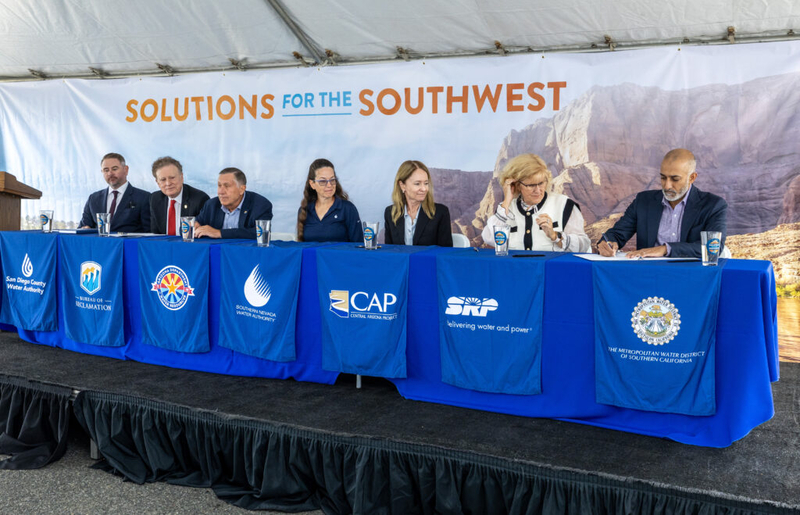
(Photo courtesy of Arizona Department of Water Resources)
Lake Mead could soon benefit from the nation’s largest desalination plant thanks to an agreement that would allow water agencies in Nevada, Arizona, and California to explore ways to exchange water supplies across the drought-challenged Colorado River Basin.
On Wednesday, the federal government and water agencies in the three states signed a memorandum of understanding to develop a framework for an interstate pilot program that could let agencies in Arizona and Nevada tap San Diego’s Claude “Bud” Lewis Carlsbad Desalination Plant.
The desalination plant, operated by the San Diego County Water Authority, can produce 54 million gallons a day. And in years San Diego has a surplus of water, the proposed program would allow California’s share of the Colorado River to be transferred to other states.
The plan would not directly send desalination-treated water to Lake Mead, but would allow “paper” transfers and exchanges between states using existing infrastructure and credits. The program could potentially leave more water in Lake Mead that could stabilize the reservoir during water shortages and blunt the impact of federal water cuts.
“Water agencies could access supplies through existing infrastructure without the need to build costly new pipelines, canals, or facilities,” said San Diego County Water Authority board chair Nick Serrano.
“By tapping into desalination, we believe we can help create a new resource for the Colorado River Basin, contributing to stability,” he continued.
If successfully developed, it would be the first program to transfer water across state lines within the Colorado River Basin.
“We are laying a solid foundation for a great leap forward toward water security in the southwest,” said Scott Cameron, the acting commissioner of the U.S. Bureau of Reclamation.
Cameron praised California’s investments in desalination and said the Trump administration “sees real potential in developing and exploring more opportunities for desalination.”
“Imagine now a future where a string of six or even a dozen desal facilities are operating along the California coast, producing ample amounts of beautiful, clean, clear, fresh water in an environmentally benign way to serve not just California communities, but to be shared at a reasonable price,” Cameron said.
The agreement comes at a time when federal officials warn the Colorado River’s water forecast is becoming more grim. A combination of record-low snowpack across the west and record-breaking heat has further intensified drought conditions.
Long-term drought has reduced Colorado River system water storage to about 36% of capacity, according to the U.S. Bureau of Reclamation.
Water shortages could also impact hydropower in the west. Lake Mead is projected to drop below the critical threshold of 1,035 feet above sea level as early as spring 2027, at which point the hydropower generating capacity at Hoover Dam would be cut by 70%.
“As Colorado River conditions grow more challenging, regional partnerships like this are an essential tool to help ensure sustainable water supplies,” said John Entsminger, general manager of the Southern Nevada Water Authority.
“This agreement allows us to explore forward-thinking, strategic investments that will strengthen water resilience in Southern Nevada and across the Lower Basin,” he said.
The memorandum of understanding was signed by representatives of the federal Bureau of Reclamation, San Diego County Water Authority, Metropolitan Water District of Southern California, Southern Nevada Water Authority, Arizona Department of Water Resources, Central Arizona Project and Salt River Project.
Las Vegas, NV