Attorney general pens letter opposing firearms bill, setting up latest Republican clash
Jun 04, 2026 | 4:55 am ET
Description
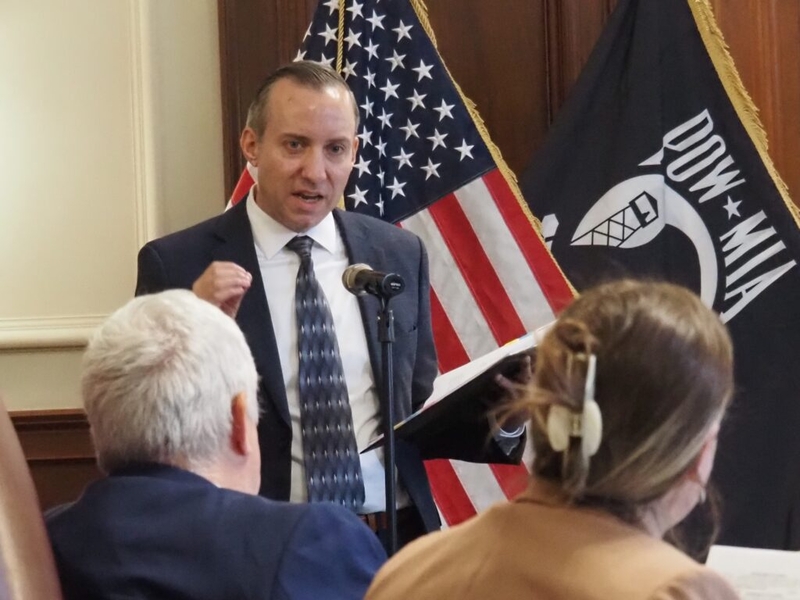
Attorney General John Formella’s opposition could set up a new point of friction between Gov. Kelly Ayotte and fellow Republicans should the bill pass the House and Senate Thursday. (Photo by William Skipworth/New Hampshire Bulletin)
A sweeping Republican bill to override local firearms rules and make firearms regulation an exclusive power of the Legislature hit a last-minute hurdle Wednesday, after Attorney General John Formella penned a letter urging it be killed.
Addressing lawmakers in both chambers, Formella said the bill, which would remove the ability for local and state governments to independently regulate firearms, would have “multiple unintended consequences that have dire implications for public safety and the rights of gun owners in this state.”
And Formella said last-minute changes to the bill, House Bill 609, made by state house leaders last week exacerbated the department’s concerns.
“I must emphasize that the broad and unprecedented language contained in this bill make it likely that other unintended consequences could result if this bill were to be enacted,” Formella wrote.
Formella’s opposition could set up a new point of friction between Gov. Kelly Ayotte and fellow Republicans should the bill pass the House and Senate Thursday. Ayotte has disappointed some conservative members of her party over her opposition to bills facilitating book removals in schools, allowing for segregation of bathrooms by gender at birth, and enabling “open enrollment” in public schools.
For Second Amendment rights supporters, HB 609 could be momentous. Last week, after the bill emerged from negotiations, Rep. Erica Layon, a Derry Republican, called the bill “the most pro-Second Amendment action that New Hampshire has taken since constitutional carry.
The bill has had many transformations. As originally introduced, it granted exclusive authority to the Legislature over the “sale, purchase, ownership, use, possession, transportation, licensing, permitting, taxation, and other matters” of firearms, ammunition, and other weapons, such as knives and Tasers. That would mean any regulation or firearms prohibition passed by either a state or local government entity would be overruled — unless it were established in state statute.
The original version allowed people to sue government bodies or employees under RSA 91-A, the right-to-know law, which could lead to awards of up to $2,000 plus plaintiff fees.
The Senate passed a version that would have pared back its scope, limiting the Legislature’s exclusive role to firearms and weapons rules that affected state employees or state property. The Senate version also would have required that any existing firearms and weapons regulations passed by state agencies over their employees or properties expire in July 2029, unless explicitly renewed by the Legislature.
But the bill that emerged from the committee of conference last week is even more expansive than its original form, after House Republicans pushed their Senate counterparts.
The final proposal re-establishes that the Legislature’s authority would supersede all government entities, state and local, and would prevent the enactment or enforcement of any “charter, provision, ordinance, bylaw, rule, regulation, or policy” that was not allowed by the Legislature.
The final bill also included stronger mechanisms to sue government entities. It would allow any person aggrieved by a government body’s violation of the law to sue for a declaratory judgment, damages, and equitable relief. If the court agreed that there was a violation, the plaintiff would receive at least $1,000; if the court found the entity had willfully or knowingly violated the law, the plaintiff would receive at least $2,000.
That version will go before the full House and Senate for a final vote Thursday; if it passes, it will head to Gov. Kelly Ayotte’s desk.
In his letter Wednesday, Formella called himself a “strong Second Amendment supporter” and said he had taken actions in favor of gun owners. But he said the final version had multiple flaws that could hurt those same firearms rights.
For instance, because the committee of conference version would require all existing firearms policies and rules to sunset in 2029, the bill would force “an incredible surge of rulemaking” ahead of that deadline, Formella wrote. That process could terminate policies that are restrictive to firearms, but it could also end policies that are protective of firearms, he wrote, “creating the distinct possibility that the overall regulatory environment for gun owners could get worse, not better.”
The bill could likewise constrain the executive branch from enacting policies that help gunowners, Formella argued. He pointed to an example in 2019, when the Department of Safety adopted changes to the state’s Gun Line — the system that enables background checks for firearms purchases — to address complaints over delays, after Republicans had pushed to end it entirely.
“These problems were remedied by expedited changes to operating procedures and policies that would not be possible if this bill were adopted,” Formella wrote.
Formella added that the bill could have ripple effects on law enforcement agencies, who might refrain from issuing needed updates to firearms policies such as storage policies, if they did not have explicit legislative authority.
And he argued that on a broader level, the bill would hamper the state’s ability to protect Second Amendment rights and “tie the hands of a co-equal branch of state government on firearms regulations and the protection of Second Amendment rights.”
“Once again, the potential for unintended consequences that are harmful to gun owners is vast,” Formella wrote.
Formella urged lawmakers to defeat the committee of conference report and “to facilitate further discussion” and study the issue further, and said the Attorney General’s Office would be ready to participate in such discussions.
But Layon suggested that many Republican lawmakers have already made up their minds.
“At its heart, HB 609 is about ensuring that the natural rights of our citizens are not trampled by out-of-control, red-tape bureaucrats and runaway local regulations,” she said in the statement. “This bill ensures that no arbitrary, bureaucrat-stamped rule is foisted upon the people unless the elected representatives of the people give them the consent to act.”

Concord, NH