Fed judge strikes down Nebraska law allowing some undocumented students in-state tuition
Jun 03, 2026 | 7:50 pm ET
Description
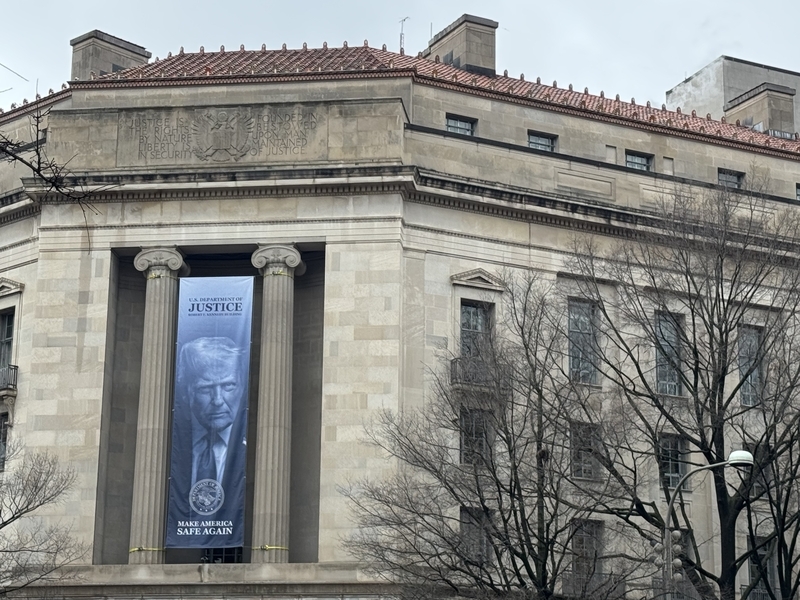
A banner showing President Donald Trump hangs on the Department of Justice on Feb. 20, 2026. (Shauneen Miranda/States Newsroom)
OMAHA — A federal judge ruled Wednesday that a Nebraska law allowing some undocumented students to access in-state tuition rates at the state’s colleges and universities is preempted by federal law and barred its enforcement.
The law had been in effect since 2006.
U.S. District Court Judge Brian Buescher wrote in a 54-page opinion that “the Nebraska statutes establishing residence requirements for illegal aliens to obtain in-state tuition, while leaving United States citizens from other states to pay full out-of-state tuition, blatantly violate” federal law.
Under the now struck-down law, non-citizens were eligible for in-state tuition if they graduated from a Nebraska high school and resided in the state for at least three years, among other requirements.
The U.S. Department of Justice sued the State of Nebraska in April seeking to declare the law invalid. It also challenged other statutes that allowed for scholarship programs for undocumented students.
Both the DOJ and the state argued that Nebraska’s law was expressly preempted by a federal law that says, in part: “An alien who is not lawfully present in the United States shall not be eligible on the basis of residence within a State for any postsecondary education benefit unless a citizen or national of the United States is eligible for such a benefit.”
Because U.S. citizens who live out of state would pay a higher tuition rate than an undocumented student who receives in-state tuition, the DOJ and state argued, the state statutes were unconstitutional and preempted by federal law.
In friend-of-the-court briefs, outside parties argued that the lawsuit was collusive since Nebraska Attorney General Mike Hilgers chose not to defend the state law and entered into a proposed agreement with the federal government. Federal law generally bars collusive or “friendly” lawsuits in which there is not a case or controversy for the court to decide on.
But Buescher said the case or controversy exists since the state law was still in effect despite Hilgers’ agreement with the federal government.
“While Nebraska agrees on the legal issue, it has taken no action to grant the United States the relief it seeks, which is invalidation of the challenged state statutes,” he wrote.
Following the ruling, Hilgers issued a statement saying he was grateful for the result.
“Federal law is clear: no benefits can be extended to illegal immigrants that aren’t available to American citizens,” the statement read. “The court enjoined several unconstitutional laws that did just that. We are grateful for the court’s consideration and result.”
In his opinion, Buescher also rejected a bid from two organizations – True Potential, which provides scholarships to recipients of the Deferred Action for Childhood Arrivals, or DACA, program, and the Orel Alliance, which works with Ukrainian immigrants and refugees – to intervene as parties in the case. He found that neither organization had standing to intervene.
Buescher further rejected a motion from those proposed intervenors to halt proceedings pending an expected appeal to the 8th U.S. Circuit Court of Appeals. True Potential and Orel Alliance are likely to appeal the denial of their motion to intervene, and they requested that the court hold off on making a final decision until after the appellate court could rule on that issue. Buescher said allowing the unconstitutional statutes to stand would be contrary to the public interest.
“The effect of a stay pending appeal would be a delay that permits the challenged state statutes to remain valid at least into the next academic year,” he wrote. “In the Court’s view, the fact that potentially unconstitutional state statutes have remained unchallenged for several years does not warrant further delay in determining their validity in the face of federal law when those state statutes are challenged.”
Buescher wrote that he made some “editorial amendments” to the consent judgment proposed by the state and federal governments. Those amendments appear to be minor changes to wording.
This story was originally published by Nebraska Public Media News, a network of local reporters working with a National Public Radio station based in Lincoln.
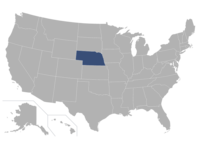
Lincoln, NE