Gubernatorial candidates have competing visions for AI use in Maine
Jun 03, 2026 | 4:00 pm ET
Description
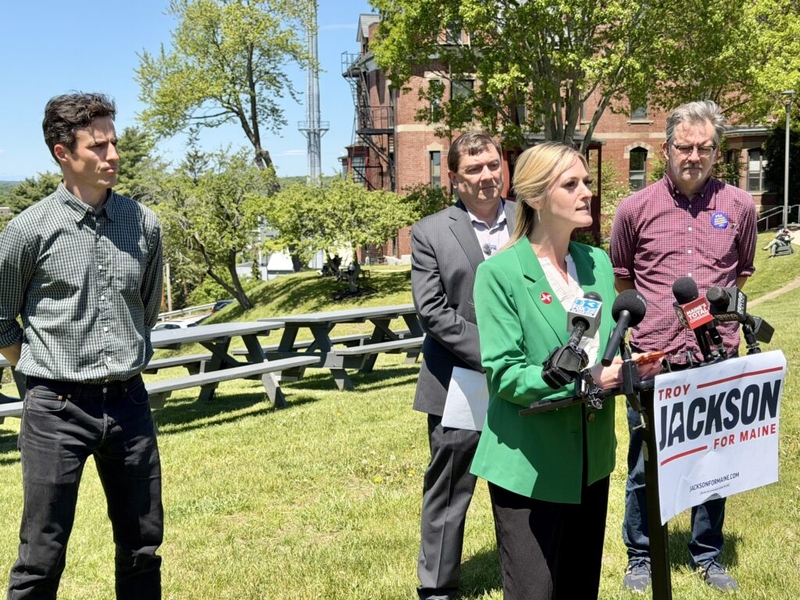
Kelli Brennan, member of the nurses union, joined by speaks in support of gubernatorial candidate Troy Jackson's plan to regulate AI. (Photo by Eesha Pendharkar/Maine Morning Star)
Two Democratic candidates released plans to limit the use of artificial intelligence in Maine’s schools, hospitals and businesses. A Republican candidate wants to take the opposite approach, prioritizing business growth over artificial intelligence regulation.
On Wednesday, gubernatorial candidate and former Maine Senate President Troy Jackson was joined by representatives for Maine nurses, teachers and labor unions outside Maine Medical Center in Portland, who all vouched for his plan to regulate AI.
“AI may be new, it certainly is new to a lot of us, but the political question is old: Who benefits, who pays and who decides?” Jackson said “Under the Jackson administration, I can assure you that tech billionaires will not be deciding this alone and not be getting their way.”
His proposal, called “Agency over AI,” bans corporations from using the technology “as cover for throwing workers out on the street.” Any major employer that attributes mass layoffs to AI will lose every state contract and tax break, the plan states. It also bans routine use of AI in classrooms or for homework. The plan notes that he’d support a comprehensive law to stop companies “harvesting, selling and exploiting Mainers’ data,” but did not say how his proposal would or would not differ from earlier iterations the Maine Legislature has failed to pass.
Under Jackson’s plan, in his first 100 days he will regulate data centers, which power the technology, so they don’t “raise power bills, drain the local water supply or make nearby homes unlivable.”
Kelli Brennan, a nurse at Maine Medical Center and co-president of the nurses union that has endorsed Jackson, said that nurses have demanded transparency on AI usage and asked MaineHealth to cancel its contract with Palantir, a tech company specializing in AI that has powered federal immigration enforcement surveillance.
“It is essential that we have elected officials who are willing to stand up to the tech billionaires and protect the working class from the serious threats of unregulated AI,” Brennan said. “When Big Tech gains access to vast amounts of healthcare data, patients and nurses worry about who can see that information and how it is being used.”
On the same day, gubernatorial candidate Nirav Shah released a similar plan to address AI use, proposing a moratorium on data centers until they can be regulated, require educator approval before any AI tool is used directly with children and ban AI from making final decisions about a person’s benefits, healthcare, education, housing, public safety or access to state services.
“AI is moving faster than Maine families, schools, workers and communities can keep up with,” Shah said in a statement. “Maine can use innovation where it helps people, but we cannot let Big Tech write the rules, exploit our kids, surveil workers, replace human judgment or stick ratepayers with the bill.”

Both Jackson and Shah (along with fellow Democratic candidates Hannah Pingree and Shenna Bellows) have said they would have signed the bill temporarily banning data centers that Gov. Janet Mills vetoed earlier this year. However, Republican candidate Jonathan Bush said on Wednesday he would have vetoed that bill.
“This is a state that desperately needs businesses to come,” Bush said. “People wonder why property taxes are going up … it’s because the share of property taxes paid by businesses is going down as businesses leave.”
Every business that wants to come to Maine should be welcomed, he added, and unnecessary regulation on AI might deter the economic growth the state needs.
“Obviously we’ll regulate, we’ll make sure that the businesses don’t poison things at all, but the message to the country should be Maine is open for business,” Bush said.
Augusta, ME