Rochester’s Anti-Poverty Portal Struggles to Meet Promise
Jun 03, 2026 | 5:00 am ET

Description
In 2015, then-Lieutenant Governor Kathy Hochul helped unveil a bold plan to reverse decades of severe poverty in Rochester.
She hailed the effort — now called the Rochester-Monroe Anti-Poverty Initiative (RMAPI) — as an innovative model that could one day be replicated statewide.
For months, a task force led by top lawmakers and spearheaded by the United Way of Greater Rochester had been taking shape. Soon after going public, it announced an ambitious goal: slashing the area’s poverty rates in half by 2030. Key to that effort was a cutting-edge website that would seamlessly connect the region’s residents to a variety of social services, acting as a one-stop shop for everything from emergency housing to food assistance and mental health care. By increasing coordination among providers, proponents explained, it could eliminate the bureaucracy of getting help — providing a more holistic, user-friendly experience.
But the task force faced early stumbles. Its first leader resigned in 2020 amid criticism. Now, more than a decade since its launch, some are calling RMAPI — along with MyWayFinder, the website it kickstarted — an expensive flop.
“I’m not convinced an app that tells me where a food pantry is is solving the problem that needs to be solved,” Monroe County legislator Rachel Barnhart said of MyWayfinder, which came online in 2024 and officially launched in 2025. “The problem is when people actually go and apply to the government for the services they’re eligible for, and they encounter extreme barriers and red tape.”
The state has pumped at least $25 million into the MyWayFinder website, which took over eight years to develop. State documents billed the website as a transformative hub that would provide a “360-degree” view of each of Rochester’s 150,000 impoverished residents, allowing clients to transition from “crisis to stable to thriving” with a vast network of providers closely tracking their needs and the services they’re receiving.
Amy D’Amico, a nonprofit consultant and local housing advocate, has referred several people to the platform to easily locate resources, including a trans person who needed help identifying a health provider.
“I think there’s a significant gap in our community and elsewhere between the health domain and the housing domain,” D’Amico said. “These are systems that just don’t talk to each other.” MyWayFinder is one of many potential solutions that could help bridge that divide, she said.
But overall, uptake has been lackluster. As of June 2026, MyWayFinder has over 2,000 registered client users — a fraction of the 150,000 sign-ups promised upon the website’s rollout. Similarly, only 48 organizations are considered “Connected Provider Organizations,” which actively receive referrals from the site, far short of the 300 providers envisioned upon rollout in state contract documents — limiting the website’s ability to function as a one-stop shop.
The website’s current operator denied that the site had failed to reach its original goals and said that all providers listed on the website are able to utilize the network and are “reachable” through the platform, even if they don’t receive website referrals.
Despite the tepid response, those running the platform have continued to seek more state dollars and are looking to expand MyWayFinder and spread the framework to other counties across New York. RMAPI has long since abandoned its ambitious target of halving local poverty rates and has pivoted to a broader set of metrics that, according to its executive director, “better reflect the root causes of poverty” and don’t rely on a single measure. RMAPI has also stepped away from MyWayFinder and transferred operation of the platform to another group.
MyWayFinder’s goal of streamlining social services couldn’t come at a more critical time. Historic federal cuts to Medicaid and food assistance are estimated to result in hundreds of thousands of New Yorkers losing their benefits in the months and years to come — placing a larger burden on nonprofit providers to fill the gaps.
These cuts are likely to be especially devastating in Rochester, where nearly 30 percent of residents live below the federal poverty line and roughly 40 percent of children live in poverty.
Rochester was once a bustling hub for some of America’s most iconic brands, including Xerox and Kodak, but decades of declines in manufacturing have taken their toll on the workforce, which has never recovered. And that was before the recent spate of federal cuts to safety net programs under the Trump administration.
The region also has a history of higher-than-average denial rates for programs like food assistance and punitive sanctions for those who fail to meet stringent requirements for drug or alcohol programs, Barnhart says.
But while MyWayFinder was built using state funds, it was never intended to connect users with the state or county agencies responsible for administering public benefits — which some critics say hamstrings the platform’s ability to ease the lives of underserved residents.
“I’m not convinced an app that tells me where a food pantry is is solving the problem that needs to be solved.”
—Monroe County legislator Rachel Barnhart
It can also be impractical, said Anna Valeria, CEO of Open Door Mission, the region’s largest housing provider. Open Door is among the majority of organizations listed on MyWayFinder that are not fully connected into the platform.
“It’s wonderful in theory, but the reality is for those of us doing the frontline work, it’s another layer to add,” said Valeria.
The platform connects directly with 48 providers, allowing users to request referrals for help such as finding a shelter or child care. But when MyWayFinder users click on a listing to Open Door or other nonprofits that aren’t fully connected, they are prompted to call or email directly for help, which Barnhart said makes the platform more akin to an online phone directory than the innovative one-stop shop promised in state documents.
Valeria said Open Door has no plans to fully connect because it has already fine-tuned its own intake process. Several other community partners that facilitate emergency and transitional housing placements for Open Door have also declined to connect, Valeria said, driving down the platform’s ability to improve coordination among providers.
She questioned why the state would bankroll MyWayFinder instead of directly supporting nonprofits at a time when many are struggling. In 2024, the United Way of Greater Rochester was criticized by local nonprofits after it announced funding changes that would significantly reduce its longtime support for them.
Barnhart raised similar concerns, calling MyWayFinder a costly attempt at unifying providers into a central system instead of investing in actual services. “We have other nonprofit organizations that essentially do the same exact work and don’t need these dollars from taxpayers,” Barnhart said of MyWayFinder and RMAPI. “We seem to be spending money to fund bureaucracy instead of putting money directly into the hands of people.”
The United Way of Greater Rochester is one of the larger nonprofits in the region, with a reported $183 million in assets as of 2024.
The organization is part of a national United Way network of affiliates that raise money through workplace giving programs and direct those donations to local nonprofits like homeless shelters and food pantries. Each United Way is independently run and operated, and many, like the Greater Rochester chapter, do not provide direct services to the public.
The organization’s relationship with RMAPI has raised questions. Nearly all of the state funds directed to the task force or MyWayFinder were issued as legislative awards, a process in which lawmakers direct grants to specific institutions. The practice has been flagged by open government advocates for inadequate oversight that “invites misuse and corruption.”
Unlike regular state contracts — which are often issued after a competitive bidding process and contain financial safeguards — agencies have limited powers to oversee legislative awards. Neither of the state agencies named on the grants that supported RMAPI and MyWayFinder were able to provide details about how the money was spent, and both noted that they had no control over the grants.
A tangled ownership structure also makes tracking spending more difficult. The state grants were entrusted to the United Way of Greater Rochester, which has housed RMAPI since the task force formed in 2015. All of RMAPI’s employees are United Way of Greater Rochester employees.
While RMAPI spearheaded the development of MyWayFinder, it has since transferred operation of the platform to another organization called TogetherNow, which also started off as part of the United Way of Greater Rochester. TogetherNow spun off into its own nonprofit organization earlier this year.
John Kaehny of Reinvent Albany said MyWayFinder’s transfer to a new operator raises questions about potential misuse of state dollars, especially if TogetherNow intends to expand the platform beyond the region. He recommended that the state open a financial probe into the matter.
The United Way of Greater Rochester charged the state $1.2 million per year to manage a five-year grant on RMAPI’s behalf while it was developing MyWayFinder but declined to share a breakdown of how it spent the $6 million total. State documents show an unspecified part of the annual fee went toward the salaries of United Way of Greater Rochester employees not directly involved in either RMAPI or MyWayFinder, such as CEO Jaime Saunders. Recent tax filings show Saunders earned over $365,000 annually as the nonprofit’s top executive in 2024.

United Way of Greater Rochester declined an interview request and responded to only some questions from New York Focus.
RMAPI Executive Director Aqua Porter said her task force is independent from United Way of Greater Rochester, despite the fact that she is listed in tax filings as an employee of the nonprofit. Porter said RMAPI’s budget over the past five years has hovered around $1 million annually, with state dollars accounting for as little as a third of overall funding at times. She declined to provide a full accounting of all state dollars RMAPI has received since 2015.
Because RMAPI is not a separate entity, it is not subject to IRS public reporting rules for nonprofits. “No matter the funding sources, RMAPI has always been an effective and deeply responsible steward of any money we receive,” Porter wrote in an email.
Porter’s low six-figure salary was among 18 United Way of Greater Rochester positions funded by state grants earmarked for the development of MyWayFinder, according to state records. She has served as head of RMAPI since 2020, taking over when the group’s last leader resigned after concerns from community members about the task force’s effectiveness turned personal, according to the Rochester Beacon.
Like United Way of Rochester, RMAPI does not provide direct services to the public. Its main function is convening a steering committee that includes several prominent lawmakers and local politicians, though it does not identify as a think tank or a lobbying group and is not subject to state ethics rules.
Congressman Joe Morelle — often described as the architect behind RMAPI’s creation in 2015, when he served as a state assemblymember — did not respond to requests for comment. Morelle has been a fixture at RMAPI events, attending a celebration for MyWayFinder last summer.
Asked about RMAPI’s legacy, Porter pointed to the group’s advocacy for policy changes such as the Empire State child tax credit, raising the state’s minimum wage, and a pilot run of Rochester’s Guaranteed Basic Income program. “RMAPI has brought to Rochester an element that had not previously existed, a central organization that sets common goals and leads the hard work,” she wrote in an email. “While systemic change takes time, we can see the results.”
Laura Gustin, executive director at TogetherNow, which now runs MyWayFinder, wrote in an email that her organization has set a new target to fully connect 15 percent of all services listed on MyWayFinder by 2028. As of June 2026, an impact tracker on MyWayFinder indicated 125 out of 3,361 total services listed on the platform – or fewer than 4 percent — are fully connected.
Gustin pointed out that MyWayFinder has been used over 200,000 times by more than 40,000 unique users and has a growing list of partner organizations. She noted that her staff have trained over 1,100 service providers to use MyWayFinder, but didn’t respond to follow-up questions about why she thinks relatively few have chosen to fully connect to the platform.
Keeping MyWayFinder up and running for its relatively small user base isn’t cheap. Gustin said that annual licensing fees for the website currently cost $1.4 million. It’s not clear whether state funds are footing this bill. Neither Porter nor Gustin provided more details about these ongoing fees. The platform itself was designed by IBM, which was hired by United Way of Greater Rochester as a subcontractor using state grant money.
Some community members remain hopeful that MyWayFinder could represent a promising new solution moving forward.
The platform has helped local residents navigate new federal changes to the Supplemental Nutrition Assistance Program, also known as food stamps. In March, new work requirements went into effect for thousands of Monroe County residents who rely on food assistance. The county directed SNAP households to a screening tool on MyWayFinder, which helped them identify if they were subject to the new mandate using a questionnaire.
The platform and RMAPI continue to receive strong political support.
Among RMAPI’s most enduring supporters is Assemblymember Harry Bronson, who represents Rochester and has served on the task force’s steering committee since 2015.
Bronson’s office declined to provide Focus with a full accounting of all state money the assemblymember has directed to the task force, but press releases and agency records indicate he is responsible for shepherding at least $10.5 million to the group.
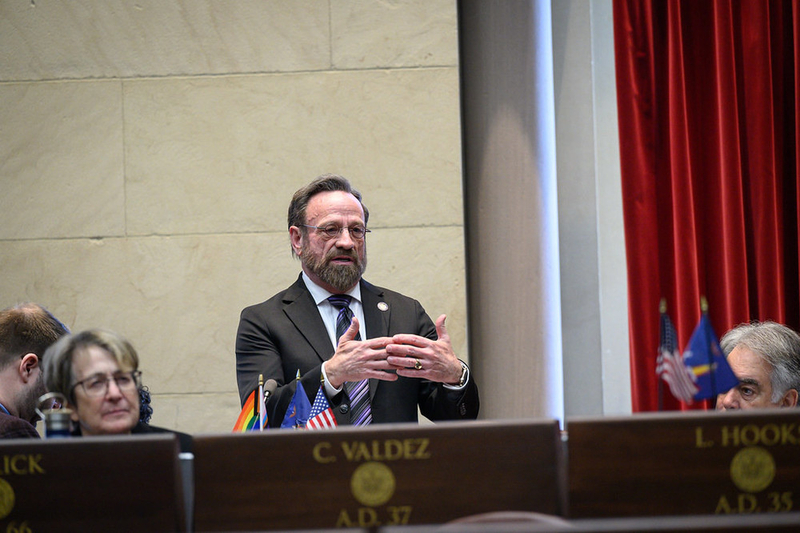
“The funds I have requested for RMAPI’s continued work bolsters their ability to do outreach, retain staff and facilitate vital community collaboration necessary for our area to persist in addressing poverty and creating upward mobility,” he wrote in a statement. “One of the most significant successes of RMAPI has been in raising awareness that poverty does not only occur in the City of Rochester, as is commonly believed, but also affects those living in the surrounding rural and suburban areas of Monroe County.”
Bronson was among those who attended a 2023 RMAPI event where Rochester Mayor Malik Evans spoke positively of the group’s efforts, calling it “a framework for change that is bold in ambition yet constructive in scope to confront the single greatest challenge of our entire region.” Monroe County Executive Adam Bello said RMAPI’s efforts had helped make the region “more prosperous and equitable.” Neither responded to requests for comment from New York Focus.
Some advocates say that raising awareness and fully connecting clients to a few dozen providers falls far short of RMAPI’s original goals.
While Valeria of Open Door welcomed RMAPI with hope back in 2015, she said she has yet to see measurable outcomes from the group’s efforts over the past decade.
“We get lost in the aspiration,” she said.
Albany