Opponents of Axon’s Scottsdale HQ will appeal after losing first round in court
Jun 02, 2026 | 12:35 pm ET
Description
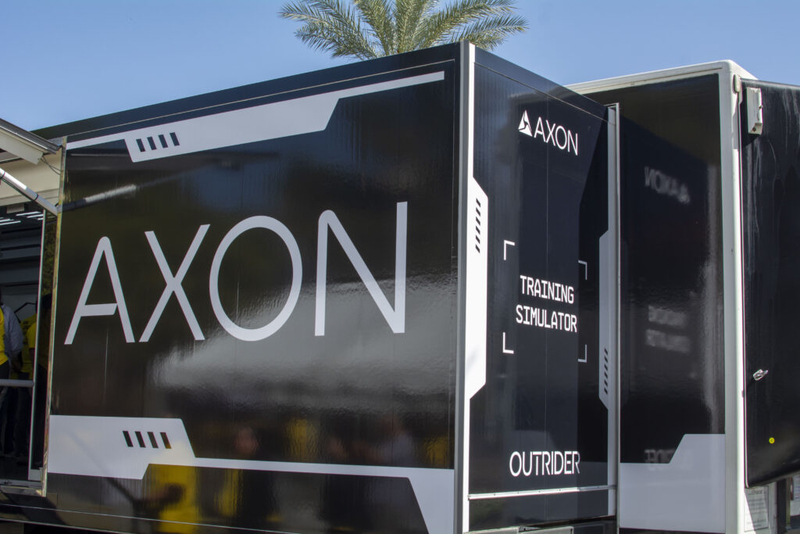
Axon brought a mobile tactical simulator to the Arizona Capitol on March 4, 2025, as part of its effort to back legislation that would stop a ballot referendum in Scottsdale brought by residents opposed to the company's plans to build a 74-acre campus near the Loop 101 and Hayden Road. (Photo by Jerod MacDonald-Evoy/Arizona Mirror)
The group behind the effort to stop law enforcement technology company Axon from building a massive headquarters and housing project in Scottsdale said it will appeal a trial court judge’s ruling that a state law barring residents from weighing in on the project is constitutional.
Taxpayers Against Awful Apartment Zoning Exemptions formed in 2024 to block Axon’s HQ project after the Scottsdale City Council approved it. With the help of a California labor union, TAAAZE successfully gathered enough signatures to force a referendum vote on the zoning change required for the project to move forward.
Axon responded by convincing state lawmakers last year to strip away the constitutional right of voters to challenge zoning decisions, effectively clearing the way for the police weapons manufacturer’s headquarters near Hayden Road and the Loop 101.
In addition to the firm’s international headquarters, the project is set to include a luxury hotel and apartments, many of which — but not all — will be reserved for the company’s employees.
TAAZE filed a lawsuit last year alleging that the law violates the Arizona Constitution, which allows residents to challenge government actions at the ballot box.
But Maricopa County Superior Court Judge Michael Herrod ruled in mid-May that the law was constitutional.
TAAAZE argued that the law failed one part of a three-part test that is meant to determine if legislation is “special” or not. The part they claimed the bill failed related to if the law is “encompassing all members that are similarly situated.”
“Plaintiffs argue that (the Axon bill) fails the second prong because the classification is not legitimate, encompassing all similarly situated members. In other words, Plaintiffs claim the law is underinclusive,” the judge wrote in his ruling. “Plaintiffs argue that since the law only applies to a few mid-size cities and towns, and not all cities and towns, the law is of special application and not general application.”
However, Herrod said that he found that to not be the case.
Since the law is addressing a specific problem of “attracting international headquarters,” then the populations chosen for the bill are likely prime candidates for that, Herrod reasoned. But he did not go without addressing the elephant in the room.
“Of course, the brightly blinking sign in this case is that the Axon bill was clearly triggered by the zoning situation for Axon and intended to allow Axon to build its international headquarters in Scottsdale,” the judge concluded.
But despite that, Herrod continued, the law isn’t written so narrowly that it can only ever apply to Axon and Scottsdale.
“Because the statute can apply in other cities, it is not a special law,” Herrod wrote. “One may argue that, in the lay sense, this is a special law because it clearly applies to Axon only at this time, but its provisions are not limited solely to the City of Scottsdale and Axon.”
On June 1, TAAAZE announced that it would be filing an appeal later this month.
“If the Axon Bill can trample on the rights of Scottsdale voters, then no city is safe from bad zoning decisions,” TAAAZE leader and former Scottsdale City Councilmember Bob Littlefield said in a statement. “There is nothing appealing about the way Axon has bullied this community to get what (it) wants. That’s why we will file this appeal to protect the rights of ALL Arizona voters.”
Axon declined to comment. A spokesperson for the City of Scottsdale did not respond to a request for comment.
TAAAZE also has a second lawsuit against the Axon HQ project — this one challenging the memorandum of understanding that the city struck with the company last year to revise the project —that will go before a judge on June 5.
Phoenix, AZ