Businessman, former Oklahoma trooper, Chip Keating embraces ‘outsider’ status in bid for governor
Jun 02, 2026 | 6:30 am ET
Description
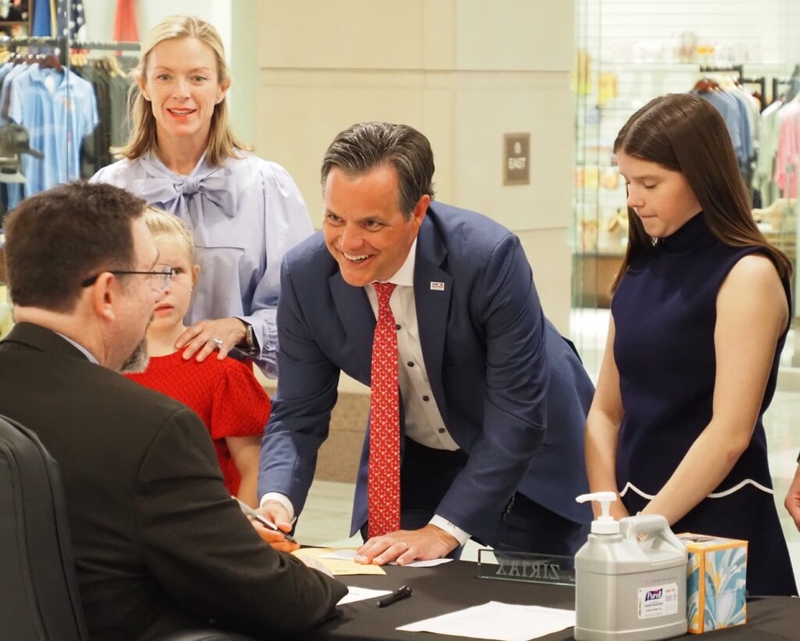
Chip Keating, surrounded by his family, files to run as a Republican candidate for Oklahoma governor at the Capitol on April 2, 2025. (Photo by Janelle Stecklein/Oklahoma Voice)
Editor’s note: This is the second in a series of profiles on four of Republican candidates seeking the party’s nomination for governor. Oklahoma Voice interviewed the four candidates who have the highest fundraising totals. Profiles will run in alphabetical order.
OKLAHOMA CITY – He comes from a well known political family, but Chip Keating says that unlike the other top contenders for governor, he is no career politician.
The Republican said he was motivated to run out of frustration with “empty suited promises.”
Keating said the candidates he is running against have been in politics for years and failed to address important state issues, such as improving education and fixing a broken medical marijuana state law.
“They’re running for their next office hopping gig, and they’re going to tell all of us how they’re going to fix it,” Keating said. “They’re not going to because if they were going to fix it, they should have done it already.”
Marijuana
Voters in 2018 passed State Question 788, legalizing medical marijuana. Since then, lawmakers have spent years hammering out a regulatory framework.
But he said lawmakers have not done a good job creating it, Keating said.
Keating points to the number of illegal marijuana growers that came with the industry’s legalization. Politicians have failed to crack down on them, which has contributed to human and sex trafficking and money laundering, Keating said.
As governor, he would declare a public safety emergency and activate the National Guard to assist law enforcement in cracking down on illegal growers.
“The Legislature has grotesquely failed on this issue, grotesquely,” Keating said.
He says he has fresh ideas.
The son of a former Republican governor, Chip Keating said his political outsider status allows him to bring a new perspective to regulating this industry and others.
He faces a crowded field of candidates in the June 16 Republican primary, including Jennifer Domenico, Attorney General Gentner Drummond, former state Sen. Mike Mazzei, former House Speaker Charles McCall, former state Sen. Jake Merrick, Leisa Mitchell Haynes, Kenneth Strugell and Calup Anthony Talyor.
“There’s good men in this race,” Keating said. “I know them. They’re good people, but frankly, they are the definition of career politicians. I don’t think people want that.”
Political ties
Though Keating has never served in office, he previously made a failed bid for the Oklahoma House in 2006.
His father served two terms as Oklahoma’s Republican governor from 1995 until 2003 while his mother in 2001 made a failed run at Congress.
Keating, 46, also served as public safety Cabinet secretary under Gov. Kevin Stitt, who is finishing his second and final term.
A businessman, Keating graduated from Southern Methodist University in Dallas and then spent nearly four years in the Oklahoma Highway Patrol.
He later founded the Oklahoma State Troopers Foundation, which works to fulfill the needs of troopers and their families by providing financial support, family and mental health services, education and equipment.
Tax policy
Legislators in recent months have been looking at reforming the state’s property tax structure to help alleviate costs on residents and businesses. They have placed an issue on the November ballot that would cap how much property taxes can increase each year.
While state government does not receive any revenue from property taxes, it is a primary funding source for local school districts, county governments, and some municipalities.
Keating said he doesn’t support eliminating property taxes, but does back a cap for seniors.
He also supports modernizing the tax structure. He said eliminating some of the many state boards and commissions could offset the cost of eliminating the income tax, he said.
Healthcare
He said the state’s transition to a privatized managed care Medicaid system, which was championed by Stitt as a way to save money, isn’t working.
Rather than the state being responsible for paying for services, the Oklahoma Health Care Authority, which manages the state’s Medicaid program, contracts with several insurance providers.
“There’s too many crossing guards in here to make this work effectively where it has worked in other states and saved money,” Keating said.
Tribes
Stitt has had a fractured relationship with many of the state’s 38 federally recognized tribes. He and tribal leaders have faced off on a range of issues, such as gaming and tobacco compacts and taxation.
“We’ve got to hit the reset button with the tribes,” Keating said.
Education
The father of three children who attend private school, Keating said he supports the $275 million parental choice tax credit program, which provides a credit ranging from $5,000 to $7,500 to parents who send their children to private schools.
Keating said the private school tax credit program shouldn’t be done on the heels of defunding public education.
“I ought to be able to have the decision to take my taxpayer dollars and follow my child,” Keating said.
Parents need more options, not less, he said.
Public education in Oklahoma is “a complete Dumpster fire.”
Improving student reading outcomes would be a catalyst to buffering some of the state’s other ills, such as incarceration rates, he said.
Oklahoma City, OK