Hale calls for color-coded mulligan on mail-in ballot mix-up
Jun 02, 2026 | 5:00 am ET
Description
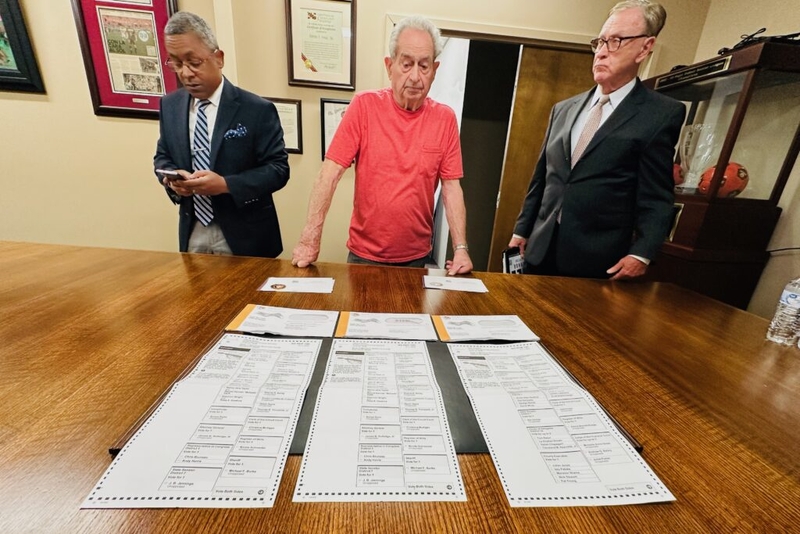
Vincent Del Pizzo, center, shows reporters the three mail-in ballots he's received since May 1. Del Pizzo appeared a news conference with Republican candidate for governor Ed Hale, right, and running mate Tyrone Keys. (Photo Bryan P. Sears/Maryland Matters)
One Republican candidate for governor is calling on the Maryland State Board of elections to send out yet another round of mail-in ballots, saying the first attempt to fix more than 400,000 ballots just led to more confusion.
Monday’s comments by Ed Hale are the latest fallout from the discovery by state elections officials last month that an undetermined number of voters, Democrats and Republicans, were accidentally sent a ballot for the opposite party’s primary.
Election officials, out of an abundance of caution, decided to send replacement ballots to 447,000 voters — an exact number could not be determined — and reached out with emails and letters alerting voters to discard the first ballot and vote the replacement.
Hale said the current fix is not working. A new round should be mailed using new colors that clearly identify the replacement ballot, he said.
“I would change the colors,” Hale told reporters. “You could probably go down to the Minute Mart, right down the street here in Rosedale, and get them printed up now, right now, and get them printed and send them out to people.”
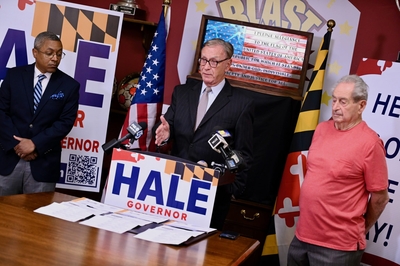
As evidence of the confusion, Hale introduced Vincent Del Pizzo, who has worked for Hale as a contractor, who has received three ballots so far: One for the Democratic primary, one for the Republican primary and a replacement GOP primary ballot.
But Del Pizzo’s example of an election board snafu is not a perfect one.
Del Pizzo, 86, was a registered Democrat. In April, he changed his registration to Republican because he wanted to vote for Hale in the primary. He received a Democratic Primary ballot on May 1, he said, then he got a Republican ballot on May 27 in line with his new registration. Three days later, he received a second Republican primary ballot.
State Elections Administrator Jared DeMarinis said the scenario was not only possible, it was likely. Voters can change their registration up to June 2. If a voter requested a mail-in ballot then changed their registration, a second ballot is sent reflecting the updated party affiliation.
“We do it all the time,” said DeMarinis.
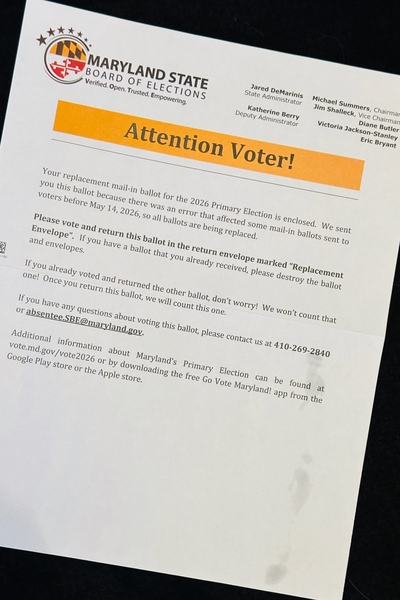
As for the third ballot, because Del Pizzo was in the group of more than 400,000 total mail-in voters, he automatically received a new ballot marked as a replacement. Inside, a letter explaining the replacement ballot.
DeMarinis called it a very unusual set of circumstances.
More than 560,000 voters expected to receive mail-in ballots earlier this year. That number includes voters who have elected to vote by mail permanently as well as those who wish to vote by mail this year.
DeMarinis said Monday that elections officials have worked hard to ensure transparency and inform the public since discovering the mix-up last month.
“I think our voter outreach program has been very good about this — making sure that voters are informed,” DeMarinis said in an interview
The snafu was caused by the printer, which made a mistake in packing the ballots, DeMarinis said. The printer, Minnesota-based Taylor Print & Visual Impressions, said it would mail out the corrected ballots at no cost to the state.

Those ballots are marked “replacement ballot” and include barcode tracking and other identifications that allow elections officials to ensure replacement ballots are counted.
But that doesn’t make it any less confusing for voters like Del Pizzo, who got three ballots in less than two months, said Hale.
“If you’re getting three out to Vince, and he wants to vote, what does he do?” Hale asked. “I mean, I don’t know what anybody would suggest that Vince do.”
“So, he could vote three times, and which vote is going to count? ” Hale said to reporters.
Del Pizzo, a Perry Hall resident, said that “right now, I’m totally confused.”
“I’m afraid to send my mail-in ballot because of this confusion,” he said. “I don’t feel safe with this process.”
Del Pizzo’s three ballots were on display Monday. One envelope, identified by Hale and Del Pizzo as the third received, is clearly marked “replacement ballot.”
When that was pointed out by Maryland Matters, Hale told reporters he had not looked at it that closely. He and his running mate, Tyrone Keys, pushed back when a reporter asked if it was possible that Del Pizzo got the initial Democratic ballot because his change in registration happened after the initial wave of ballots were processed.
“It’s possible,” said Hale. “And it’s possible if Vince had wheels he’d be a bike.”
But Nikki Tyree, executive director of the League of Women Voters of Maryland, said even an anecdotal case can diminish public trust.
“Even when it’s anecdotal, even when you look at it as somebody who knows how it works, and say, ‘You guys can’t possibly think that this is happening to everybody,’ the onus, still falls on SBE [State Board of Elections], maybe even the League to be able to explain to voters to make them feel confident and informed, and not have to rely on this like rampant spread of misinformation,” Tyree said.
DeMarinis explained that barcodes and other ballot tracking, as well as voter registration information, will prevent a voter from casting the wrong ballot or more than one ballot. In the event a voter casts a ballot in the wrong party primary, that vote would be flagged and held, he said.
“We have a closed primary system,” said DeMarinis. “No one can vote in the primary of a political party to which they do not belong.”
Additionally, he said, the first round of ballots have been flagged. If one is returned, it will be held while the board waits to see if a replacement ballot is returned. If it is, the first-found ballot is not counted; if it isn’t, the initial ballot could be counted, as long as the party matches the voter’s registration.
DeMarinis, in his update to the board last week, outlined other steps the board has taken to alert voters. Those included a postcard mailing to all affected voters, more than 400,000 emails and 103,000 text messages to voters. The board also has a detailed explanation on its website of how to vote the replacement.
“At the end here, if voters have any questions or about this, we have a web page that’s dedicated just to this,” DeMarinis said. “We have a lot of stuff on social media.”
Tyree applauded the initial actions of election officials but said more needs to be done.
“There’s a lot of organizations like the League who stand ready to help out spread the word,” Tyree said.
She noted that similar situations in Pennsylvania.
“We have had this happen before, and what happens is we work with the … Board of Election, and we start phone-banking like crazy,” she said. “There’s a coordinated effort to make sure that all of the voters are contacted more than once. It’s not just a preferred method of communication.”
She added that texts and emails should go out daily.
“Did you text them? Did you email them? Did you call them? Did you try calling them again? Have you sent multiple emails?” she asked. “This is something where you send them an email every single day until Election Day. Did you vote your replacement ballot? Did you vote your replacement ballot? I think it would instill a lot more confidence.”
It is not yet clear what effect – if any — the error will have on election results. Hale stopped short of saying he might use the issue to mount a legal challenge.
“I don’t even know what to say about that. If they go out like this, you know the inaccuracy of what would happen,” Hale said.
He added: “How do you accept that? I think this has got to be fixed today. It can’t wait. This has got to be fixed now.”
Hale also refused to speculate on whether or not any of his Republican primary opponents might challenge the outcome.
“I can only guess what they would do. I don’t know,” Hale said. “I’ve seen things that have been said in this campaign that are just astounding to me.”
Annapolis, MD