If common ground exists in Lansing, it wasn’t on display at Mackinac’s legislative panel
Jun 01, 2026 | 5:48 am ET
Description
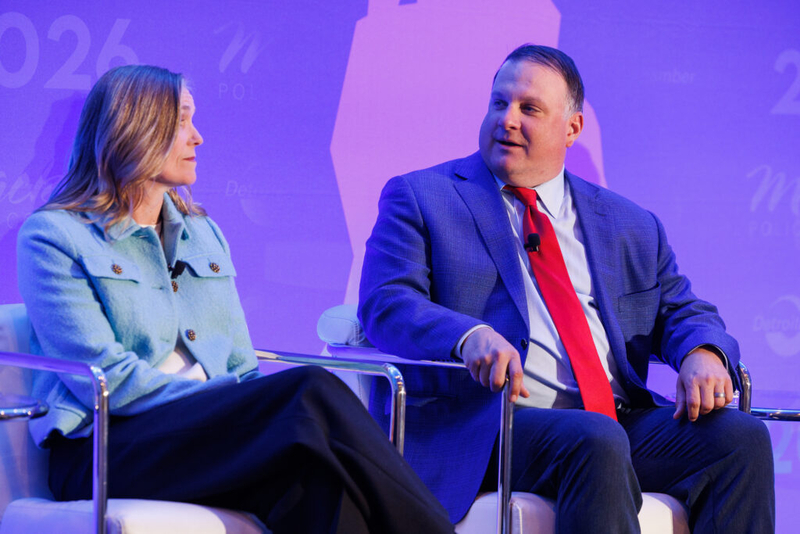
Michigan Senate Majority Leader Winnie Brinks, left, and House Speaker Matt Hall, right, speak during the Mackinac Policy Conference on Mackinac Island, Mich., on May 28, 2026. (Photo by Andrew Roth/Michigan Advance)
MACKINAC ISLAND – Like the rest of the state, the politically divided Michigan Legislature is having trouble finding common ground, and the perpetual drama between the two chambers was on full display during this year’s Mackinac Policy Conference.
Each year, the conference hosts a panel discussion with the respective leaders of the state House of Representatives and Senate. The panel gives attendees and observers from around the state a glimpse into how the two chambers are working together — or against each other — to solve the state’s biggest challenges.
The conference’s theme this year was “a quest for common ground,” a questionable premise with the state and its residents appearing more divided than ever, and the perception by many that business leaders didn’t have the pulse on working people’s problems.
Several attendees throughout the week told Michigan Advance that they, too, were skeptical that the conference’s conception of common ground might be a relic of the past. They also remained skeptical that the conference had the ability to make lasting change for middle- to lower-income earners.
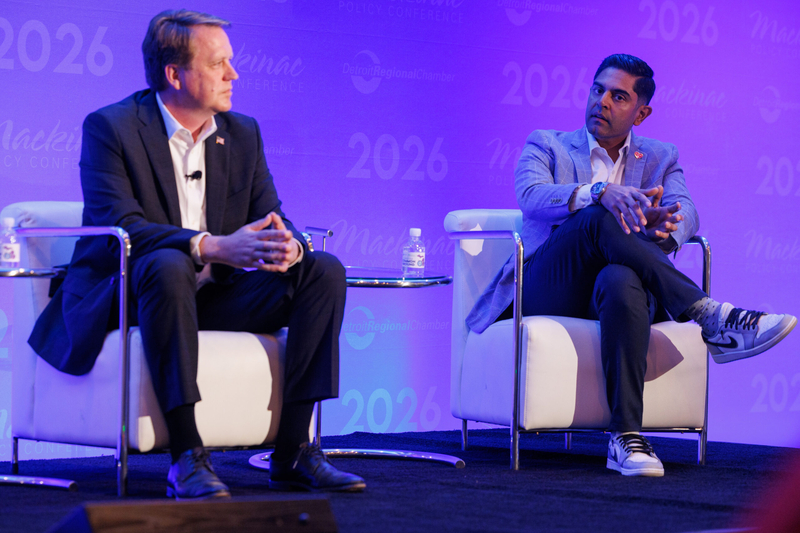
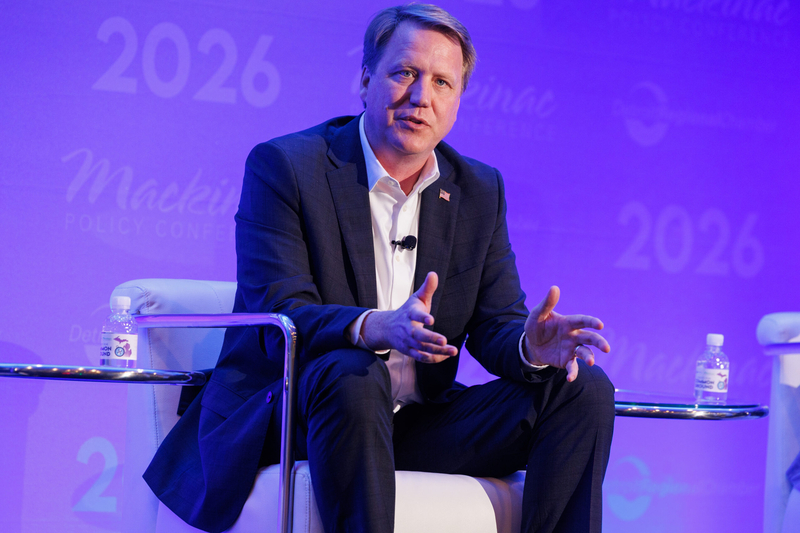
On Thursday, the final event was a panel featuring Senate Majority Leader Winnie Brinks (D-Grand Rapids), House Speaker Matt Hall (R-Richland Township), Senate Minority Leader Aric Nesbitt (R-Porter Township) and House Minority Leader Ranjeev Puri (D-Canton).
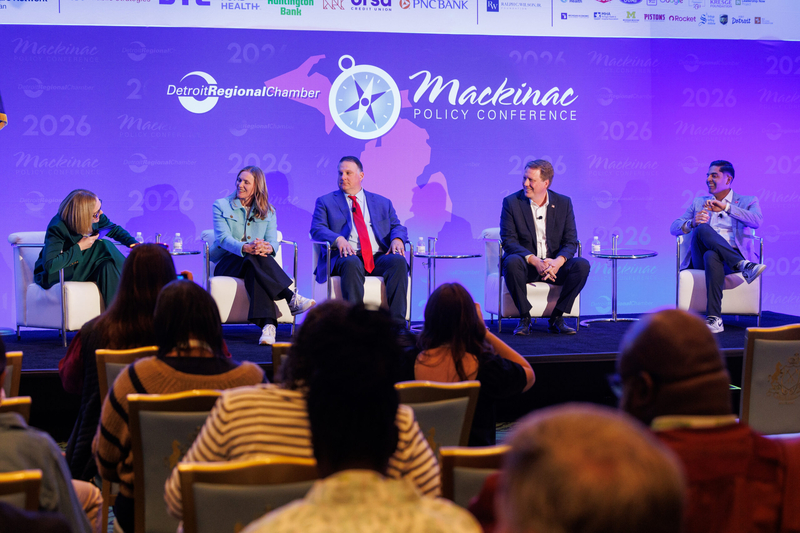
If the panel was meant to further the conference’s quest for common ground, it failed to do so, as simmering tensions finally boiled over.
The biggest hurdle the Legislature will face this year, as in many years, is the upcoming fiscal year budget. The statutory deadline to complete negotiations is July 1, a self-imposed target to enable the state’s public schools to know how much money they’ll receive from the state as they start their fiscal years. There are no consequences for the Legislature if they miss that deadline, other than scrutiny from schools and their stakeholders.
The real deadline is Oct. 1, the date prescribed by the Michigan Constitution to have a budget deal completed and signed by the governor’s office.
Last year, the 2025-26 fiscal year budget came together only after the Legislature blew that final deadline and after an hour-long government shutdown. With the 2026 election season on the horizon, House and Senate observers were hopeful that the need to leave Lansing sooner than later might motivate the chambers to get a budget deal on time.
The panel discussion, however, revealed that the leaders do not see eye-to-eye on how quickly they could hammer out a new budget. It was also revealed that they hadn’t done much negotiating during their time on Mackinac Island.
“We have a lot of work to do, but we can do it if folks are committed to getting in a room and making decisions that need to be made in negotiating the details,” Brinks told panel host Zoe Clark of Michigan Public. “My goal remains to get it to the governor’s desk on time for her to review it and have it signed by July 1.”
That gives the Legislature just one month to hammer out the details. Does that give them enough time to get it done?
“Oh, we’ll see,” Hall said in response. “We had a great meeting, leader Brinks and I and the governor before we came down here. We started some of the table setting, which was good. But I told the leader, and I’ll say it here, once they drop the tax increases and the efforts to raid the rainy day fund, we’ll probably get a deal pretty quickly.”
Those preconditions set by Hall could prove to be this year’s sticking point.
Competing visions for Michigan’s future
Gov. Gretchen Whitmer has proposed a set of tax increases to make up for lower than expected revenue projections and the loss of one-time federal funding left over from the COVID years. The Senate and the governor also see eye-to-eye on using rainy day funds to help bolster this year’s budget. Hall and his Republican colleagues have said that was a non-starter, as they want to eliminate property taxes. The GOP House believes it can continue to cut the budget and backfill those cuts with new revenue from luxury service taxes.
Those factors do not bode well for a consensus budget to form any time soon. Hall in particular is hanging his hat on the property tax reforms, which the governor’s office has indicated it has no interest in signing into law.
Nesbitt said that families are getting squeezed by the state’s budgeting processes, and that it is becoming harder for families to make ends meet. Nesbitt, a candidate for governor this year, didn’t mention the fact that national pressures, such as the imposition of tariffs and foreign policy decisions being made by the administration of President Donald Trump, were having some of the biggest impacts on people’s wallets.
The Senate’s minority leader said he hoped they could return to Lansing and pass some of the House Republican bills that the Senate likely has no interest in taking up, and not the budget overall.
Puri, who could be in line to become the House speaker if Democrats retake the chamber next year, turned the attention back to the budget and the need to get it done on time.
“It’s no different than last year,” Puri said. “Lansing Democrats were screaming from the rooftops on the importance of getting it done on time. The reality is that we have a sizable budget here in Michigan, which millions of Michiganders count on for critical programs that help them across the state.”
Puri added that it was unfortunate when leadership in his chamber, pointing to Hall, has “a warped sense of reality, and wants to continue to use every opportunity to turn everything into a political football, the people of Michigan suffer.”
Bare-knuckle boxing at the Grand Hotel
This is when the gloves started to come off, and all sense of forging common ground ended for the discussion.
Hall accused Puri of having a “negative governing philosophy.” The speaker also invoked another area of tension between the two House caucuses: the participation of former House Speaker Joe Tate (D-Detroit). Tate had become sidelined after the House under his watch failed to push key Democratic priorities over the finish line in a chaotic 2024 lame duck session. He reemerged after Hall named him the House Appropriations Committee minority vice chair, which undoubtedly will drive a wedge between Democrats and their GOP colleagues.
“The difference is Joe Tate will work with us to get a deal, and will represent your caucus well,” Hall said with a grin. “We want to ensure that there’s a vibrant Democrat party with real leaders. … And we’ll do that. We’ll bring in Joe Tate and we’ll get a deal. And he’ll actually participate, something you didn’t do in the last budget.”
That led to questions about who is actually at the negotiating table: The triumvirate of Whitmer, Brinks and Hall? Or Joe Tate and other legislative actors? When Clark asked the panel exactly who was doing the negotiating, the panel sat silent for several seconds.
Brinks finally broke the silence, saying that, from her perspective, it was state Sen. Sarah Anthony (D-Lansing), the Senate’s appropriations chair. She also threw some figurative sand back in Hall’s face.
“She’s very good at it, and that might be what he’s concerned about,” Brinks said of Anthony and Hall. “We are going to continue to do what we’ve done in the past. There’s been a proven procedure of how to get a responsible, balanced budget done, on time, for the people of Michigan.”
Brinks said that wasn’t new, and that Republicans used to know how to get such a budget done on time. That has changed with Hall in office as speaker, she said. Later in the discussion, Brinks accused Hall’s budget proposal as blowing a $5 billion hole in next year’s funding by eliminating much without making it revenue neutral.
Hall said he envisions the negotiations coming down to him and Whitmer and Brinks, but he was still advocating for pushing out Puri, bringing in Tate and involving Nesbitt somehow. That plan effectively also shuts out the House’s appropriations chair, state Rep. Ann Bollin (R-Brighton Township).
At one point in the discussion, Brinks also laid into Hall, noting his penchant for pontification, which she said would set him up nicely “for your next job.”
“I will also add that listening to the folks here, it’s very difficult to take you seriously when you devolve into insults rather than focusing on the task at hand,” Brinks told Hall. “Or when you call everything waste, fraud or pork, when these are essential services that the people of our state rely on and they have paid for. The COVID dollars that came to us were meant to ease the pain and suffering of the people of Michigan and they were expended to do so.”
Brinks also called on Hall and Nesbitt to stop relitigating past budget fights and other woes.
“Four of the last eight years, Republicans were in control,” Brinks said. “So it would be really helpful if you could avoid personal insults and start arguing your policies and your budget ideas on the merits of those ideas. Keep it simple and just get it done.”
Will the election help or hurt the budget process?
Clark brought up the specter of the upcoming election, and how Brinks’ and Hall’s members need them to get it together so they can get back into their districts and campaign for their reelection efforts.
Hall said his focus was not on getting out to go and campaign, but rather to engage with Whitmer and Brinks and keep them at the table to solve Michigan’s various problems. The chamber highlighted those problems at the outset of the event, noting Michigan’s education and economy being ranked near last. Hall added legislative accountability to that mix.
“If we can stay in a little longer and solve that problem, that would be a meaningful change for the people of Michigan,” Hall said.
Nesbitt also said Michigan was at a crossroads.
“We can either just tinker around with the status quo over the next few years, and we’re going to continue to be in the bottom 10 in education, job growth, job opportunities, income growth and education,” Nesbitt said. “Or we can actually shake up the status quo in Lansing. Whether it’s lowering costs … these are real things for real people.”
Despite the back and forth, no one in the room seemed to acknowledge that Flint was still suffering from its 2010-era water crisis, nor that both parties voted nearly unanimously to create a state economic development plan in 2021 that produced few results despite warnings from some lawmakers that it wouldn’t create the kinds of jobs its proponents were hoping for.
Those who went to Mackinac Island last week in search of common ground instead witnessed infighting and panel discussions with half-hearted solutions, leaving one to ask whether the annual meeting was anything more than an opportunity for lawmakers to get their last public jabs in before the real hard work toward finalizing a budget begins.
Lansing, MI