Challenger takes aim at incumbent’s campaign finances in South Dakota US Senate race
Oct 16, 2026 | 7:09 pm ET
Description
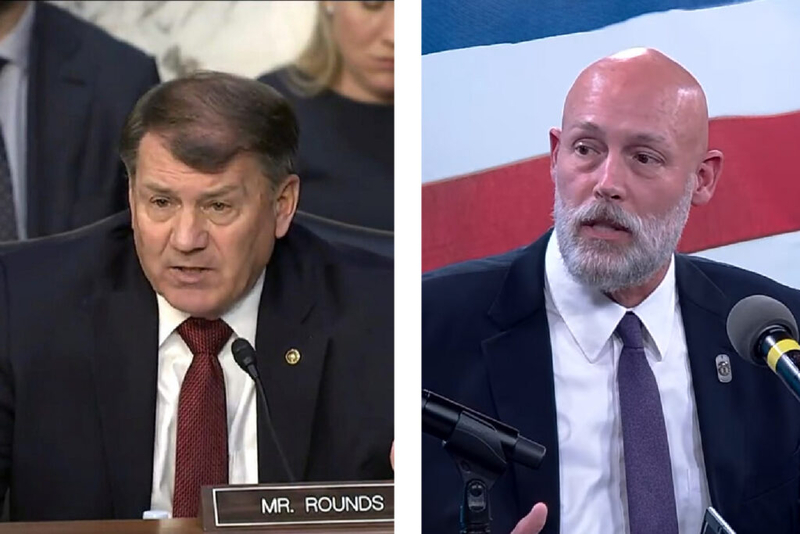
U.S. Sen. Mike Rounds, R-South Dakota, left, is being challenged by independent candidate Brian Bengs in the Nov. 3, 2026, general election. (Photos courtesy of U.S. Senate committee livestream and South Dakota Public Broadcasting)
The candidates for U.S. Senate in South Dakota’s Nov. 3 election have divergent views on the influence of money in their race.
Independent candidate Brian Bengs said voters of all political stripes want campaign finance reform, which will be his “single biggest policy goal” if he’s elected.
“Everybody wants a lot of the same things,” Bengs said. “They want the corruption of money in politics to be reduced or eliminated.”
Bengs has highlighted the sources of money flowing to the campaign of his opponent, Republican U.S. Sen. Mike Rounds.
Last month, Bengs called attention to $200,000 in contributions to Rounds’ campaign committee or associated political action committees, later verified by Searchlight, from people and political action committees tied to tech-company investors and major tech companies such as Meta (owner of Facebook), OpenAI, Anthropic and Alphabet (owner of Google).
Politico reported that Rounds’ senior aide and former chief of staff, Robert Skjonsberg, is registered in South Dakota as a state-level lobbyist for Meta. Wired magazine reported that AI-focused political groups have put nearly $1 million into supporting Rounds.
Rounds co-chairs the Senate Artificial Intelligence Caucus. He has been involved in legislation impacting the tech industry, including being a sponsor or cosponsor of bills that would promote artificial intelligence innovation in the financial services industry, prevent smuggling of American-made semiconductors into China, and boost American manufacturing of robotics.
Rounds said criticisms about the source of his campaign funds are a distraction.
“Does anybody see where I would make a vote that would be different based upon individuals participating in funding my campaign or anybody else’s campaign?” Rounds said. “Everything that we do is reported. Everything that we do is done in accordance with Senate ethics rules and campaign rules. And the reason why folks support me is because they agree with me on my positions.”
Party identities
Bengs grew up in Iowa, served in the Navy and as an attorney in the Air Force, and later worked as a college professor and park ranger. He now lives in Hot Springs.
He is running his second U.S. Senate campaign in South Dakota, this time under a different label after receiving 26% of the vote as a Democrat against Republican Sen. John Thune in 2022.
Independent U.S. Senate candidate Brian Bengs joins the Searchlight Report podcast to share what motivated him to run, and what it could mean to have an independent representing South Dakota.
Republicans outnumber Democrats 2.5 to 1 in South Dakota. The Democratic Party has been further subjugated by the rise of independents and voters who list no party label on their registration, who now collectively outnumber Democrats in the state. The Democratic nominee this year for U.S. Senate, Julian Beaudion, dropped out of the race in August.
Rounds grew up in Pierre, built an insurance and real estate business, served in the Legislature, served eight years as governor, and won election to the U.S. Senate in 2014 and reelection in 2020.
During his time in the Senate, Rounds has helped secure support for the upcoming B-21 stealth bomber mission at Ellsworth Air Force Base near Rapid City, helped address mail delays across South Dakota, and restored funding for tribal radio stations, among other accomplishments.
Rounds alleges Bengs is a Democrat pretending to be an independent to improve his odds of winning in a conservative state. Rounds pointed to indicators such as Bengs’ F rating from the National Rifle Association’s Political Victory Fund, versus Rounds’ A+.
“These are fake independents,” Rounds said of Bengs and other Great Plains Senate candidates running as independents this year. “They’re Democrats.”
As for Bengs, when asked what policy differences he has with Democrats, he mentioned disagreeing with some Democrats he described as supporting “defunding the police,” “abolishing prisons” and “abolishing ICE.” Bengs said “the Biden open border policy” was a “fiasco.”
Bengs was a registered independent before running as a Democrat against Thune. Bengs said he ran as a Democrat that year because independents lack a national party organization that can provide a built-in donor and volunteer network.
This time, he said his independent campaign is relying on small-dollar individual donors, many of whom, he acknowledged, are from out of state.
“I hate this system, this money chase,” Bengs said.
On AI
Rounds said the United States should continue to develop AI because authoritarian nations like China, Russia and Iran are and will continue to develop it. He worries what will happen, he said, if those nations advance ahead of the U.S.
But Rounds said the government should ensure a small number of large AI companies do not dominate the AI market, and the government should not allow AI to become a tool for controlling its own population. He hopes AI can be used for beneficial purposes, like finding a cure for cancer.
Republican U.S. Sen. Mike Rounds of South Dakota joins the Searchlight Report podcast to talk about his friendship with the late Sen. Lindsey Graham, a request for more information about a Wounded Knee Massacre medals review, his support of “clandestine” efforts to investigate Postal Service problems, and the future of water pipeline projects in the state.
Bengs said nations should come together to avoid potential harms to humanity from rogue uses of AI.
“If it can destroy us, it can destroy them,” he said. “So, China and the U.S. are facing the same thing.”
On data centers, Rounds has said they “should only be built if their companies pay their own way and provide the power they consume.” He praised state legislation approved in South Dakota earlier this year that regulates data center water and electricity use.
“I think what the South Dakota legislature did this last year with the governor signing it into law was a great example for the rest of the country,” Rounds said. “How local control is the most important to make sure that, if a data center or any other type of industry comes in, that folks at the local level have the deciding say, in terms of what it is.”
Bengs said he wants a halt to new AI-data center construction until the federal government establishes what he describes as meaningful guardrails. Bengs said he worries about what would-be “CEO-kings” will do with their growing power and influence.
“Let’s stop, pull back the reins right now,” he said. “Let’s not keep building this out until we get something in place to deal with the prospect of a superintelligence that decides for itself what it wants to do.”
Iran war
Bengs said he opposes the U.S. war with Iran. He is worried about the president waging the war without congressional authorization, and said ending the war and its disruption of global oil supplies would improve energy prices and reduce inflation.
Bengs said presidents of the past also had to deal with the threat of Iran, but chose to not escalate it into a war “because we recognized what they would do, which was what they are doing” with the Strait of Hormuz, a shipping route for oil tankers.
3 Republicans break with Trump in US Senate vote to block war in Iran
Bengs said the United States should have pursued nonmilitary methods of dealing with Iran.
“Covert espionage was the preferred method to deal with it because of the prospect of what Iran would do if you launched a full-scale military war,” Bengs said.
Rounds, a member of the Select Committee on Intelligence and the Armed Services Committee, has voted against resolutions intended to check the president’s power to continue the Iran war.
“That would have encouraged the Iranians and their allies, and it would have continued to put pressure on those young men and women,” Rounds said, referring to U.S. armed forces. “I won’t do anything that’s going to put them in harm’s way more than what they already are.”
Rounds said he was privy to information shared with the Intelligence Committee that convinced him Iran’s threat of obtaining nuclear weapons had grown too great, and Trump’s action was necessary.
“I think he made the right decision,” Rounds said.
But Rounds said Trump should have committed to a more decisive military campaign.
“And so that’s the area where, if you’re going to get in, and you’re going to make a commitment, you probably need to be prepared to execute and to finish the job,” Rounds said.
Israel
Bengs said Israel has gone too far in its Gaza war, and U.S. military assistance should be conditioned on compliance with international law.
“There are limits,” Bengs said. “If you’re going to commit war crimes, if you’re going to commit genocide, you do not have our support and you will not receive any additional support until you get on the right side of international law and human rights.”
Bengs pledged to refuse campaign contributions from the American Israel Public Affairs Committee, known as AIPAC. Rounds’ campaign committee and affiliated political action committees have received a combined total of about $320,000 from AIPAC, or people who earmarked contributions toward Rounds through AIPAC, since early 2025.
Rounds said those contributions are from “American citizens here in the United States who feel very strongly that Israel is an ally of the United States,” adding, “I happen to agree that Israel is an ally of the United States.”
Rounds said Israel is a strategic democratic ally in a dangerous part of the world, and the U.S. should continue to support Israel’s war in Gaza. He said the Oct. 7, 2023, surprise attack carried out by Hamas militants from the Palestinian territory caused the response from Israel, comparing it to the U.S. response to the Sept. 11, 2001, terrorist attacks.
“We work with them, we provide them with weapon systems,” Rounds said of Israel. “The benefit to us is, not only do they pay us for those weapons systems, but they in turn improve those weapons systems, and we get the benefit of the research they do to improve the weapons systems.”
Russia and Ukraine
Rounds has backed continued U.S. support for Ukraine’s ability to defend itself from Russia’s invasion, and has supported congressional efforts to pressure Russia. Rounds said he disagrees with President Trump’s recent move to remove sanctions on Russian diesel fuel imports into the U.S.
Bengs also said the United States has a responsibility to support Ukraine, pointing to the 1994 Budapest Memorandum, under which Ukraine gave up its Soviet-era nuclear arsenal in exchange for security assurances. He said abandoning Ukraine would undermine nuclear nonproliferation by giving other countries reason to conclude that nuclear weapons are necessary for their security.

Pierre, SD