Kris Mayes moves to remove David Marshall as Navajo County recorder
May 14, 2026 | 9:11 pm ET
Description
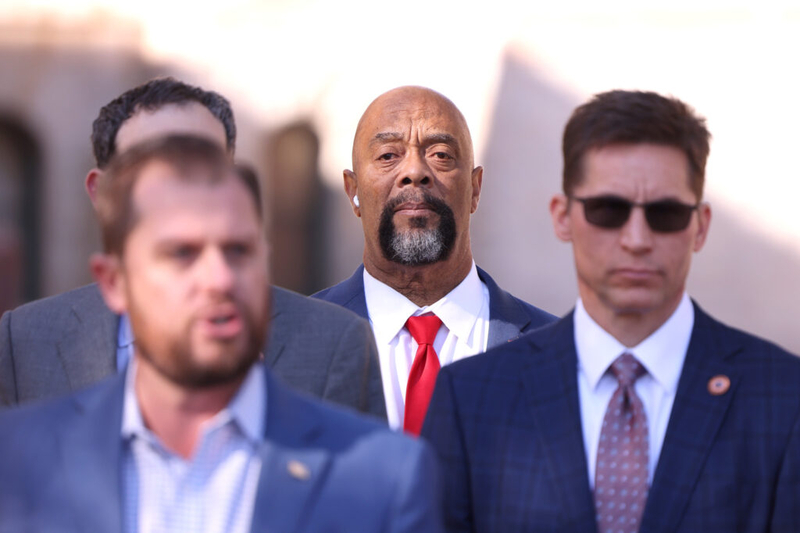
David Marshall in January 2025. (Photo by Gage Skidmore/Flickr/CC BY-SA 2.0)
Attorney General Kris Mayes is asking the courts to remove Navajo County Recorder David Marshall, alleging that his appointment to the post last month blatantly violates the Arizona Constitution.
In a rare legal filing known as a quo warranto — Latin for “by what authority” and designed to prevent the unlawful usurpation of office — Mayes says that, because Marshall was elected to the state legislature in 2024 and was sworn into office in January 2025, the Arizona Constitution bars him from holding any other public office.
The claim centers on a constitutional provision that restricts what public roles members of the legislature can hold during their elected term: “No member of the legislature, during the term for which he shall have been elected or appointed shall be eligible to hold any other office or be otherwise employed by the state of Arizona or, any county or incorporated city or town thereof.”
Mayes contends that the language, particularly the phrasing “during the term for which he shall have been elected,” makes clear that legislators are ineligible to hold another office or work a government job until their two-year term ends.
Last month, the Navajo County Board of Supervisors appointed Marshall as recorder to fill a vacancy created when the elected recorder, Tim Jordan, resigned in January. Marshall resigned his seat in the Arizona House of Representatives three days later and also ended his bid for the Arizona Corporation Commission.
On April 24, Mayes sent a letter to Marshall demanding that he resign and warning him that she would seek to have him removed from office if he didn’t.
“Because your term as an elected representative will not conclude until January 2027, you are not currently eligible to hold another public office or be otherwise employed by the state or ‘any county … thereof,’” she wrote.
Mayes noted that a legal opinion the attorney general’s office issued in 1977 concluded that the constitutional language “clearly prohibits the taking of any other office or employment during the elective term, whether or not the legislator resigns.”
On May 6, Linley Wilson, a private attorney representing Marshall, responded with a letter arguing that Mayes is relying on a 49-year-old advisory opinion — and ignoring Arizona Supreme Court precedent in the process.
Because Marshall resigned from the legislature prior to being sworn in as Navajo County recorder, Wilson wrote, the constitutional provision no longer applied to him.
“The evil that Section 5 was designed to prevent simply does not exist when a legislator, like former Representative Marshall, has resigned from the legislative body before assuming the new office,” she wrote.
And not only has “no Arizona court … ever held that a legislator who resigned before assuming another appointed office was subject to ouster,” but several Supreme Court rulings indicate that the constitutional provision Marshall is alleged to have violated applies only to sitting lawmakers.
For instance, in a 1973 case, the high court found that “the most reasonable interpretation of the subject provision is to hold that ‘member of the Legislature’ is the office” held, not the person who holds the office. And in 1961, the court ruled that a person who was elected to the legislature, but never sworn in, was not disqualified from another post.
“Consistency does not equal correctness, and no number of advisory opinions can override a contrary holding of the Arizona Supreme Court,” Wilson, a former deputy solicitor general at the AG’s Office, wrote.
In a statement, a spokesman for Mayes said the AG was unpersuaded by Wilson’s arguments and believes the courts will side with her and remove Marshall from office.
“The law is clear, Mr. Marshall is not eligible to serve in this office. AG Mayes alerted him to this in late April and asked him to resign — he did not do so, which led to today’s action,” Richie Taylor said.
***CORRECTION: An earlier version of this story incorrectly identified Linley Wilson, Marshall’s attorney, as Lainey Wilson.
Phoenix, AZ