Alabama Gov. Kay Ivey signs primary bills as state seeks to redistrict
May 08, 2026 | 3:20 pm ET
Description
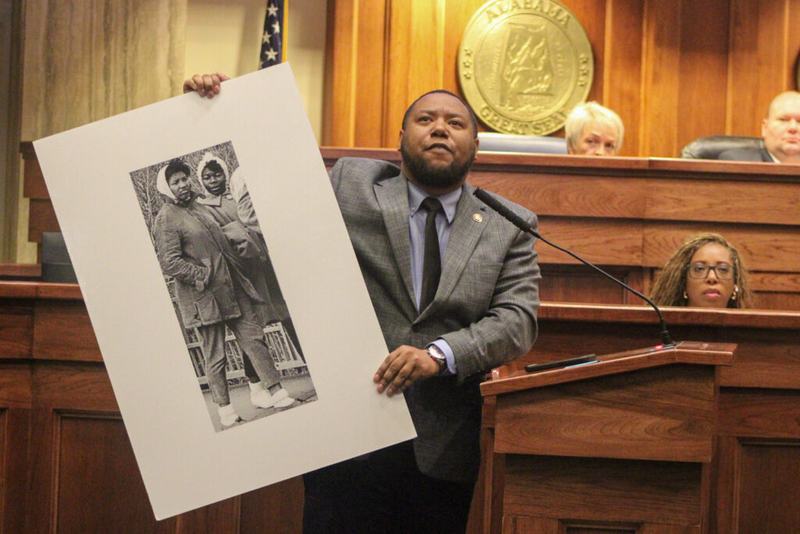
Sen. Robert Stewart, D-Selma, holding a photo of his aunt, who he said marched on "Bloody Sunday" in 1965, on the floor of the Alabama Senate on May 8, 2026, in Montgomery, Alabama. The Alabama Legislature Friday gave final approval to two bills that would set new primary elections in some congressional and legislative districts in the state if the federal courts allow officials to use maps previously declared discriminatory against Black voters. (Anna Barrett/Alabama Reflector)
The Alabama Legislature Friday gave final approval to legislation that would set new primary elections for a handful of congressional districts and two Montgomery-area state Senate districts if a federal court allows the state to use maps it has ruled was discriminatory against Black voters.
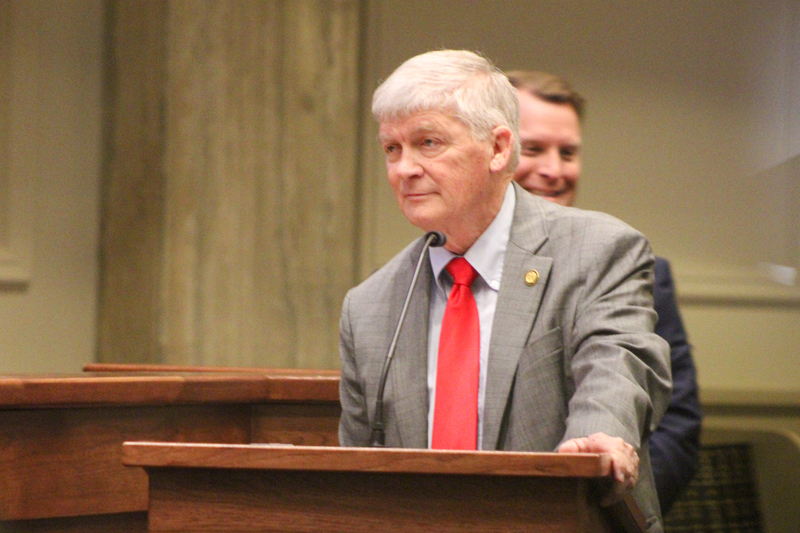
The House Friday approved SB 1, sponsored by Sen. Chris Elliott, R-Josephine, authorizes a special primary election for Alabama Senate Districts 25 and 26 near the state capital. The bill passed on a 75-29 vote.
A few hours later, the Senate passed HB 1, sponsored by Rep. Chris Pringle, R-Mobile which would allow new primaries for certain congressional districts in the state if the U.S. Supreme Court agrees to lift an injunction against the state redrawing its congressional lines until 2030.
Both bills passed after an often-emotional debate that invoked Alabama’s history of segregation and voter disenfranchisement and amid protests in the House gallery.
“And I know we are going to redistrict here at some point, and we are going to look at some of the Census data, and you are going to look at some of the people in this room, you are going to look at me in the face, you are going to shake my hand, say everything nice, and you are going to redraw my district so I can’t come back,” said Rep. Chris England, D-Tuscaloosa.
The session came after the Alabama Attorney General’s Office filed a challenge to a court order last year banning the state from changing its congressional district lines before 2030 and an appeal of U.S. District Judge Anna Manasco’s finding last year that the shape of the Montgomery-area Senate districts deprived Black residents of proper representation and violated Section 2 of the Voting Rights Act. Those moves came after the U.S. Supreme Court’s ruling in Louisiana v. Callais last week, which weakened Section 2.
Gov. Kay Ivey signed the bills early Friday afternoon.
“Alabama now stands ready to quickly act, should the courts issue favorable rulings in our ongoing redistricting cases,” the governor said in a statement Friday.
Democrats said they plan to file a lawsuit to challenge the law under a 2022 constitutional amendment that forbids election law changes less than six months before an election. The ACLU of Alabama Friday said in a statement that it has pending litigation before the Supreme Court in Allen v. Milligan, noting the opinion in the Callais ruling said it did not affect Alabama’s congressional districts.
“For several years now, the court has been consistent: Alabama violated the 14th Amendment by intentionally discriminating against Black voters in its congressional and legislative maps,” ACLU of Alabama Director JaTaune Bosby Gilchrist said in a statement. “The Callais opinion even agrees.”
House debate
Pringle, who carried SB 1 on the House floor Friday, said the bill “does not specify a primary election.”
“The primaries, under state law, are controlled by the parties,” he said. “The parties decide how they want to arrive at their nominees.”
Pringle stood at the podium for roughly three hours to respond to criticism from Democrats against the motivations of the legislation.
“This is a sad day,” said Rep. Marilyn Lands, D-Huntsville. “We have heard from the people over and over during the public hearings, there have been protests, we have all received calls, and texts, and letters, people have reached out, people have been overwhelmingly against what has happened today.”
Democrats repeatedly criticized SB 1,alleging that it dilutes the Black vote and that it would create confusion for the coming primary election.
Pringle, appearing frustrated with all the attacks, referred to court-ordered elections for the Alabama Legislature in 1983.
“The parties decide, just like the Democratic Party did in 1983 when it went into a closed room and hand-picked its legislative candidates,” Pringle said. “I am giving you the opportunity to for all of you to go back into a room and handpick the candidates, just like the Republicans.”
The allegation prompted a strong response from Democrats.
“Do you not realize that was in 1983 and we are now in 2026?” said Rep. Barbara Drummond, D-Mobile. “What year are we in: 2026.”
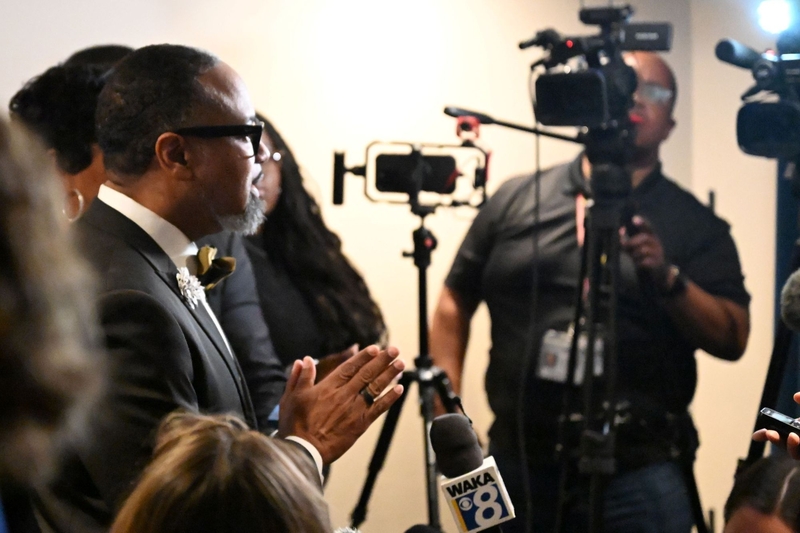
Rep. Napoleon Bracy, D-Prichard, said in a news conference that the Legislature passed the bill in violation of Amendment 4 to the Alabama Constitution, approved in 2022.The amendment prohibited the Legislature from passing any bills to change election law in the state within six months of a general election.
“This was a constitutional amendment on the ballot that the citizens of the state of Alabama voted on overwhelmingly because they did not want any chaos to happen leading up to an election cycle,” he said. “We have heard this from the Attorney General’s Office before, we have heard this from the Secretary of State’s Office before, and now, for some reason, they think they can violate our state’s constitution.”
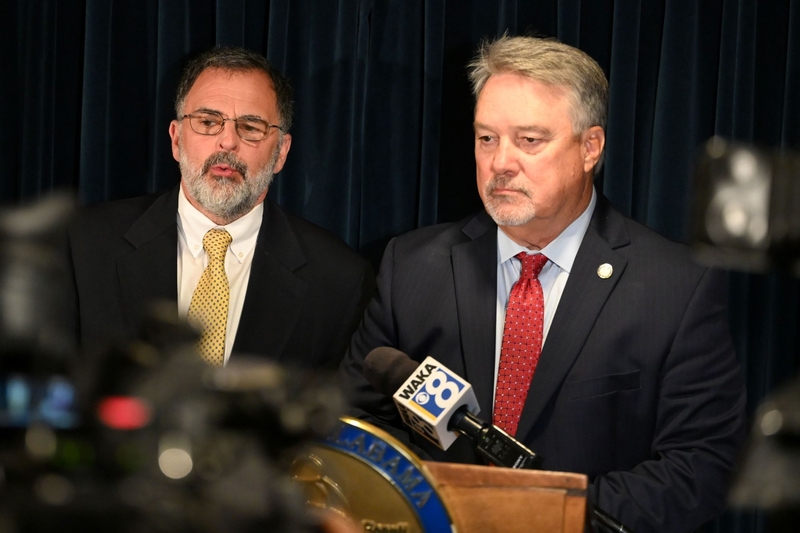
House Speaker Nathaniel Ledbetter, R-Rainsville, said in a news conference following the Democrats that he hopes the courts will reverse the current injunction.
“I applaud the Governor for calling us in and giving us the chance to revisit that,” he said. “What happened here in Montgomery with that seat probably should not have happened to begin with.”
He said it was the Legislature’s job to draw the district lines, “and for the court to interfere with that, and to be honest with you, I thought it was a slap in our face because we spent hundreds of thousands of dollars in reapportionment redrawing those lines, and we let an 18-year-old kid send a map in and they took it.”
Protests
About an hour into the session, a protest erupted in the House gallery that resulted in Dee Reed of Black Voters Matter getting removed from the building. Democratic state representatives went up to the gallery to intervene just as building security and state troopers were attempting to remove Dee Reed of Black Voters Matters from gallery amid the protest.
Several security personnel, along with law enforcement, grabbed Reed on the edge of the gallery and dragged her from her seat to the exit door. Along the way, Reed went to the floor and personnel surrounded while on the ground to try and subdue her. Once they gained control, they began to escort her to the exit and eventually head out of the building.
People in the gallery could be heard yelling, “Let her go, let her go” as troopers were attempting to escort her.
“They had her on the ground, with white state troopers and others, pinning her to the ground,” said Rep. Juandalynn Givan, D-Birmingham, who attempted to intervene.“Too many emotions. This is taking me back, and to see a Black woman being pinned down in Alabama, in the statehouse, by state troopers, it is unacceptable.”
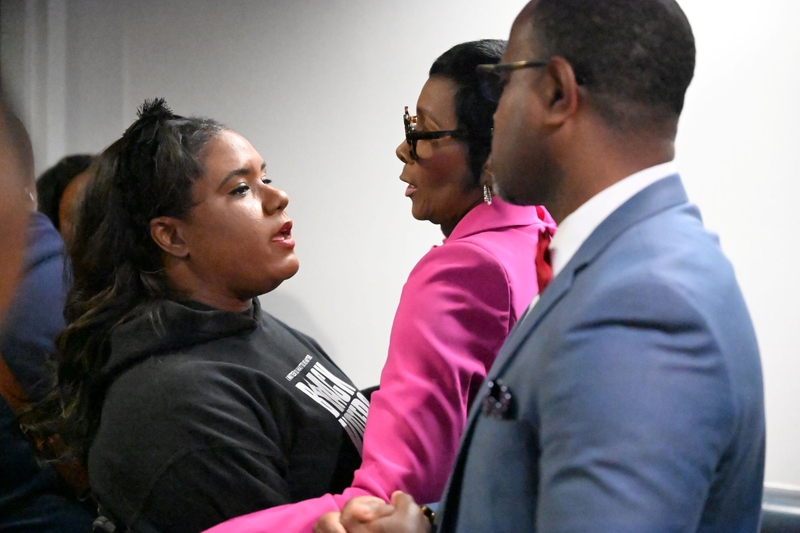
“However she was treated, it was wrong, unacceptable,” said Rep. Ontario Tillman, D-Bessemer. “She had every right to be here in the people’s house. That is the whole point of this. She has a right to protest. She has the right to use her voice, and that is what she was doing.”
The House recessed amid the protest but resumed debate late Friday morning.
“This is the people’s house and we are discussing issues that are serious,” England said after debate resumed. “People will get emotional when we are talking about representation and engaging in fights we thought we already dealt with.”
‘A sin and a shame’
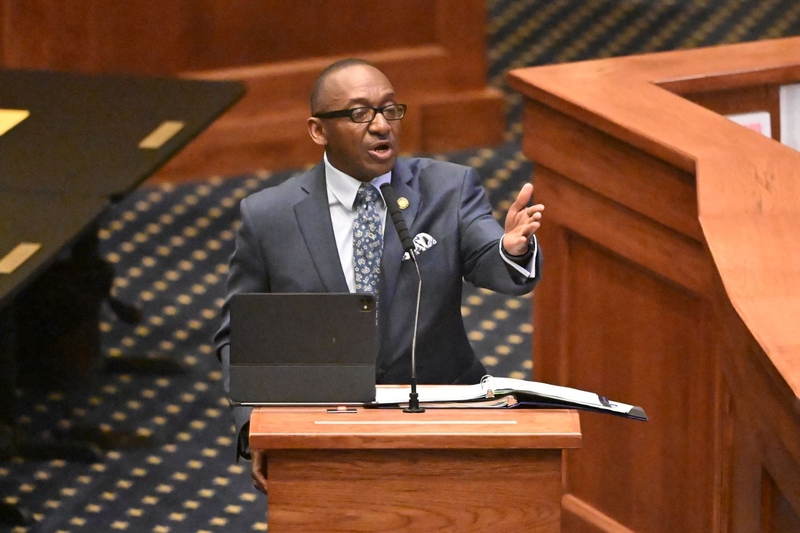
In the Senate, all eight Democrats spoke on HB 1, carried by Sen. Greg Albritton, R-Atmore. The law would set up new primary elections for congressional districts 1, 2, 6 and 7, if a federal court lifts an injunction preventing the state from using the congressional map the Legislature passed in 2023.
Albritton said that the law is conditional on the U.S. Supreme Court’s actions. Senate Minority Leader Bobby Singleton, D-Greensboro, pushed back, saying it is more than that.
“I think it goes a little bit deeper than something being conditional. For some it may be just politics, and we’re trying to help Washington give a little power for the midterm,” Singleton said. “The courts did not ask us to be here today, and Callais did not ask us to come here and do what we’re doing.”
Singleton also said that the law goes against Supreme Court Justice Samuel Alito’s majority opinion in Callais that said the ruling does not affect the state’s redistricting case known as Allen v. Milligan.
“They weren’t dealing with us. So for you to come here and say that you’re only complying to what Callais said, you’re wrong,” Singleton said.
Albritton said that the law is not about race, but about partisan politics.
“I was agreeing with you that the maps we drew were partisan. They were designed to benefit the Republican Party,” Albritton told Singleton. “I did not say that they were race based.”
In the Callais decision, the Supreme Court ruled that racial discrimination with intent does violate Section 2 of the Voting Rights Act, but redistricting in the name of party does not. Texas, California, South Carolina, Tennessee, Florida and Virginia have either redistricted to give either party more guaranteed congressional seats in the 2026 midterm elections, or are in the process of doing so.
Albritton said that district lines should be drawn based on “economics” and “physical geographic boundaries.”
“The Republican-controlled Legislature has the duty and the right to draw the maps in a way that reflects the partisan nature of it,” he said. “I think the partisan nature of it is reflective of the numbers of people that were on the committees and such, but I don’t think there was an exclusion in that.”
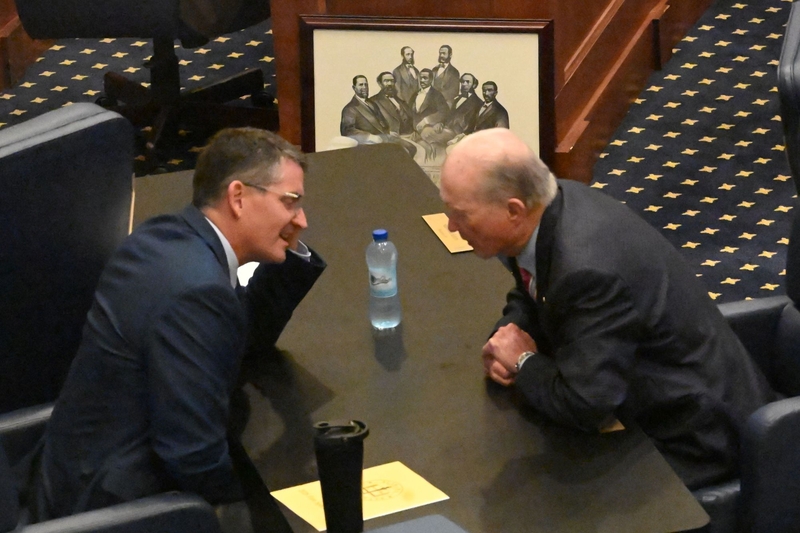
Sen. Robert Stewart, D-Selma, said the special session and the legislation was a call back to the Civil Rights Movement, which his family participated in.
“My mama’s Mama was a nurse on ‘Bloody Sunday’ at Good Samaritan Hospital. Called into work, left her husband, my grandfather, left her babies to treat legendary protesters on ‘Bloody Sunday,’ all who just wanted the right to vote,” he said.
He held up a photo of his aunt, who attempted to march from Selma to Montgomery on “Bloody Sunday” on March 7, 1965, but was beaten by counter protesters.
“My aunt bludgeoned, on the Edmund Pettus Bridge, tear gas, billy clubs, trampled over for the right to vote not a long time ago,” he said. “We didn’t even have the Voting Rights Act intact for 50 years. That is a sin and a shame.”
Sen. Vivian Davis Figures, D-Mobile, who is the mother of U.S. Rep. Shomari Figures, D-Mobile, said that she is not worried about her son losing his job in Washington, D.C., she is instead worried about the voices of his constituents. If the Supreme Court overturns the 2030 injunction, the state would revert to a 2023 map approved by the Legislature that federal courts later ruled to be racially discriminatory. Figures’ district, drawn by a court, would be the most affected; the Black Voting Age Population (BVAP) would drop from 48.7% to 39.9%, likely making it Republican-leaning.
“We’re debating whether every citizen in Alabama deserves equal representation under the law. We’re debating whether power matters more than principle,” Figures said. “We are debating whether this Legislature will honor the Constitution of the United States and the Voting Rights Act, or whether we will openly defy both.”
Attorney General Steve Marshall said this week that Black Alabamians are “better off” with a Republican representative. Figures strongly disagreed.
“If approximately 30% of Alabama’s population is minority, why should minority voters effectively receive only one meaningful congressional opportunity district out of seven?” she asked.
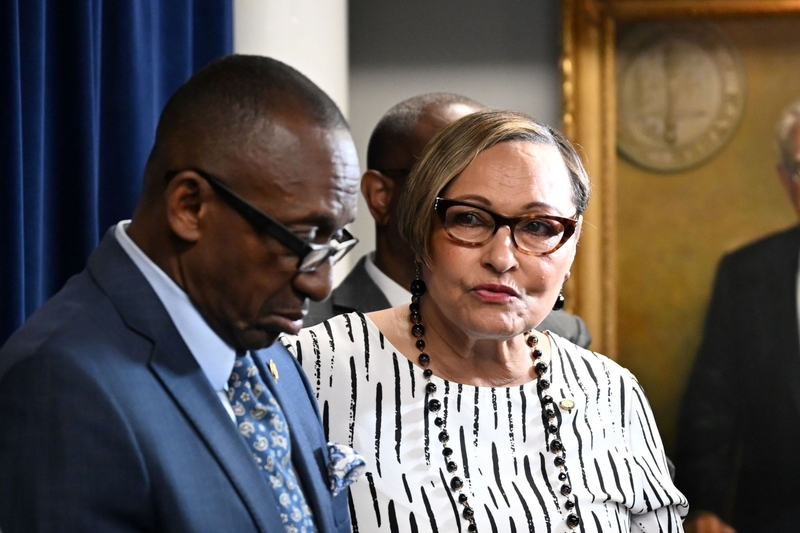
Singleton spoke again before the chamber passed the legislation 27-8, warning his colleagues that the law not only violates multiple court orders but also the state constitution. Voters in 2022 approved an amendment to the state constitution that prohibits changes to a general election within six months of an election. The last effective date for 2026 legislation affecting a general election was May 3. The special session began on May 4.
“I don’t know how we’re better off in a red state as a people, if we are still at the bottom,” Singleton said. “Don’t get mad when I post each and every one of your pictures to show that you voted, because it would be the truth, against the Voting Rights Act. You voted against people having a voice in Congress.”
After the Senate adjourned, Senate President Pro Tem Garlan Gudger, R-Cullman, said the constitutionality question “pisses me off.”
“The judicial system, which is a different branch of government, is the one that has put that in front of us so that is what we’re doing, to be prepared and ready,” Gudger said. “We’re trying to comply with those rules.”
As of Friday at 4 p.m., neither court had lifted their respective orders.
Sen. Linda Coleman-Madison, D-Birmingham, said after the adjournment that regardless of the outcome, lawmakers are accountable to their voters.
“These same people, my colleagues on the other side, they’ve got to go back and face their voters. They have minority people, people of color, and a diverse population in their own districts. They’re going to have to go back and explain to them how they feel that, ‘Hey, we don’t really feel that you should count. Even though I’m supposed to be your representative, I don’t feel that you should count,’”she said. “The bottom line is that the voters have the last word.”
Updated at 2:46 p.m. with Gov. Kay Ivey signing the bills and comments from Ivey and the ACLU of Alabama and at 5:30 p.m. with the Senate debate.
Updated Monday, May 11 at 12:03 p.m. to clarify that the ACLU of Alabama has not filed any litigation as of Monday afternoon.
Montgomery