Rockland County School District Sues State for Blocking Its Superintendent Pick
Apr 30, 2026 | 5:30 am ET
Description
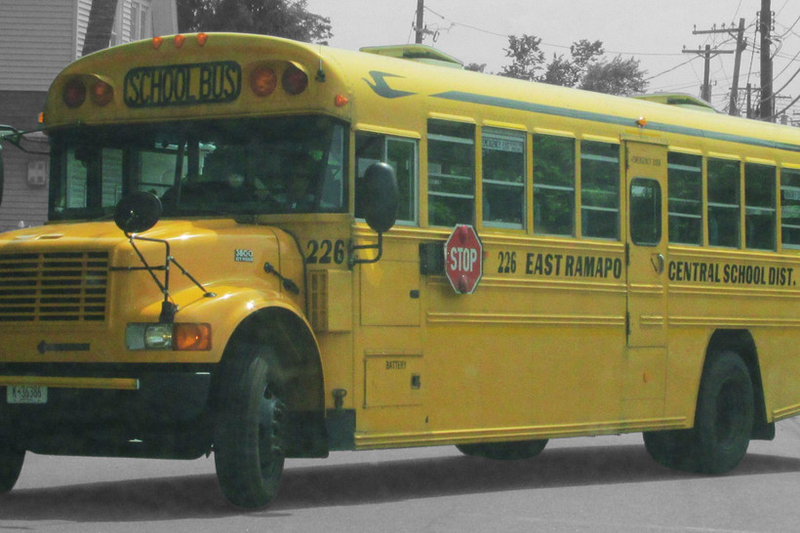
East Ramapo budget cuts have contributed to to high dropout rates, chronic absenteeism, unsafe building conditions, and transportation disruptions in the public school system. / Photo: ThoseGuys119/Flickr | Illustration: New York Focus
Update: April 30, 2026 — After publication, the Albany County Supreme Court rejected the East Ramapo school board’s request to pause the superintendent search during litigation. The State Education Department then informed the board that the commissioner’s directive to interview additional candidates still stands and must be completed by May 15. The legal case is ongoing.
A Rockland County school district that has been at the center of numerous scandals — including lawsuits, state investigations, and federal probes — is suing the state for rejecting its unanimous choice for superintendent.
The lawsuit was filed last week by East Ramapo Central School District and its board, which have been overseen by state-appointed monitors for over a decade after it slashed public school funds to bankroll private religious education.
Since 2005, East Ramapo’s school board has been divided between public school parents and Orthodox Jewish parents who send their kids to private yeshivas, with the latter making up the board’s majority. For years, the board eliminated critical staff positions, cut programming, and mismanaged its finances, contributing to high dropout rates, chronic absenteeism, unsafe building conditions, and transportation disruptions in the public school system.
Grappling with repeated turnover among superintendents, the school board launched a new search for a permanent leader late last year. But that effort has hit a standstill, with the district and state at odds over who should take the helm. If the impasse continues, the state says it may have to install its own choice.
In the lawsuit, filed on April 23 in Albany County, the board claims the state-appointed monitors allowed its top choice for the superintendent job to move through the final rounds of the interview process before rejecting her “without any explanation, rationale or guidance.”
The district is requesting that the court vacate the monitors’ decision and allow the board to hire its previously recommended candidate, and also to pause the superintendent search while the litigation is ongoing.
In a statement provided to New York Focus, State Education Department spokesperson JP O’Hare said that while the agency does not typically comment on litigation, “it is necessary to set the record straight given the frivolous nature of this lawsuit.” He said that while the board’s preferred candidate had academic strengths, she lacked the operational experience necessary to address the complex and urgent issues the district faces.
Board President Shimon Rose, several other board members, and the school district’s attorney, Barbara Marissa Maisto, did not respond to requests for comment. At a meeting last month, Rose updated the community on the dispute, emphasizing that the monitors were involved in every stage of the hiring process and had allowed the board’s preferred candidate to move to the final round.
“The board felt there was no better candidate to serve the students’ needs and provide the dedication and leadership our district desperately needs,” he added.
The rejected candidate’s identity has not been made public. The lawsuit describes her as “a seasoned educator with experience in multi-cultural and diverse population school districts,” as well as “Latina and a resident of East Ramapo.”
Sabrina Charles-Pierre, the board’s longest-seated member, first ran for the seat in 2015 to represent the interests of the public school community. “We still don’t know the reason,” Charles-Pierre said about the state’s rejection. “It just makes me question their agenda and the purpose of why they were involved to begin with.”
When Charles-Pierre attended school in East Ramapo decades ago, its students outperformed state averages on exams. Today, the public school graduation rate is 15 points lower than the state average. Just 21 percent of third graders are proficient in reading, compared with 54 percent statewide.
After members of the local Orthodox Jewish community won a majority of the seats on the public school board, it made headlines for cutting millions of dollars from the budget while it spent more on private schools, including on the district’s “universal bussing” program that provides transportation to yeshiva students regardless of how close they live to their school. (In a 2014 statement to The Journal News, former board president Yehuda Weissmandl said they had to make cuts to balance the budget and that the district has “struggled for a long time with misconceptions that are resistant to fact.”)
“We want to be able to stand on our own two feet eventually and to get this district to a place where we don’t have to worry about oversight.”
—Sabrina Charles-Pierre, East Ramapo school board member
East Ramapo now serves roughly 10,500 public school students, most of whom are economically disadvantaged, students of color, and learning English as a second language. It’s one of the few districts in New York where more students — around 30,000 — are enrolled in private schools than in public schools.
It is also one of five where the state is attempting to mitigate severe fiscal stress, academic failure, or leadership dysfunction by assigning monitors, who serve as nonvoting board members, advising on operations, recommending cost-saving measures, and reporting on district performance. In 2021, the state expanded the authority of East Ramapo’s two monitors to include veto power over board actions that violate state rules or conflict with improvement plans, including superintendent hiring decisions.
Charles-Pierre said she sees the benefit of state intervention, and that in recent years, she hasn’t observed board members acting in favor of private schools. Despite their differences, current board members have been committed to improving the public school system, she said, but years of leadership turnover have hampered those efforts.
In the 11 years Charles-Pierre has been on the school board, she said she has worked with five superintendents and interim superintendents and roughly 10 state monitors.
“Consistent leadership is the solution,” she said. “But it has to be the right person who is willing to move the district forward with no personal agenda.”
The school board unanimously selected someone for the superintendent job in March after a monthslong vetting process that the state monitors were involved in, choosing from a monitor-approved list of finalists, the lawsuit states. The monitors then rejected the board’s choice and requested they pick someone else. The lawsuit alleges that this is the second time in as many years that the monitors have vetoed the board’s unanimous pick for the job, describing “a pattern of obstruction” that has deprived students of stability and high-quality leadership.
In the following weeks, board members filed an appeal with State Education Commissioner Betty Rosa, who signed off on the rejection. In an April 16 response, Rosa countered that the monitors had explained their decision, and again directed them to pursue other candidates. She warned that if the impasse does not resolve in the coming months, she will consider appointing a superintendent herself.
O’Hare, the department spokesperson, reiterated in his statement that the monitors discussed the rejection with the board on multiple occasions, including on a March Zoom call and at a public forum held earlier this month.
The board is “attempting to force through a superintendent candidate who does not possess the full range of skills required to lead a district facing significant operational and systemic challenges,” O’Hare wrote.
A copy of the candidate’s resume included in the lawsuit describes her as a bilingual educator with over 20 years of experience in schools, including as an associate superintendent at a district serving 24,000 students; an assistant superintendent for curriculum, instruction, and assessment; and a middle and high school principal.
O’Hare said the state has a legal responsibility to ensure that East Ramapo students receive a high-quality education, and that the state’s monitors will continue to work to ensure the candidate hired has demonstrated their capacity to lead the district.
“Unfortunately, this filing reflects a troubling pattern,” he said. “The board has chosen to prioritize its own interests and advance a campaign of misinformation rather than focus on the needs of the public school students it is entrusted to serve.”
Charles-Pierre maintains that the monitors never informed the board that the candidate was rejected due to a lack of operational experience. She added that the district will never be able to find a candidate who has experience leading a district as unique as East Ramapo.
She believes the state should replace the district’s current monitors because they haven’t cultivated strong enough relationships with board members, resulting in poor communication and a lack of transparency.
“We want to be able to stand on our own two feet eventually and to get this district to a place where we don’t have to worry about oversight and eyes watching over us,” she said, “But the only way we can do that is if we all work together. Until then, it’s an ongoing fight.”
Albany