Governor OKs new development law despite rejection of similar measure by Oklahoma voters
Apr 28, 2026 | 6:30 am ET
Description
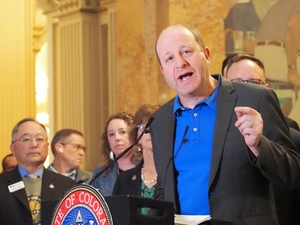
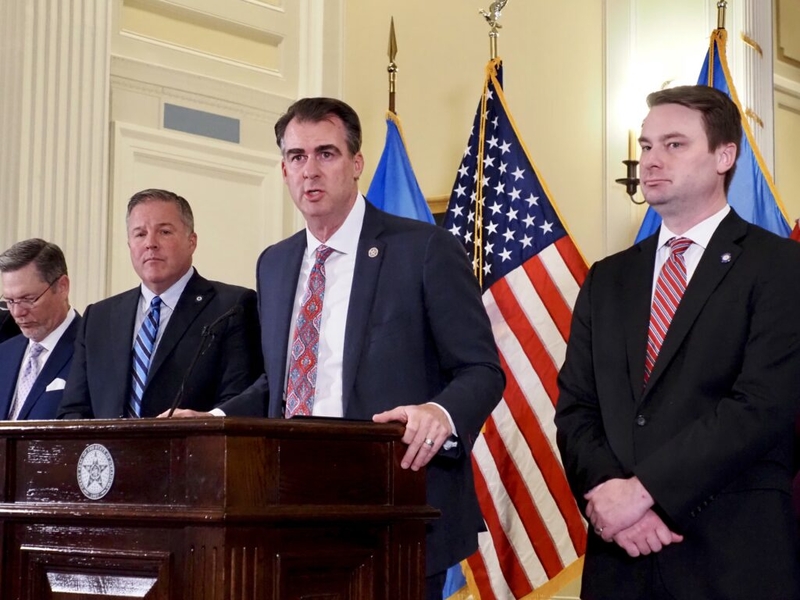
Gov. Kevin Stitt speaks at a news conference April 1, 2026, announcing details of the Fiscal Year 2027 state budget. He is flanked by legislative leaders at the state Capitol in Oklahoma City. (Photo by Nuria Martinez-Keel/Oklahoma Voice)
OKLAHOMA CITY — A new law heralded by Oklahoma Republicans as a method to grow the state’s housing supply appears remarkably similar to a ballot measure that voters soundly rejected less than two years ago, critics say.
State Rep. Andy Fugate, D-Oklahoma City, said Gov. Kevin Stitt’s decision to sign Senate Bill 2060, allowing for the creation of public infrastructure districts, ignores the will of the voters, who rebuffed a similar state question. The 2024 state question, which was rejected by 62% of voters, would have given developers the ability to levy debt against property owners.
“I think it’s disappointing to see the Legislature once again ignore the will of the people, the people who clearly said ‘no.’ And the Legislature said that doesn’t matter,” Fugate said.
Supporters though say while there are similarities between the new law and the failed state question, the two have different financing structures.
The BUILD Act, which takes effect Nov. 1, allows local governments, such as city councils or county commissioners, to approve the creation of public infrastructure districts for residential or commercial development purposes. All property owners in the district must agree to its creation, which initially could be just the developer.
As the property is developed and residents buy into the district, they will be required to pay an assessment to pay for the cost of the infrastructure district. The local government would create a governance system for the district, like a board of trustees, which would eventually transition to be made up of homeowners.
Voters in November 2024 voted down State Question 833 that would have made changes to the state Constitution by allowing for the creation of public infrastructure districts to pay for things like sidewalks, water lines, sewers and roadways. Much like the new law, property owners would have been able to create one of these districts and sell bonds backed by property taxes to pay for the improvements.
The BUILD Act expands on existing statute and is not a constitutional change.
Fugate, who voted against the measure, said he’s frustrated that lawmakers are circumventing the will of Oklahoma voters and allowing the creation of “public infrastructure” that isn’t actually public.
He said “savvy developers” don’t need help from the state, the Legislature or the taxpayers of Oklahoma to build the “next high-end gated community.”
“In a nutshell, you can, under the provisions of the bill, create a state-sanctioned homeowners association which has this incredible ability to spend money and force people to pay for it all in the name of public infrastructure,” he said. “But that public infrastructure includes things like a library within a gated community or a golf course within a gated community, which is very clearly not what people think of as public infrastructure.”
Fugate said he’s concerned that people who have to pay more to live in those districts may reject local bond issues in an effort to decrease their cost of living.
“Their kids, oftentimes, especially in these gated communities, are not attending the public schools, so there’s no reason for them to impose property taxes on themselves for things that they won’t feel the benefit of,” he said.
Rep. Mark Lawson, R-Sapulpa, who authored the bill, said those who don’t like the BUILD Act don’t have to live in these districts.
Housing is a need across the state, and with that comes a need for more commercial properties, he said. This legislation is a way to encourage development across Oklahoma, Lawson said.
“What we’re doing here is very specific that it’s only the people inside of (a district), the rest of the city doesn’t pay for this” he said. “I think what is in this bill is much more prescriptive of what the state question would have been. But I just think there was a lot of misinformation that was put out about what the state question did, and I saw a lot of the same concerns that were founded on bad information about what the BUILD Act does.”
The creation of the districts is overseen by people elected at the local level who know what their communities need, Lawson said.
“There’s no way that these things can run afoul unless a current city council says, ‘Oh, yeah, go do whatever you want,’” he said. “The thing is, city councils can do that today, they don’t need the BUILD Act to do that. It changes nothing about how our cities are governed, how our local counties are governed.”
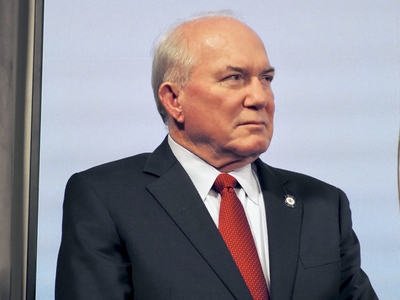
Sen. John Haste, R-Broken Arrow, was the author of both the BUILD Act and the resolution that put State Question 833 on the ballot in 2024. He said the financing structure of the BUILD Act is entirely different from the state question and does not deal with property tax revenue.
“It also doesn’t take away anything from cities or counties, because if it’s within a city, it has to be approved by (the) city council,” he said. “If it’s an unincorporated area, it has to be approved by the county commissioners. So the financing will be paid for by the developers and the individuals within this area.”
People who are looking to buy a house or open a business in a district will be notified that they’ll have to pay a certain amount to cover the cost of the bond, Haste said. The BUILD Act will not count against a city or county’s bond capacity, he said.
“If it’s an existing area where it’s already been built out, let’s say they want to bond for some new water, new sidewalks, whatever infrastructure,” he said. “Then 100% of the surface owners, so if you have a house or business there, have to agree to it. Even one person can say no, it cannot happen.”
Haste said the Governor’s Office had reached out to him to carry this legislation.
“I think at the end of the day, it’s so simple that some people think there’s got to be a catch and there’s not,” Haste said. “Because, again, there’s checks and balances all the way through.”
Stitt has been among the law’s most ardent supporters. He signed the bill earlier this month after the House approved the measure 54-40 and the Senate passed it 29-14.
“States like Texas, Florida, and Utah have used similar tools to support rapid, high-quality growth, and they’ve seen real results,” Stitt said in a statement. “The difference is that we’ve taken what works and built a better model for Oklahoma that protects taxpayers, strengthens local control, and helps us stay a top destination for families and businesses.”
A spokesperson for Stitt did not answer specific questions about concerns that the BUILD Act is too similar to State Question 833.
The Oklahoma Municipal League, a group representing Oklahoma’s local governments, was involved in drafting the language of the BUILD Act and celebrated it becoming law.
The act allows local jurisdictions across the state to create housing while allowing the “burden of infrastructure costs to be paid by builders and investors while maintaining local control,” the group said in a news release.
Oklahoma City, OK