Arkansas lawmakers, ALICE advocates anticipate affordable housing legislation in 2027
Apr 16, 2026 | 6:53 pm ET
Description
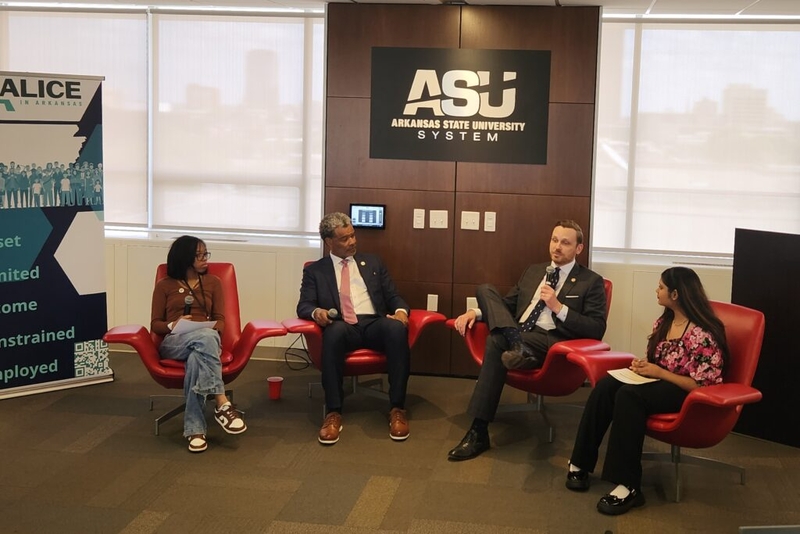
Democratic Rep. Jay Richardson of Fort Smith (second from left) and Republican Rep. Jeremiah Moore of Clarendon (second from right) answer questions about housing affordability from ALICE Youth Leadership Coalition members and Little Rock Central High School students Eluana Otis (left) and Samidhi Mudalige (right) at the Arkansas State University system office in Little Rock on April 16, 2026. (Photo by Tess Vrbin/Arkansas Advocate)
Arkansas youth leaders led a discussion Thursday with state officials to brainstorm affordable housing policies aimed at low-income workers.
Lawmakers from both parties attended the Little Rock event hosted by the ALICE Youth Leadership Coalition, a statewide group of young Arkansans who work to raise awareness of the asset-limited, income-constrained, employed (ALICE) population. ALICE signifies households earning enough money to be above the federal poverty line but struggling to afford necessities like housing, food and health care.
According to a 2025 report from United for ALICE, a research movement led by United Way of Northern New Jersey, 44% of Arkansas households were part of the ALICE population or lived below the poverty line in 2023, a 3% decrease from 2022.
Several attendees said Thursday’s discussion about housing policy intended to lay the groundwork for next year’s legislative session.
“I think there will be a certain focus on affordability in the 2027 session,” said Republican Rep. Jeremiah Moore of Clarendon, who is running for a third House term.
Charles Blake, a former Democratic state representative and current Southern Bancorp executive, said in an interview that ALICE advocates want lawmakers to support low-income housing tax credits, down payment assistance programs and recurring funding for the Arkansas Housing Trust Fund, which has sat empty since its establishment in 2009.
Moore and his Democratic colleague Rep. Jay Richardson of Fort Smith answered a series of questions about housing affordability from ALICE Youth Leadership Coalition members and Little Rock Central High School students Eluana Otis and Samidhi Mudalige.
Richardson said one policy that should help Arkansans’ pocketbooks is the proposed increase of the homestead tax credit from $600 to $675. The credit was $375 at the beginning of 2023.
On Wednesday, the House approved a resolution to introduce a bill to raise the tax credit. The Senate plans to take up an identical resolution next week. Two-thirds approval in both chambers is required for non-fiscal bills to be introduced during the Legislature’s fiscal session, which focuses on the state budget.
Moore represents a large rural district in east Arkansas and said he is considering sponsoring legislation next year to make homeownership easier for rural Arkansans. He also said he would support a tax credit for homebuilders to build houses on existing lots in smaller cities. The second proposal would likely require support from legislative leadership and the governor’s office in order to advance, he said.
Otis said she has seen other Central High students pursue trade school instead of four-year degree programs as a path to financial stability.
“I feel like expanding that in Arkansas would be very helpful to these ALICE families and just students in general,” Otis said.
Little Rock