Senate rushes Community Trust Act through, limiting immigration cooperation
Apr 11, 2026 | 8:29 am ET

Description
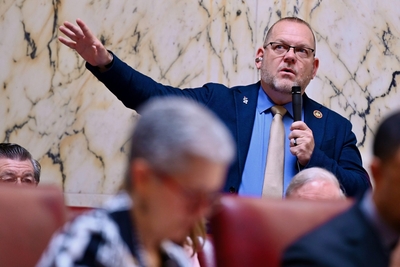
Sen. Charles Sydnor (D-Baltimore County) speaks to Sen. William C. Smith Jr. (D-Montgomery), chair of the Senate Judicial Proceedings Committee. (Photo by Bryan P. Sears/Maryland Matters)
The Maryland Senate approved a measure Friday night that would limit cooperation with Immigration and Customs Enforcement, closing what advocates said was a loophole in state efforts to clamp down on working with federal immigration officials.
The 29-13 vote sends Senate Bill 791 to the House with just a few days left before the 90-day legislative session ends at midnight Monday. The House is scheduled to work Saturday, but it’s not clear if the bill can reach the floor by then.
A House version of the bill, sponsored by Del. N. Scott Phillips (D-Baltimore County), has yet to get out of committee, making the Senate bill the likely vehicle for action in the next few days.
The bill would close a loophole that lets local law enforcement agencies and jails detain individuals based on their immigration status and requests from ICE. Supporters have said the bills, labeled the Community Trust Act, complement legislation signed into law earlier this year that bans the so-called 287(g) agreements between ICE and local law enforcement agencies.
“Tremendously proud to have gotten it done,” said Sen. William C. Smith Jr. (D-Montgomery), who voted for the bill and defended it on the Senate floor. “It’s going to make a huge difference and a bold statement on behalf of the state that we’re a welcoming place that respects public safety and due process and constitutional rights.”
Senate Minority Whip Justin Ready (R-Frederick and Carroll), who voted against the bill, said it brings an “unintended consequence.”
“You do not want to be on the side to be protecting criminals who are also here illegally,” he said. “This bill has way too many loopholes to where you’re not allowing law enforcement to do their job to protect us.”
One of the main portions of the amended version of the bill, sponsored by Sen. Clarence Lam (D-Anne Arundel and Howard), adds a “covered individual.” That includes a person detained in a local or state correctional facility who may be notified to ICE if they were convicted of a felony in the United States, are a registered sex offender, or who served at least 12 months in a state prison.
But the Senate added a fourth provision Friday during more than two hours of debate. The “friendly amendment” from Sen. William G. Folden (R-Frederick) would add a person who committed an offense in another state and served at least five years in prison “and the individual completed at least five years of incarceration of that sentence.”
The bill retains language that local authorities could only act if they receive a judicial warrant, not an administtrative warrant issued by the federal Department of Homeland Security, the Department of Justice or agencies.
But the amended version adds that a district court commissioner, or a judge, may consider “the existence of an immigration detainer” on whether to authorize pretrial release for a defendant charged with a felony or set bond or bail for that person.
The bill was amended after the Senate Judicial Proceedings Committee voted to advance an amended version of the bill Thursday night.
Republicans offered 13 floor amendments. All but Folden’s were rejected.
Some GOP proposals won a few Democratic votes, like Sen. Johnny Ray Salling’s (R-Baltimore County) amendment to add someone charged with a child sex offense to the list of covered individuals. The vote was 24-18 to reject the amendment.
One of the main sticking points during Friday’s first session debate focused on two words: convicted versus charged.
Democrats noted due process for a person who may be charged with a crime, but could be later found not guilty. Depending on the crime, Republicans said a person should face certain consequences, especially if that individual is in the country illegally.
Sen. Charles Sydnor III (D-Baltimore County) said his Republican colleagues were “just forgetting and throwing away this whole notion of use being innocent until proven guilty. In this country, we believe that there’s a presumption of innocence.”
Sen. Paul Corderman (R-Washington and Frederick) said local law enforcement should be able to collaborate with federal officials, especially if a person charged with murder.
“When someone is charged with murder, clearly something has happened here,” he said. “The fact that we wouldn’t allow our local partners to work with our federal partners, it’s just absolutely absurd. This has nothing to do with due process. [If] that’s the message you want to put out there, that’s great. It’s just wrong.”
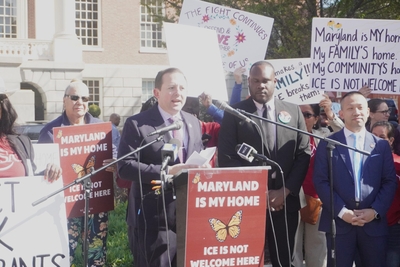
About 15 minutes after the Senate adjourned Friday afternoon, several Democrats joined a press conference with the immigrant rights advocacy group, We Are CASA, that led a rally Wednesday where some speakers pointedly called out the Senate for not acting on the bill.
On Friday, several senators joined CASA that included the chamber’s leader, Senate President Bill Ferguson (D-Baltimore City).
When asked later about the advocates leaning on the Senate over the Community Trust Act, Ferguson took the high road.
“We’ve been working on this for several weeks, talking with members [and] getting it to a place where we could pass it,” he said. “People are passionate when they’re advocating and this is an issue that brings out a lot of emotions.
“What we did today in the Senate is move forward the right thing to do,” he said. “I’m really confident that this was a solid work product that we were able to move through.”

Annapolis, MD