Turning Point USA is ‘ballot harvesting’ — the practice its leaders spent years demonizing
Apr 03, 2026 | 6:03 pm ET
Description
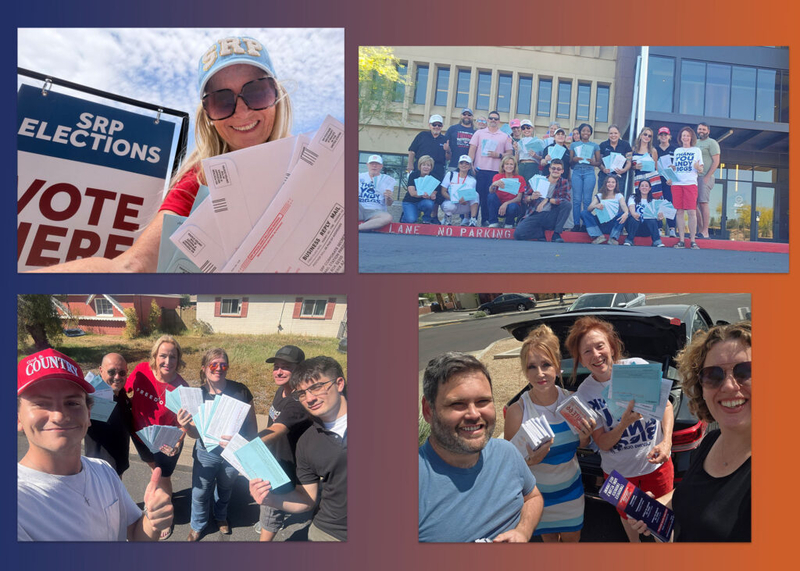
Social media photos of Turning Point volunteers showing off the ballots they've gathered from voters for the April 7, 2026, Salt River Project elections. (Photos via X.com)
In March 2022, Tyler Bowyer, COO of Turning Point Action, the political arm of Turning Point USA, was clear: Anyone who engages in ”ballot harvesting” should be prosecuted.
The practice of third parties collecting ballots from voters and delivering them to county election officials to be counted, a strategy used by Democratic campaigns — particularly in Latino communities — has been illegal in Arizona since 2016.
Bowyer and the late Charlie Kirk, the founder of Turning Point and its face until his murder last year, have both argued that ballot collection is a vector for cheating or stealing elections — without citing proof — often amplifying dangerous conspiracy theorists at the same time.
Such claims were the point of the movie “2000 Mules,” which was an attempt to prove that ballot collection is a vector for fraud in elections. The movie’s claims have been thoroughly debunked — even its creator has admitted the allegations are discredited.
Kirk is featured in the film and promoted it on his podcast after its debut. He also helped amplify a number of false claims by many of the people involved in it to his large audience.
But things seem to have changed at Turning Point, which has spent heavily to elect a slate of far-right candidates to the Salt River Project board of directors in this month’s election. A key part of their strategy is going door-to-door to collect ballots from homeowners in SRP’s service area. Or, to use the pejorative Turning Point and other conservatives have used for years to denigrate the practice, they are engaging in ballot harvesting.
“Team Salt River brought in 30 ballots today,” one post on X said, including photos of Turning Point volunteers holding the completed ballots in their envelopes.
“8 voters. 8 ballots. All people I personally registered last month,” another post says.
Even Bowyer has bragged about Turning Point’s ballot harvesting operation, promoting the organizations “super chaser” events — a colloquialism for going from house to house and gathering up ballots. (One of his posts features a photo of a woman with what appears to be a homemade hat with “SRP” written on the front as she takes a selfie with a voter. SRP said it “does not authorize the use of SRP branding or anything that could be interpreted as SRP branding.”)
Although Arizona’s ban on ballot collection has been in place for a decade, only two people have actually been prosecuted for violating it.
The law bans anyone but a family member, caregiver or household member from collecting and dropping off another person’s ballot, but it doesn’t apply to the April 7 SRP elections, as it explicitly exempts any election “held by a special taxing district.”
SRP effectively urges candidates for its board to engage in ballot collection.
“Candidates running for SRP elected office are informed about the ability to collect ballots under ARS 16 –1005 I(1) and requested to return any signed and sealed ballots voluntarily received from voters to SRP on the same day collected unless dropping off would occur after the close of the voting center for that day, but as soon as practical on the next day that the voting center is open,” SRP spokeswoman Jennifer Schuricht told the Arizona Mirror.
SRP processes the ballots at its corporate office and “uses specialized election software and scanning equipment to compile both the voter acreage values and candidate selections for the District and Association ballots prior to executing a tally process to determine results after polls are closed on election night.”
Turning Point did not respond to a request for comment asking about its stance on ballot collection or how it runs its collection efforts.
Putting aside the clear hypocrisy in Turning Point leaning heavily on ballot collection after its leaders, including Kirk, have denigrated the practice and likened it to stealing elections, one voting rights advocate said it’s smart campaigning.
“I think ballot collection should be legal, and that may not be an entirely popular opinion,” Alex Gulotta, the state director for All Voting is Local Action, told the Mirror. He sees it as a modern “get out the vote” effort that helps underserved communities.
Gulotta argued that Arizona’s ban on the practice hurts rural communities in a state where the majority of the population votes by mail. In metropolitan counties like Maricopa and Pima, most people live along Postal Service mail routes, making it easier to send and receive a ballot. But voters in rural counties, especially those on tribal land, don’t have that advantage.
“The process of being able to collect ballots when 80% of the people vote that way should be legal in all elections,” Gulotta said, adding that the ban also makes it difficult to assist those in difficult situations. “There is this very narrow limited exception of family members or caregivers. You can’t help your neighbor cast their ballot.”
Gulotta added that the conspiracy theories pushed by the likes of TPUSA and others never addressed any true issue.
“There was never a real problem. It is simply a story to make voting harder,” Gulotta said. “All of these things are, in fact, exaggerated instances to make voting harder because they don’t want to hear what the voters want to say.”
Phoenix, AZ