Montana Supreme Court dismisses constitutionality challenge to ‘The Montana Plan’ initiative
Apr 01, 2026 | 4:53 pm ET
Description
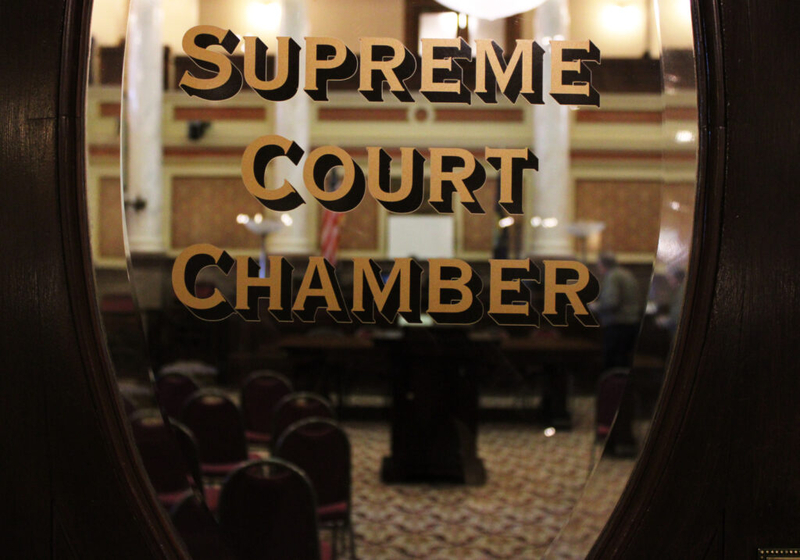
The door to the old Supreme Court Chamber at the Montana Capitol. (Micah Drew/Daily Montanan)
The Montana Supreme Court has dismissed a challenge from a coalition of business and industry groups over a proposed ballot initiative seeking to limit corporate spending in Montana elections.
In a unanimous decision, the court said reviewing the constitutionality of an initiative is “disfavored” because Montanans have a right to go through the initiative process.
Organizers behind the Transparent Election Initiative were cleared to begin gathering signatures last month to put I-194, or Ballot Issue 10, on the ballot in November.
The statutory initiative, dubbed “The Montana Plan,” would create a new Montana law to prohibit corporations — known in law as “artificial persons” — from spending money on political candidates or ballot issues. The Montana Plan is a direct challenge to the federal Citizens United ruling wherein the U.S. Supreme Court said that the power to spend money in elections is tantamount to free speech.
But a group of corporations and industry groups — comprising the Montana Mining Association, the Montana Chamber of Commerce, Montana Stockgrowers Association, Montana Petroleum Association, Montana Trucking Association, Montana Contractors Association, Treasure State Resource Association and Billings and Kalispell’s respective chambers of commerce — filed a lawsuit with the state Supreme Court arguing the initiative is unconstitutional.
Montana Attorney General Austin Knudsen had already performed a procedural review of the initiative and found it legally sufficient. That was a departure from a similar measure the Transparent Election Initiative had initially submitted as a constitutional amendment, which the Knudsen and the Supreme Court had struck down on legal grounds.
Writing for the court, Justice Beth Baker wrote a long line of Montana Supreme Court cases emphasize that the attorney general’s authority to review legality of ballot initiatives is limited, citing previous rulings that the AG is not authorized to “withhold a proposed ballot measure from the ballot for an alleged substantive constitutional infirmity.”
“We decline to disturb this precedent here,” the opinion states. “… As Ballot Measure No. 10 has not even qualified for the ballot, opining on the substantive constitutional issues raised would be unquestionably advisory. This Court does not issue advisory opinions.”
The industry and business coalition has alleged Ballot Measure 10 is unconstitutional because it “restricts protected political speech, is unconstitutionally vague, and unconstitutionally conditions entities’ benefits on their relinquishment of First Amendment rights,” according to court filings.
In a statement, Jeff Mangan of the Transparent Election Initiative, expressed gratitude for the Supreme Court’s “swift and unanimous decision, which reaffirms the right of Montanans to participate in the initiative process and have their voices heard.”
“Our focus can now return to what this effort has always been about: Collecting signatures from Libby to Sidney and continuing to build a grassroots movement led by everyday Montanan,” Mangan said in a statement. “The Montana Plan is about giving people a real voice in their elections — not allowing big money to drown that voice out — and we’re proud to keep that work moving forward.”
Mangan, a former Montana Commissioner of Political Practices, said the idea leverages the state’s ability to regulate corporations in state law and would be used to reign in corporate spending, while still allowing a path for political action committees to operate.
Artificial persons, as defined in Montana Law, include non-profits, trusts, partnerships, corporations, trade associations, or unincorporated associations and includes all such entities doing business in Montana — including those registered out of state.
The idea has made headlines nationally as a way to oppose Citizens United, an unpopular decision.
According to a national YouGov Survey from last fall, 79% of respondents, including 74% of Republicans and 84% of Democrats, agree that “large independent expenditures by wealthy donors and corporations in elections give rise to corruption, or the appearance of corruption.”
On Wednesday, former Secretary of Labor Robert Reich, who served under President Bill Clinton, released videos across social media drawing attention to the issue, saying “a very unlikely state is leading the way first-of-its kind plan,” which would “effectively neuter Citizens United.”
It’s not the first time Montana has led the way in limiting corporate influence in elections. Hearkening back to the state’s Copper Kings era, where a bribery scandal led to William Andrews Clark being elected to the U.S. Senate, Montana has been weary of outsized corporate influence in politics, and banned corporate spending in elections back in 1912.
Following Citizens United, the U.S. Supreme Court overturned a state supreme court decision that had upheld the century-old law, despite the state’s history of corrupt corporate influence in the political sphere.
Helena, MT