Judge dismisses part of claim against Ravalli County; case continues
Mar 11, 2026 | 8:32 pm ET
Description
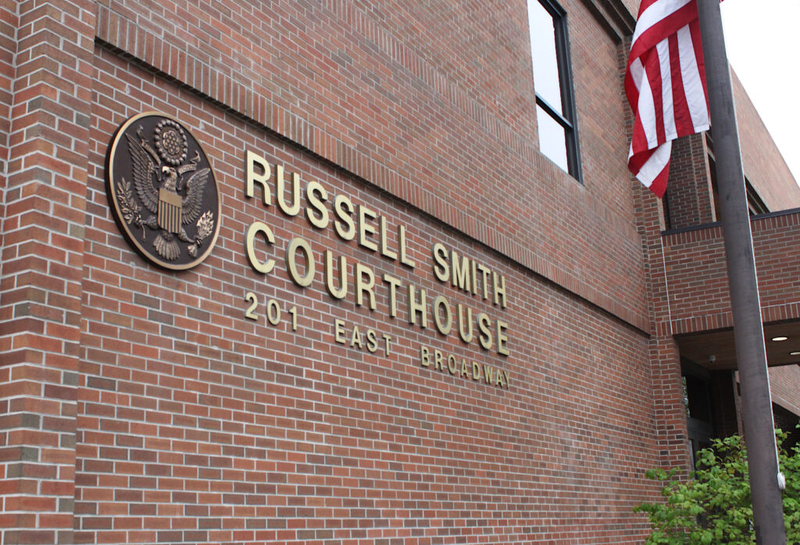
The Russell Smith Courthouse, the Missoula Division of the U.S. District Court of Montana. (Photo by Micah Drew)
MISSOULA — A federal judge dismissed Wednesday a claim Ravalli County was falsely imprisoning people who enrolled in a jail diversion program — one part of a lawsuit being heard this week in U.S. District Court in Montana.
But witness testimony continued in the class-action case, and a justice of the peace said people who enrolled in the program have thanked her for changing their lives.
In Leonard et al vs. Ravalli County, plaintiffs allege a pretrial diversion program violates their due process rights.
Witnesses said they pay steep fees to meet their conditions of release without court oversight or a chance to appeal. Furthermore, they told the federal court that even if they win, there’s no possibility of refunding fees – often thousands – they were charged.
The county argues the state authorizes the pretrial services, such as alcohol monitoring, and it allows the counties to charge for them. The sheriff said it started as a way to improve the justice system in the county.
In the class-action, plaintiff Daniel O’Toole also alleged false imprisonment on behalf of himself and others, but lawyer Maureen Lennon on behalf of Ravalli County made a motion for partial judgment against him.
Lennon said it appeared the plaintiffs were trying to establish the false imprisonment claim due to the administrative delay of the pretrial services process — that people enrolling in the program weren’t in fact free soon enough.
But Lennon, who made the motion after the plaintiffs rested their case, said the record reflects undisputed testimony that O’Toole, who did not testify, was not held in jail pending payment of fees.
She said some class members testified they were held following an initial appearance — but the delay was not unlawful, and unlawfulness is an essential element of false imprisonment.
In other words, just because a person bonds out of jail doesn’t mean they’re entitled to immediately walk out, Lennon said.
Rather, she said, the county needs time to process their release and to ensure it’s compliant with court orders.
Judge Dana Christensen agreed with the defendants on false imprisonment.
Christensen said judgment on a matter of law is appropriate when evidence in the record does not support a particular verdict.
The judge said in false imprisonment, the plaintiffs must prove restraint of an individual against their will, and also the unlawfulness of the restraint.
“The evidence I’ve been provided here does not establish or prove in any way, shape or form that Mr. O’Toole was wrongfully imprisoned in terms of those two requirements,” Christensen said.
The judge said he was issuing the order in favor of Ravalli County on the false imprisonment claim regarding O’Toole and regarding the class. He said O’Toole was still part of the class alleging due process violations.
Christensen said people who enroll in the program might need 10 to 45 minutes, but he had a hard time seeing how any delay once they learned they needed to pay program fees would amount to unlawful restraint.
On behalf of the plaintiffs, lawyer Phil Telfeyan, with Equal Justice Under Law, said the bulk of the case, on the due process claims, still goes to the jury.
Wednesday, the defense called witnesses, and Justice of the Peace Jennifer Ray became emotional on the stand recalling defendants who thanked her for ordering them to test for substances.
Ray said Charles Post had a difficult time getting his feet under him.
She said she saw him making his payments three or four times, and in those encounters, he told her it had been a hard road, but he hadn’t been drinking.
Post was a witness for the plaintiffs who testified one day earlier.
He said he was homeless, the fees were difficult for him to afford, and he was going without medicine and racking up debt to pay them because he feared going to jail if he didn’t.
“If I don’t, they’ll put me back in jail and take away my freedom, what little I have,” Post said.
Ray, though, said Post told her he was sober, had lost weight, and said it had been “life changing” for him to be monitored and held accountable. Ray said she told her staff it was good to see him doing well.
“It was literally about five days later, he was back in custody,” Ray said. “We like to see those success stories, and that was a success story, and then it wasn’t.”
But Ray also said she’s received thank-you letters from people who appreciate her effort in holding them accountable, including with testing. She remembered one letter in particular from a woman on the pretrial program.
“She said making me stay on testing has saved my marriage and my life,” Ray said.
In cross examination, however, lawyer Lily Milwit, with Equal Justice Under Law, said the plaintiffs were not challenging the judge’s ability to set conditions to hold people accountable.
Rather, Milwit said they were challenging the pretrial supervision fees that the county set independently. Many defendants pay $300 to $400 a month, and some pay more than $1,000.
Milwit asked if Ray could adjust the fees for clients who had difficulty paying them.
“I have no authority over the fees,” Ray said.
Thursday, Ravalli County is expected to call its final witness, and the lawyers are expected to deliver closing arguments.

Helena, MT