Proposal to expand Heritage Act protections to all public memorials advances in SC Senate
Jan 13, 2026 | 6:43 pm ET
Description
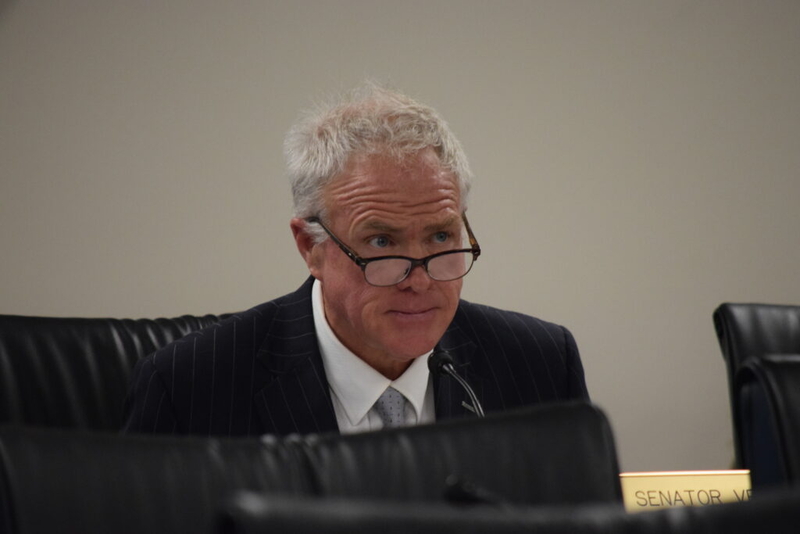
South Carolina Sen. Danny Verdin, R-Laurens, presides over a hearing Monday, Jan. 13, 2026, on a bill he sponsored extending the protections under the Heritage Act to all memorials on public property in the state. (Photo by Jessica Holdman/SC Daily Gazette)
COLUMBIA — A state Senate panel advanced a proposal expanding a law originally passed to keep Confederate monuments in place.
The bill introduced by Sen. Danny Verdin, R-Laurens, and co-sponsored by 29 other Republicans would extend the protections under a portion of state law commonly called the Heritage Act to all memorials on public property in South Carolina. It also would stop the addition of informational plaques placed near some monuments in recent years offering broader context on the bad parts of history.
Republicans on the panel, chaired by Verdin, voted with little debate to move the legislation along for consideration by the full Senate Finance Committee. The two Democrats on the panel did not vote.
Representatives of two associations representing South Carolina’s cities and counties opposed the proposal, saying it pre-empts local authority. Members of only one group, the American Heritage Association, spoke in favor. It formed in 2018 to fight the removal of monuments.
A twin proposal in the House has yet to be heard. Both bills were introduced last March.
A statue’s removal
For a quarter-century, state law has given the Legislature sole authority over whether to remove or change the name of any building or memorial on public property that commemorates American wars, as well as Native American or African American history. In 2021, the state Supreme Court upheld that authority.
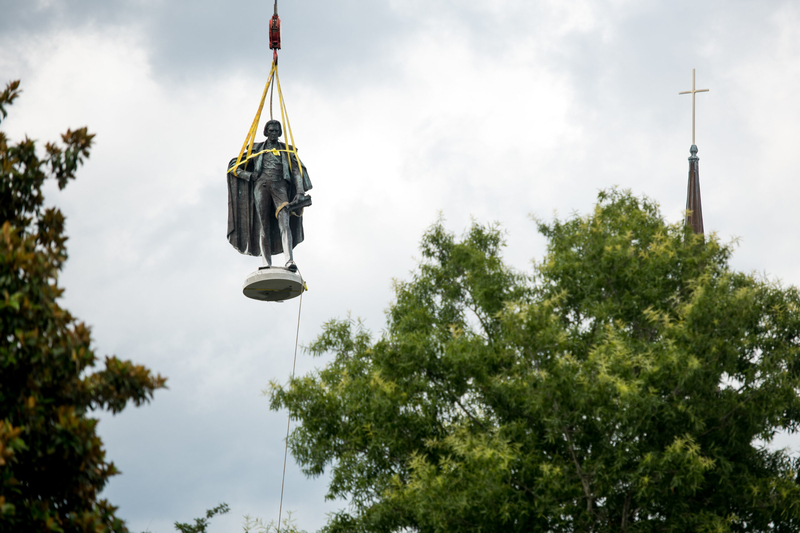
But that did not stop the 2020 removal of the bronze statue of John C. Calhoun from a downtown Charleston park, prompting the Charleston-based association to declare the so-called Heritage Act — a title that’s actually nowhere in state law — “no longer effective.”
SC legislators seek to expand Heritage Act protections to all public memorials
The group sued on behalf of descendants of Calhoun two years after Charleston City Council voted to lift the statue from its 125-foot pedestal, where it stood for 124 years. The council’s vote came in the aftermath of a white police officer killing George Floyd, a Black man, in Minneapolis. The group wanted Calhoun’s statue back on public display somewhere in Charleston.
The city of Charleston argued in court it was within its rights because the statue was not on public property. The city leases the square from the Board of Field Officers of the Fourth Brigade, a historic militia that owns Marion Square where the statue sat atop a stone pillar.
Plus, the city continued, the 12-foot-tall figure didn’t memorialize a war, Native Americans or Black history.
While Calhoun, a former U.S. congressman, secretary of war, and vice president under two presidents was a fierce defender of slavery, he died 11 years before the first shots of the Civil War were fired in Charleston Harbor — what the law calls the War Between the States.
Attorney General Alan Wilson gave the same reasoning in an opinion released days after Calhoun came down in June 2020: The Calhoun statue was not protected by the law, he wrote.
When the group faced legal challenges over whether it was actually eligible to sue, the association followed up last year by asking legislators to change the law altogether.
Legal standing
Though it’s called the Heritage Act, those words don’t actually appear in state law. The memorial protection was part of a 2000 compromise that moved the Confederate flag from atop the Statehouse dome to a 30-foot flagpole beside a Confederate memorial on the Statehouse’s front lawn. (That compromise also made both Martin Luther King Jr. Day and Confederate Memorial Day state holidays.)
The Legislature removed the flag from the grounds entirely in 2015, following the massacre of nine Black parishioners of Mother Emanuel African Methodist Episcopal Church in downtown Charleston by an avowed white supremacist.
Brett Barry with the American Heritage Association told senators that his group raised and spent $250,000 in legal fees to no avail, as Charleston Circuit Court Judge Jennifer McCoy ruled in January 2024 that only the state attorney general can enforce the Heritage Act.
Wilson, in a separate lawsuit over a marker elsewhere in Charleston, submitted a court brief last July agreeing with the association. Private groups should be allowed to file suit, he wrote, as his office does not have the resources to defend the more than 1,000 monuments across the state.
“We spend all this money on these legal cases, but because of deficiencies in the Heritage Act, none of our lawsuits have ever been tried on the merits, but rather dismissed or forced to settle on appeal,” Barry said.
In addition to expanding the scope of monuments covered under the law, the proposed legislation would allow private organizations to sue to block removal and punish people who vandalize or move a monument without the Legislature’s approval.
A judge could order restitution. The state could also withhold tax aid to local governments where it happened.
Meanwhile, Charleston and the American Heritage Association reached a settlement in July over the Calhoun statue’s removal. The city turned the statue over to a newly formed nonprofit called the Calhoun Monument Preservation Society, which intends to put the monument somewhere outside the city limits.
Historical marker installed
While the Calhoun memorial no longer stands in the Charleston park, a relocated monument honoring Confederate Gen. Robert E. Lee was put nearby.
In 2021, the Charleston County School District removed the 2.4-ton highway monument from the Charter School for Math and Science on King Street. The American Heritage Association sued again, this time on behalf of the United Daughters of the Confederacy, which had originally installed the marker.
This time, the attorney general filing a friend-of-the-court brief saying the 2021 removal violated the Heritage Act.
Ultimately, the lawsuit was dropped after the group reached an agreement with Marion Square’s owners. The monument has been in the park since December.
Other monuments
Other monument removals and changes include:
- A statue of Christopher Columbus pulled from a city park in Columbia and transferred to the S.C. State Museum after it was vandalized in 2020.
- A name change to a city of Charleston auditorium whose previous namesake, Christopher Memminger, owned slaves and served as the Confederate States’ first treasury secretary.
- Attempts in North Augusta to remove an obelisk memorializing Thomas McKie Meriwether, a white man who died participating in a mob that attacked a Black militia in 1876 at what became known as the Hamburg Massacre. The mob captured and executed four of the Black militiamen who had retreated to a warehouse used as the village armory. Two others were gunned down as they fled. The city installed educational panels telling the story of the massacre. An inscription says the white supremacists “do not represent the attitudes of the people of North Augusta today,” the North Augusta Star reported.
In cases involving informational plaques, Barry told legislators the plaques “seek to denigrate the monument’s subject matter, thereby allowing perhaps the greatest alteration of all.”
“By physically altering these sites with purported modern clarifications, we effectively hijack the original intent,” he said. “By prohibiting the physical alteration of monuments, we allow history to exist as it was, providing future generations intellectual freedom to engage with our ancestors on their own terms.”
What exactly does SC law say?
The following is the 2000 law commonly called the Heritage Act:
No Revolutionary War, War of 1812, Mexican War, War Between the States, Spanish-American War, World War I, World War II, Korean War, Vietnam War, Persian Gulf War, Native American, or African-American History monuments or memorials erected on public property of the state or any of its political subdivisions may be relocated, removed, disturbed, or altered.
No street, bridge, structure, park, preserve, reserve, or other public area of the state or any of its political subdivisions dedicated in memory of or named for any historic figure or historic event may be renamed or rededicated.
No person may prevent the public body responsible for the monument or memorial from taking proper measures and exercising proper means for the protection, preservation, and care of these monuments, memorials, or nameplates.
Source: S.C. Code of Laws Section 10-1-165

Columbia