Grand Rapids-area candidates for local, state offices commit to community priorities at forum
Oct 12, 2026 | 4:30 pm ET
Description
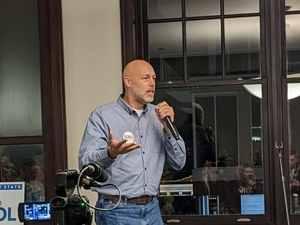
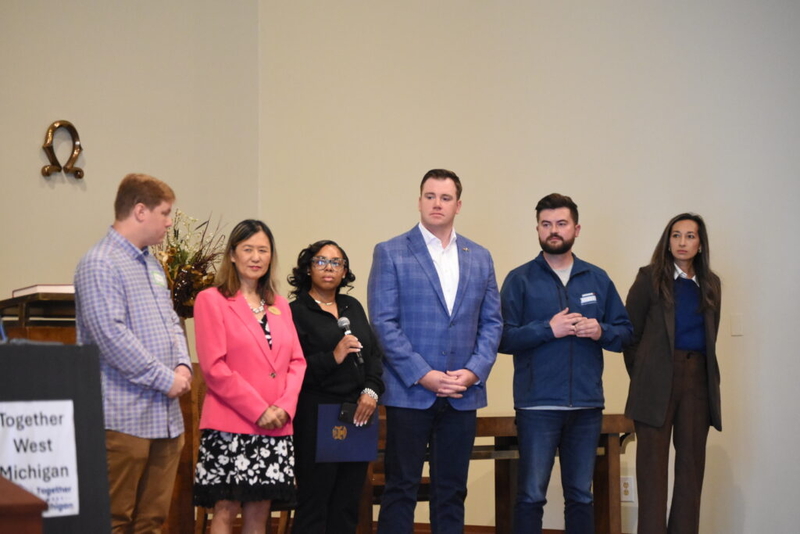
State House candidates listened to questions from Together West Michigan organizers about a set of community priorities at a forum on Oct. 10. (Photo by Katherine Dailey/Michigan Advance)
State and local candidates gathered in Grand Rapids for a candidate accountability forum hosted by advocacy group Together West Michigan, largely agreeing on issues ranging from traffic lights to a child care tax credit.
“You’ve heard from the candidates running for election as to where they stand on the issues,” Milton Roye of St. Marks Episcopal Church, a co-chair and moderator of the event, said. “Now it’s up to you to make sure you hold these folks accountable. They serve us. They’re here to protect us and make sure that they are doing what you are asking them to do.”
Both major-party candidates for Michigan Senate Districts 29 and 30 participated in the forum, answering questions on informing their constituents of new legislation passed to make housing more affordable, funding Grand Rapids’ public transportation system, establishing a Michigan child care tax credit and expanding the existing TriShare childcare benefit program.
Republican Brady Middleton and Democrat Abbie Groff-Blaszak are competing for the 29th District seat currently held by term-limited Senate Majority Leader Winnie Brinks (D-Grand Rapids). Republican incumbent Sen. Mark Huizenga (R-Walker) is seeking to defend his 30th District seat against current state Rep. Carol Glanville (D-Walker).
All of the candidates agreed on the four issues, stating that they would support those policies in their own districts and in the statehouse. One question, however, divided the candidates along party lines: whether they would support the Drive SAFE bills that would allow under-documented immigrants to obtain state drivers’ licenses.
Middleton and Huizenga both said that they would “maybe” support the bills, while both Democrats said that they would support them, with Groff-Blaszak suggesting that once it was passed, she would support a next step of examining sanctuary policies at a state level.
“Although I support the premise behind it, I can never commit to a bill until I see the final product. It always happens where they put edits in there and amendments, and so I always want to make sure that I know what I’m voting on,” Huizenga said. “I worked on a farm. I grew up with migrants. Those are our friends and our neighbors, and finding ways to keep our people safe, whether it’s you or me or our parents or friends or the migrants, that they have access to insurance as well as the other resources to make them successful.”
State House candidates from the 79th, 80th, 81st, 82nd, 83rd and 84th districts were asked their opinions on the same set of policies — but not all of the candidates in the race were present to answer those questions.
The Democratic nominee in each race attended the event, but the only Republican state House candidate present was Drew Robbins, running for the 84th District against Khristian Silvis to fill Glanville’s seat. An organizer with Together West Michigan confirmed that all Republican and Democratic candidates in each race were invited to the forum.
Incumbent Reps. Stephen Wooden (D-Grand Rapids), Kristian Grant (D-Grand Rapids), and John Fitzgerald (D-Wyoming) participated, as did Zach Abbott, challenging incumbent Republican Rep. Angela Rigas (R-Alto) and Lily Cheng-Schulting, who is seeking to fill the seat of outgoing Rep. Phil Skaggs.
Similarly, the candidates all committed to each policy, except for Robbins, who said he could “not currently” support the Drive SAFE bills.
In nonpartisan elections for city commission seats in Grand Rapids, Walker and Wyoming, every candidate present said they would work to release use-of-force data for their city’s police department.
In Grand Rapids specifically, the only area of disagreement between candidates was on a transfer of funds to the Grand Rapids Land Bank Authority for affordable housing. Two candidates — Lisa Knight in the 2nd Ward and Kelsey Perdue in the 3rd Ward — expressed concerns about the authority’s commitment to actually developing that affordable housing as their reasoning for their opposition.
In a keynote speech at the event, Rev. Darryl Gaddy of Pilgrim Rest Baptist Church emphasized to the crowd the importance of remaining disciplined and organized in demanding accountability from their elected officials.
“Doing justice means every person deserves safety, respect, and dignity in encounters with policing. Doing justice means traffic safety. That we must protect people in every neighborhood as they transit throughout the city. It means transportation cannot become a barrier that prevents our neighborhoods from reaching work, school, worship, healthcare, and opportunities,” Gaddy said, emphasizing a number of the projects that Together West Michigan volunteers work on. “Doing justice means accountability and transparency. These are not favors that are given to us by the institutions. They are obligations that are owed to the public. And so, when decisions are made about our lives, our streets, our tax dollars and our families — the people deserve clear information, honest answers, and meaningful influence. Doing justice means we recognize the humanity of immigrants, our neighbors, co-workers.”
A head count from Together West Michigan, a coalition of Grand Rapids-area groups working on community issues, estimated that just under 500 people attended the Saturday morning gathering.
Lansing, MI