Maryland loosens diesel rules for farmers amid high fuel costs
Oct 12, 2026 | 4:12 pm ET

Description
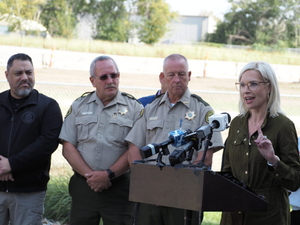
Maryland Democratic Gov. Wes Moore announces a new executive order on data center projects on Sept. 23, 2026. The order establishes a state task force to examine data center proposals. (Photo by Christine Condon/ Maryland Matters)
Maryland Gov. Wes Moore is allowing farmers and loggers to use tax-exempt diesel fuel in their on-road trucks, amid high fuel prices during the United States’ war with Iran.
In an executive order that took effect on Friday, Moore took an unprecedented step in Maryland, allowing truck drivers hauling products from timber to live poultry to fill their vehicles with “red-dyed” diesel, which is exempt from the state’s motor fuel tax of 47.45 cents per gallon, and the federal excise tax of 24.40 cents per gallon.
“Our agricultural and forestry sectors are the bedrock of our state’s economy, and our administration is dedicated to supporting these vital industries as rising fuel prices put a squeeze on the industry nationwide,” Moore said in a statement issued Friday.
Moore’s order, which declared a state of emergency, will remain in effect for 30 days, but it could be renewed. Unless the governor orders otherwise, the emergency period will not extend beyond Dec. 31. Moore’s order also suspends fees associated with exceptional hauling permits, which allow qualifying vehicles carrying agricultural and forestry products to transport heavier loads on state highways.
Red-dyed diesel is “nearly identical chemically” to regular diesel, according to the order. The red dye is added to signify that the fuel isn’t subject to highway excise taxes, and it’s typically only allowed for use in off-road vehicles and machinery, including tractors and construction equipment.
Maryland’s order came after similar orders in other states, and one from U.S. President Donald Trump. But Maryland officials are still waiting on word about precisely how Trump’s order will be enforced, said Harrison Palmer, chief of staff at the Maryland Department of Agriculture.
As a result, as of Monday morning, officials at the Maryland Department of Agriculture were advising farmers and loggers to avoid using red-dyed diesel in vehicles that plan to cross Maryland’s border, since neighboring states have not allowed the fuel to be used on their highways, Palmer said.
Maryland officials were working on the issue in September, Palmer said. But there were a few kinks to work out between various state agencies, because this was a new step for Maryland.
“We’ve not done something like this before, because we had never been in a situation like this,” Palmer said.
Over the past year, diesel prices have risen about 76.2% in Maryland, according to AAA, reaching $6.467 per gallon on Oct. 5. It comes amid an already difficult year for farmers, Palmer said, as many parts of the state experienced prolonged drought conditions, and a surprise April freeze led to crop losses.
“Everything has sort of been up against you all year, and now — as you’re just trying to get [crops] off the field, you’re getting hit with this enormous fuel bill,” Palmer said.
A high-end estimate indicates that Maryland could lose a maximum of $300,000 per month in tax revenue because of the governor’s move, Palmer said. It’s a price the state is willing to pay, Palmer said.
“We’re making sure that we’re doing right by the folks who are putting food on the table for us every single day,” Palmer said.
The Maryland Farm Bureau had been pushing for state officials to take this step, including in a letter on Sept. 28.
“Diesel is not optional for agriculture,” wrote Maryland Farm Bureau President Jamie Raley. “Feed has to reach animals every day. Livestock have to be moved to market, to processors, and between farms on a schedule set by the animals, not by fuel prices. Timber has to reach mills, and with mill closures in recent years, many of our loggers now drive much farther to find a market.”
Even after Trump’s order, the Farm Bureau continued pushing for Maryland to take action, writing on Facebook: “Dyed diesel fuel is still not legal in our state, and federal action does not automatically waive state fuel taxes or enforcement requirements.”
On Friday evening, the Bureau applauded Moore’s issuance of the executive order.
“We greatly appreciate the state’s action to provide farmers meaningful relief as they face record-high diesel prices at harvest time,” read a statement that the Farm Bureau shared on Facebook.
Annapolis, MD