Lawsuit claims SC governor illegally sent National Guard troops to DC
Jan 08, 2026 | 3:59 pm ET
Description
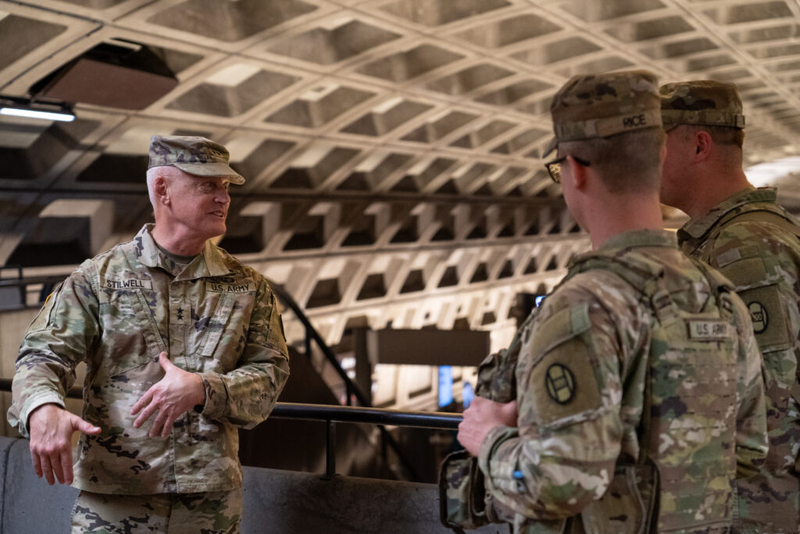
Army Maj. Gen. Robin Stilwell, left, adjutant general of the South Carolina National Guard, visits with soldiers assigned to 4th Battalion, 118th Infantry Regiment, patrolling the Washington Metro in Washington D.C., on Aug 28th, 2025. (Photo courtesy of U.S. Army National Guard/Sgt. Ian Doyle)
COLUMBIA — Gov. Henry McMaster overstepped his bounds in sending National Guard troops to Washington, D.C., a Navy veteran and nonprofit watchdog agency claimed in a lawsuit filed in state court.
The lawsuit announced Thursday asks the state Supreme Court to reverse McMaster’s deployment last month of 300 troops to Washington and stop him from sending any more National Guard members to the capital or any other state under the initiative launched by President Donald Trump to combat what he called a “crime emergency.”
Soldiers left in early December for a 90-day deployment. It was the second time in six months that McMaster sent National Guard soldiers to the nation’s capital. Following a request from the Pentagon, a first cohort of 200 service members left for the capital in August and returned in September. Maj. Gen. Robin Stilwell is also named in the lawsuit. As adjutant general, he leads the state’s military force and reports to the governor.
A similar lawsuit filed in West Virginia regarding that state’s National Guard deployment was dismissed in November. A circuit court judge ruled Gov. Patrick Morrisey acted lawfully under West Virginia law.
McMaster’s office contends the South Carolina governor also has broad authority to deploy state National Guard troops.
Decades-old South Carolina law says the governor can do so to counteract “war, insurrection, rebellion, invasion, tumult, riot or a mob,” whenever a large violent group is working together to break state or U.S. laws, if there’s imminent threat of that happening, or in response to a public disaster.
The lawsuit, however, contends none of those situations is happening in Washington.
Instead, “Operation D.C. Safe and Beautiful,” as the president coined the deployment, has National Guard members acting as routine law enforcement officers, according to attorneys for the state chapter of the American Civil Liberties Union and nonprofit Democracy Forward Foundation.
South Carolina soldiers’ “primary mission is to provide critical support to law enforcement agencies, reinforcing safety and security for residents, workers, and visitors in the nation’s capital,” the adjutant general’s office said in a statement ahead of the December deployment. During the August deployment, troops patrolled transit stations, events and popular tourist destinations, the office said last month.
The capital city didn’t need the help, and the mayor didn’t ask for it, attorneys for the ACLU argue.
Total violent crime in Washington throughout 2024 fell 35% from the prior year, marking a 30-year low, the U.S. Department of Justice reported ahead of Trump’s inauguration.
Skye Perryman, president of Democracy Forward, accuses McMaster of using National Guard troops “as pawns in a harmful political gambit brought about by the President’s desire to militarize the nation’s cities.”
Sending South Carolina’s troops to another state means less help if a disaster happens at home, the lawsuit argues. That’s a problem for people like Navy veteran James Weninger, a plaintiff in the lawsuit and a resident of coastal Berkeley County, according to the lawsuit.
“South Carolina’s National Guardsmen should not be asked to undertake illegal deployments or be used to score political points by our government,” Weninger said in a statement.
SC sends 300 National Guard troops to DC in second deployment rotation
Trump asked governors to activate troops under what is known as a Title 32 agreement, which means the federal government pays for the costs of deployment, but the governor keeps control over the guardsmen.
In response to criticism last summer about sending the troops amid hurricane season, McMaster said he’d bring them back if a hurricane or other natural disaster threatened the state.
The guard also said the mission does not diminish its ability to respond to in-state emergencies. The National Guard in South Carolina includes about 9,200 Army National Guard and 1,300 Air National Guard members, according to the guard.
Brandon Charochak, McMaster’s spokesman, said South Carolina governors have “unambiguous authority to utilize and deploy the state’s National Guard to save and protect American lives, defend the homeland, and assist in enforcing the rule of law.
“To suggest otherwise demonstrates either a remarkable ignorance of constitutional and statutory law, or a terminal case of Trump Derangement Syndrome,” he said in a statement.
South Carolina’s troops joined around 1,500 more from nine other states, along with local National Guard members, to patrol Washington, D.C., starting last August.
Attorneys in the South Carolina case want to skip the lower courts entirely. The ACLU and Democracy Forward asked the state Supreme Court to take up the case directly, citing its public importance and immediacy. Attorneys also asked for a speedy hearing.
The state’s highest court has not yet made a decision about whether to hear the case.
Columbia