Even after parole, some Alabamians can remain on supervision for the rest of their lives
Dec 30, 2025 | 8:01 am ET
Description
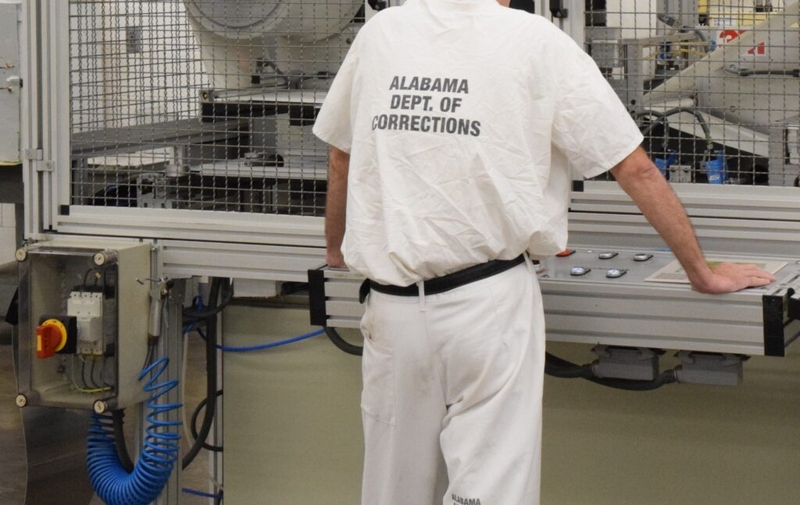
An inmate in the custody of the Department of Corrections. A new report highlights the challenges facing 1,200 Alabamians paroled after being sentenced to life in prison. Some of those who have been released and led productive and meaningful lives for decades can be sent back to prison for minor offenses that did not even result in a conviction. (Brian Lyman/Alabama Reflector)
People sentenced to life in prison in Alabama may receive parole.
But the almost 1,200 Alabamians who have done so are on supervision for the rest of their lives; are required to pay a $40 monthly fee and can lose their freedom for slightest infraction, even if they remained trouble free for decades.
“We are talking about people who have been released, the parole board reviewed their files, determined they were safe to release, and they have been out in the community,” said Carla Crowder, executive director of Alabama Appleseed, a nonprofit that focuses on criminal justice reform. “They have been granted parole. And they are revoked and sent back under these flimsy circumstances.”
Their circumstances were described in a November report from Alabama Appleseed titled “Taking a Life,” which looks at those who released from prison after life sentences.
The report profiles five parolees who the report says lived without incident after their release, some for decades, only to find themselves reincarcerated for violating a condition of parole or an arrest that may not have resulted in a charge. Both could put them back in prison for life.
Archie Hamlett, 53, was sentenced to life in prison in 1995 after a jury convicted him of trafficking marijuana. He spent 22 years at Donaldson Correctional Facility in Bessemer before he was granted parole in 2017.
The report described his life after prison as a “steady series of achievements,” including obtaining a commercial driver’s license; starting a trucking business; renovating a house, and restoring vintage vehicles.
But according to the report, Hamlett was pulled over in January and detained after law enforcement learned of his criminal record.
Hamlett, who suffers from a documented medical condition requiring him to urinate often, felt nauseous and requested that he be allowed to use a portable urinal that he stored in his truck. Officers refused. Hamlett then had to choose whether to urinate on himself or relieve himself in the dark. He chose the latter and was charged with public lewdness and booked into the Madison County Jail.
“I wasn’t trying to be disrespectful,” Hamlett said to the officer that was detailed in the report. “I had to use the bathroom. I have a medical problem and I had to use the bathroom bad. I had a medical urinal, but they wouldn’t let me use it. I used the bathroom outside.”
The parole board revoked his parole and sent him to prison to serve out the rest of his life sentence until he, once again, is eligible for parole in March.
“And because of this one episode that happened late, one freezing night, he is now in Easterling prison, and that is such a waste,” Crowder said.
The report notes that Hamlett isn’t unique among parolees in building a new life after release. Bennie Haggins was convicted of first-degree robbery in 1983 and sentenced to life in prison but paroled in 1991. He remained on parole for 33 years and earned a pardon in October. During that time, he reported to this parole officer every month and paid the $40 monthly fee to the state of Alabama.
Haggins worked at Sterilite Corporation in Birmingham until he retired in 2012, then volunteered at the Salvation Army. Eventually he joined the Emergency Disaster Services team, getting sent to locations affected by natural disasters.
“When I look back, I destroyed my whole life, but God blessed me with the opportunity to get it back,” Haggins said in the report. “I took full advantage of it and tried to help as many people as I could help, and I haven’t stopped.”
Hamlett and Haggins received life sentences as part of the state’s Habitual Felony Offender Act, first passed in 1977, which enhances criminal penalties for those with a prior criminal history. Courts have invoked that law less frequently since 2006, when new sentencing guidelines were adopted by the Alabama Legislature, but individuals may still receive long sentences for lower-level offenses if they have prior convictions.
Hamlett was charged and convicted of nonviolent, property offenses when he was 16 years old. Haggins had a series of convictions prior to getting sentenced in 1983: grand larceny in the same year and a second in 1978.
More than 300 people are serving life sentences for property crimes, while another 200 individuals were sentenced to life in prison for drug crimes, according to the report.
Having been sentenced to life in prison, both Hamlett and Haggins are but two of the almost 1,200 people with life sentences who must remain on parole for the rest of their lives. Almost 400 people remain on parole for more than 15 years while another 72 people are still on parole after 30 years, according to the report.
Alabama Appleseed has called for legislation allowing those sentenced to life because of HFOA to have their cases reviewed and potentially resentenced.
Alabama Appleseed proposes a series of reforms aimed at reducing the burden for those who spend years on parole.
The report urges the state to end the monthly $40 fee that people on parole must pay for their supervision. The organization also wants to expand opportunities for people on parole to be granted a pardon. The report calls for the Alabama Bureau of Pardons and Paroles to create a standardized process for communicating how people on parole may be granted a pardon that is mandatory and detailed.
Alabama Appleseed also wants to end the revocation of parole if people are arrested for a crime but not charged or convicted. It also wants to end automatic revocation for technical violations.
“We are not saying that every person with a life sentence should get out,” Crowder said. “This report just shows that over 7,000 people with life, life without parole, or virtual life, are too many people for our prisons to be well run.”

Montgomery