Opposition to AI is a political force. Maine’s leaders should catch up.
Dec 22, 2025 | 3:25 pm ET
Description
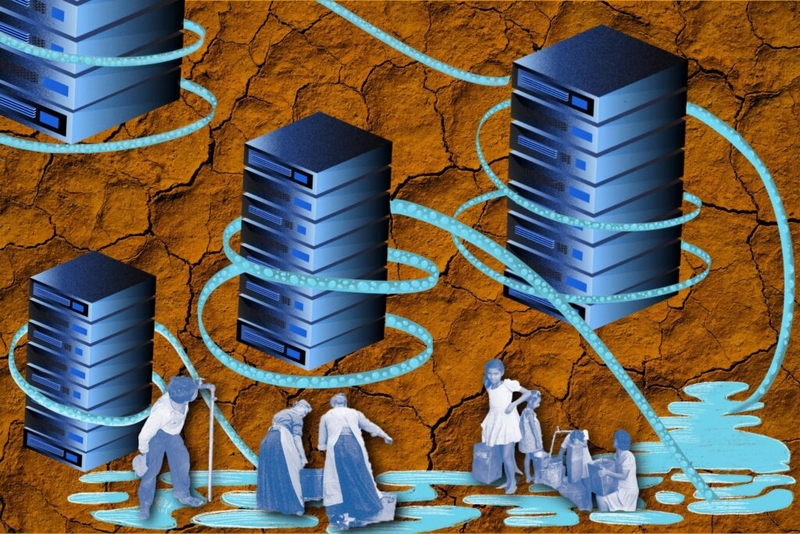
A typical AI-focused hyperscale data center uses as much electricity as 100,000 households and consumes 5 million gallons of water — as much as a town of 50,000 people. (Image by Gloria Mendoza/ BetterImagesofAI.org/ Licensed by CC BY 4.0)
A plan to build an AI data center in Lewiston’s Bates Mill complex was set to get the green light by the city council last week. The city arranged a tax break for the relatively unknown company developing the project. The vote was seen as a formality as most expected the project to easily pass. But then the public got wind of the plan.
Within days, locals quickly organized and city councilors reported they were inundated with “by far” the most messages they had ever received on any issue. Hundreds of people showed up in person to the council meeting. Instead of sailing through, the deal was unanimously voted down.
With proposed projects in Lewiston, Wiscasset, and Limestone, Maine may soon be entering the national data center construction boom, driven by investors ($60 billion in 2025 alone) who need the centers to power AI technology.
Locals are right to be wary: these centers consume a horrifying amount of resources. A typical AI-focused hyperscale data center uses as much electricity as 100,000 households and consumes 5 million gallons of water — as much as a town of 50,000 people. These jaw-dropping stats are expected to rise with the construction of newer centers, which require even more power and water to run. Communities in Virginia and Maryland have seen their electric bills rise as much as 25% thanks to AI.
The Lewiston City Council vote shows there is a clear energy in Maine to push back against Big Tech, the forced adoption of AI, and the raw deal of data centers. It’s time our political leaders take note. Given our busy election year, you might expect that candidates in a crowded gubernatorial race in particular would spot the opportunity to stand out. So far, people who care about this issue are without a champion.
Of all the Democratic candidates running for governor, none have discussed AI on their campaign website or included it in their platform. In fact, only Republican Jim Libby, a legislator who served on the governor’s AI task force, has mentioned it as part of his platform.
Few others have shared any statements about the issue on Facebook. I hope we’ll see this change, because tech policy touches every other issue we’re facing in Maine.
There’s a tendency to assume that discussions around tech policy need to be framed in tech terms — that to truly be an “expert” in emerging tech, you have to understand every single aspect of the technology itself. That’s baloney. To deeply understand the implications of a technology, you need to first have a grounding in the power and motivations behind who owns the technology.
The current motivations behind the companies that are building the data centers and pushing broad-scale adoption of AI in every single industry are clear: move fast, force adoption, and don’t worry about breaking the rules in the process.
We can compare the local debate around AI to the Central Maine Power corridor — the transmission line that voters overwhelmingly opposed in a 2021 referendum that was later deemed unconstitutional by the Maine Superior Court. If the corporation moves fast enough, it doesn’t really matter what the people think: the project will get built anyway. Let the public into the process right at the end, and the whole “democracy” part will just be a formality with no ability to affect the outcome.
The adoption of AI and the building of data centers elicit such strong reactions and responses from a broad group of people for a very specific reason: we, the people, haven’t been consulted.
We are told that AI will do many incredible things, but we’re never asked if we want those things. No one asked if Mainers wanted a data center in Limestone. We just saw in the news that it’s happening. Case closed.
Google and Spotify and all of the other companies didn’t ask if we wanted AI features — they just added them anyway and hid the ability to turn it off. Residents in Wiscasset, where there’s another large-scale data center being proposed, can’t even find out who is behind the project, let alone any estimates on water and energy use.
This lack of transparency and local input is intentional. If the public is asked about whether we want AI, I believe the overwhelming answer is that we don’t. The proliferation of AI is, at its core, an anti-democratic process to create a deeply authoritarian world. The lack of public input to this process is a feature of this technology, not a bug.
Here’s where it gets more scary: Large language models like ChatGPT and others are trained on vast amounts of data, everything from Reddit forums to individual website content to social media posts, emails, and even the wholesale theft of books and art. Data is the currency that these models are trained on, without which they will flounder. Our public institutions hold a lot of data.
Public institutions that have been hollowed out by decades of underfunding are particularly vulnerable to being co-opted by AI. Absent strong digital privacy safeguards and in-house tech expertise, we may soon find that the solution to understaffing is to feed the data entrusted to these institutions — everything from food stamp eligibility to student homework, criminal records, and even historical documents — into an AI system. This new tech will be sold as an efficient, cost-saving tool to “fix” a medley of deeply entrenched societal and political ills.
The result of an AI takeover isn’t efficiency. Several studies have shown that the introduction of AI doesn’t save time, isn’t delivering value, and can serve to hide new modes of extraction. The end result of this technology is a reality controlled by tech monopolies.
It sounds like science fiction but the next level of AI looks like predictive policing models trained on racist data that identify “probable criminals” based on the color of their skin. It looks like people getting denied food stamps, housing assistance, or jobs because of data or activity that used to be siloed, protected, or private. It also looks like people being charged more for car, home, or health insurance premiums because our insurance company can now buy data on all of our activities, movements, and motions.
The world enabled by AI is not a world we want to live in. Mainers know this. It’s time our political leaders catch up.
Augusta, ME