Legislators should exert states’ rights and regulate AI
Dec 16, 2025 | 11:13 am ET

Description
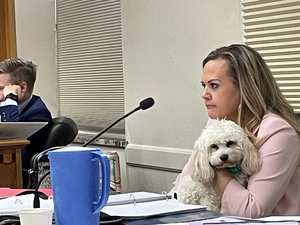
Author Frank Knapp writes that artificial intelligence "must be regulated to protect all of us." (David Espejo/Stock photo via Getty Images)
President Donald Trump recently issued an executive order to preempt states from passing new legislation or having laws on the books that regulate artificial intelligence, with some
exceptions.
The president believes that the United States should dominate AI for the purposes of “national and economic security.”
He calls for Congress to pass federal law to set a national standard to replace individual state AI regulations that he says impede the innovation the country needs.
States not complying with the executive order will face legal challenges by the U.S. Department of Justice and loss of federal funding.
How should the South Carolina Legislature respond?
There is bipartisan desire to protect children from online exploitation. Sextortion and AI-generated mental health counseling are two of the threats to children that have resulted in possibly up to one in five children being victims and well over 50 suicides nationally.
Every member of Congress will tell you that this must be stopped.
Yet, other than a law on intimate imagery involving deepfakes, there has been no AI regulation by Congress since 1996. And the Communications Decency Act turned out to primarily be a civil liability shield to protect AI companies.
It is not only children harmed by AI-generated threats. Adults with mental health issues can also suffer.
Consider this recent Washington Post headline: “A former tech executive killed his mother. Her family says ChatGPT made her a target.”
Over 250 bills in 47 states have been introduced to regulate AI regarding health care.
Then there is the intentional misuse of AI that impacts the lives of many Americans.
For example, over 40 bills have been filed in the states targeting AI algorithms that can be used to “promote anti-competitive and discriminatory practices in the housing industry” resulting in higher rents.
AI algorithms, created by the tech companies themselves, are also largely responsible for our nation being so horribly divided. Social media platforms use the search and browsing history of their customers for the purpose of maximizing use and thus higher profits.
The key ingredient is to feed the customers with messages and misinformation aligned with their interests to drive strong emotional response.
According to Cindy Shen, a communications professor at the University of California at Davis, “outrage and hostility tend to drive engagement” and results in “online echo chambers where extreme views go unchallenged.”
The impact on our political system is that candidates for office find it essential to pay more attention to their voter base with the most extreme, social media-created opinions.
Finding common ground with all voters and the other political parties to solve problems is not rewarded.
States will keep pushing AI laws despite Trump’s efforts to stop them
No one should expect Congress, even with Trump’s approval, to pass legislation to regulate AI.
The billions AI companies have and will spend on the national AI regulation debate will all but guarantee congressional failure, in spite of a national Gallup poll finding 80% approval of more AI safety regulations.
So, should South Carolina move forward with state AI regulations to protect our citizens from the intentional and unintentional harms of AI, which will hopefully include the corrosive effects of
algorithms on our society?
Yes, says state Rep. Brandon Guffey, a York County Republican and an ardent supporter of states’ rights.
He has become a national leader in the effort to protect children from online threats.
Prior to the president’s executive order, Guffey said on my podcast that if there is one that takes away states’ right, “the first thing I am going to do is to try to pass as many regulations as I can on AI just to get challenged in court from the federal level.”
Every state should follow Guffey’s lead to force a national showdown.
While the executive order promises to exempt state AI regulations on child safety protections, no one should assume that will happen when the tech companies push back.
AI must be regulated to protect all of us.
Given an inept Congress bowing to tech billionaires, that job is up to the states.
Columbia