Piscataway Creek has been poisoned again – where is the accountability?
Jun 10, 2026 | 4:16 am ET
Description
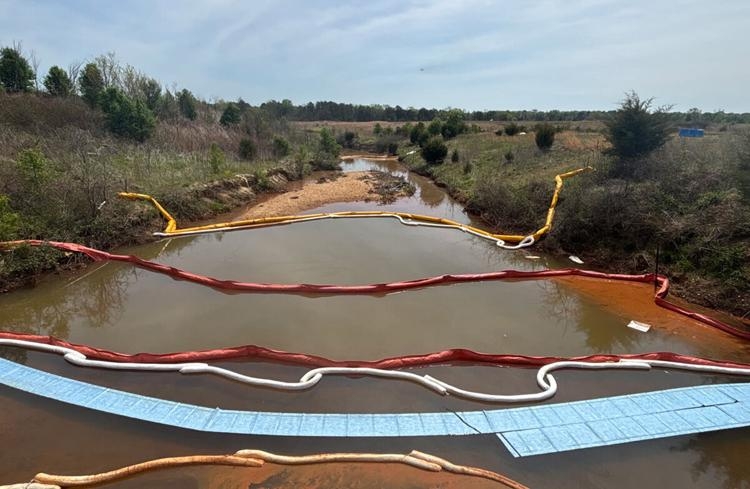
Multiple booms were deployed on Piscataway Creek inside Joint Base Andrews to keep jet fuel on the water’s surface from being carried downstream. (Photo courtesy Joint Base Andrews)
More than 6 million people across Maryland, Virginia, West Virginia, Pennsylvania and Washington, D.C., rely on the Potomac River for drinking water. Recently, into one of its tributaries, Piscataway Creek, approximately 32,000 gallons of jet fuel, roughly the equivalent of an entire fuel tanker truck or three Boeing 737s, reportedly leaked from Joint Base Andrews from January until the full scale of the spill became publicly known last month.
The contamination comes on top of years of per- and polyfluoroalkyl substances (PFAS) pollution linked to the same base. For the communities along Piscataway Creek, this latest spill is not an isolated accident. It is another chapter in a long and deeply troubling pattern of contamination, delayed disclosure and inadequate public accountability.
For the residents along Piscataway Creek, it feels personal. It feels exhausting. And frankly, it feels like a betrayal.
Because this is not the first time this base has contaminated these waters and harmed the surrounding community.
This spill occurred in communities already carrying disproportionate environmental and public health burdens. That is why this moment is fundamentally about public accountability.
No one is questioning the importance of Joint Base Andrews or its national security mission. But no mission should exempt any institution from transparency, environmental responsibility and public accountability.
Your opinion matters
Maryland Matters welcomes guest commentary submissions at [email protected].
We suggest a 750-word limit and reserve the right to edit or reject submissions. We do not accept columns that are endorsements of candidates, and no longer accept submissions from public officials or political candidates.
Opinion pieces must be signed by at least one individual using their real name. We do not accept columns signed by an organization. Commentary writers must include a short bio and a photo for their bylines.
Views of writers are their own.
For years, residents in southern Prince George’s County have been living with pollution tied to Joint Base Andrews — especially PFAS. The persistent pollution of the creek with these “forever chemicals” contaminated fish badly enough that Maryland issued its first-ever fish consumption advisory for PFAS in Piscataway Creek.
Now those same residents are being told that tens of thousands of gallons of toxic jet fuel leaked into the very same creek already burdened by contamination from the same base.
That is what makes this moment so infuriating for the community. The people living around Piscataway Creek are not experiencing an isolated accident. They are experiencing repeated pollution from the same federal facility, yet again, while being asked to trust that everything is under control.
At what point does this stop being called an “incident” and start being recognized for what it is — a longstanding pattern of environmental harm inflicted on the same communities repeatedly?
Time and again, these communities are expected to absorb the consequences of pollution tied to the base.
The leak may have continued for months before Maryland regulators were fully informed about the scale of the spill. State officials and lawmakers have raised serious concerns about delayed reporting and inadequate containment efforts.
Maryland Department of the Environment inspectors reportedly concluded that cleanup and containment efforts were “minimal and insufficient.”
People living here are now forced to ask impossible questions yet again: Is the water safe? Are the fish safe? Is the soil contaminated? What happens the next time there is a spill? What else haven’t we been told?
Communities should not have to repeatedly serve as environmental investigators just to understand the risks they live with due to pollution from a neighboring federal installation.
And this is what environmental injustice looks like in real life.
Southern Prince George’s County communities — many of them historically Black communities that have long faced disproportionate environmental burdens — continue to bear the risks while others benefit from the operations creating those risks. The pollution stays here. The uncertainty stays here. The health concerns stay here. And too often, accountability does not.
The problem is that communities like this have too often been expected to quietly live with repeated contamination while institutions avoid meaningful accountability. This fuel spill is another warning sign. Another contamination event. Another example of environmental injustice.
The people living near this creek deserve more than carefully worded statements and vague reassurances claiming “no immediate threat.” They deserve transparency. They deserve independent oversight. They deserve long-term monitoring. They deserve aggressive cleanup. And they deserve meaningful enforcement when pollution laws are violated.
Annapolis, MD