Arizona rejects Trump administration demands for complete voter registration database
Aug 29, 2025 | 10:10 pm ET
Description
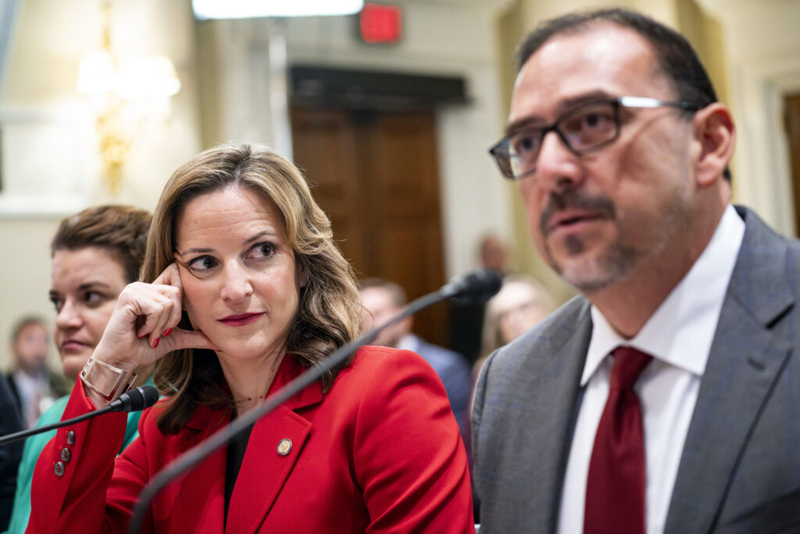
Michigan Secretary of State Jocelyn Benson looks on as Arizona Secretary of State Adrian Fontes speaks during a House Administration Committee hearing in the Longworth House Office Building at the U.S. Capitol on Sept. 11, 2024 in Washington, D.C. The hearing examined “American Confidence in Elections” while looking forward to the 2024 presidential election in just under two months. Photo by Bonnie Cash | Getty Images
Arizona Secretary of State Adrian Fontes says he has refused demands from the U.S. Department of Justice to hand over voter registration information and provide his office’s voter list maintenance procedures.
“Arizona voters deserve to participate in elections without fear that their personal information will be collected and stored in federal systems without proper legal safeguards or transparency,” Fontes said in a written statement on Friday.
For several months, the U.S. Department of Justice has been asking states to turn over voter data and information about voter list maintenance practices, causing concern about how the federal government plans to use that information.
President Donald Trump has, for years, spread false claims that U.S. elections, and especially the one he lost to Joe Biden in 2020, are rigged. Now, in his second term as president, Trump has taken a heightened interest in state and local election administration and announced plans — like his promise to ban vote-by-mail — to illegally assert power over those processes.
It’s the responsibility of Arizona’s county recorders, not the federal government, to register voters and maintain voter rolls, per the federal National Voter Registration Act and the Arizona Election Procedures Manual.
In his statement, Fontes said that the DOJ’s demands to provide a complete copy of the state’s voter registration database, which includes sensitive personal information like driver’s license, Social Security numbers and birthdates, “raise serious legal and constitutional concerns.”
“Arizona law strictly prohibits the disclosure of this information, and releasing it would subject state officials to felony liability,” he wrote. “These protections exist for a reason: to defend voters’ privacy and prevent misuse of their personal data.”
Fontes said that Arizona’s “robust, data-driven approach” to voter list maintenance is rigorously applied and said that only eligible voters remain on the rolls.
Those procedures include confirmation mail to voter addresses, action based on undeliverable election mail and reports from the Electronic Registration Information Center, which helps states collaborate to update voter information across state lines. The state also participates in the SAVE program, which allows it to verify immigration status for voter registration purposes.
Fontes wrote that these services help alert his office to duplicate registrations, and keeps elections officials in Arizona in the know when a voter moves, dies or updates their registration.
Arizona also updates voter registration records if a voter is convicted of a felony that disqualifies them from voting or if they are declared mentally incompetent.
“These efforts are not only essential for election integrity — they also help ensure that election mailings are sent to valid, up-to-date addresses, minimizing waste of taxpayer dollars and significantly reducing the confusion and mistrust that can result from voters receiving mail for individuals who no longer reside at an address or are deceased,” Fontes said.
During his campaign last year, Maricopa County Recorder Justin Heap claimed that one-third of voters in the state received vote-by-mail ballots for people who didn’t live at their addresses. But that claim was based not on actual data from official sources, but on a show of hands at his political events.
Fontes also pointed out that Arizona law requires voters to provide documentary proof of U.S. citizenship when they register. Arizona is the only state with this requirement.
While noncitizen voting is incredibly rare, Trump and his allies have falsely claimed that it is prevalent.
In agreement with other election experts, Fontes wrote that the DOJ hasn’t adequately explained how it has the authority to preempt Arizona’s voter privacy protections or how its request complies with the federal Privacy Act of 1974.
“Any federal agency collecting data on voters — particularly data connected to how individuals exercise their First Amendment rights — must follow federal law, including disclosing how that data will be used, maintained, and protected,” Fontes said.
And, so far, the DOJ has not done that.
“Arizona already uses best-in-class tools and well-established legal procedures to ensure the accuracy, integrity, and efficiency of its voter registration system,” Fontes wrote. “Our commitment to secure, lawful, and transparent elections is unwavering.
Fontes promised to continue to protect the rights and privacy of the state’s voters as his office continues to respond to inquiries from the federal government.
Phoenix, AZ